


Sanitary pumps, also known as hygienic pumps, are classified based on their application environments. They are specifically engineered for transporting products that ultimately come into contact with the human body, serving industries such as pharmaceuticals, dairy, beverages, food, cosmetics, food additives, and fine chemicals.
Depending on the diversity of the media they handle, here are the 10 most common types of sanitary pumps used in processing lines today.
Centrifugal Pumps
Working Principle: Centrifugal pumps are categorized into single-stage and multi-stage configurations. In a single-stage centrifugal pump, the pump casing is filled with liquid before starting. As the impeller rotates at high speeds, the liquid gains velocity due to centrifugal force. This high-speed liquid then passes through the expanding volute casing channel, where its dynamic pressure (velocity) is converted into static pressure. Compared to single-stage variants, multi-stage centrifugal pumps feature two or more impellers. This design allows them to absorb and pressurize water in successive stages, lifting fluids to much higher elevations. Users can increase or decrease the number of impeller stages to achieve the desired head.
Advantages: Simple and compact structure, small footprint, lightweight, excellent manufacturability, cost-effective, strong self-priming capabilities, low sensitivity to fluid contamination, wide speed range, high resistance to shock loads, easy maintenance, and highly reliable operation.Disadvantages: Unbalanced radial forces, high flow pulsation, elevated noise levels, lower energy efficiency compared to positive displacement pumps at high viscosities, poor parts interchangeability, difficult to repair once worn, and cannot be used as variable displacement pumps.
Self-Priming Pumps
Working Principle: Before startup, the pump casing must be pre-filled with water (or retain water internally from previous runs). Once turned on, the high-speed rotation of the impeller forces the water in the impeller channels toward the volute. This creates a vacuum at the inlet, opening the inlet check valve. Air inside the suction pipe is drawn into the pump and moves through the impeller channels to the outer edge, where it is evacuated.
Performance Features: Extremely tight tolerances between the pump casing and the impeller ensure exceptional suction capabilities. The suction piping can evacuate air and seamlessly transfer products that contain entrained gases. These pumps combine a compact structure, smooth operation, high efficiency, and extended service life with low maintenance requirements.
Twin-Screw Pumps (Parallel Displacement Pumps)
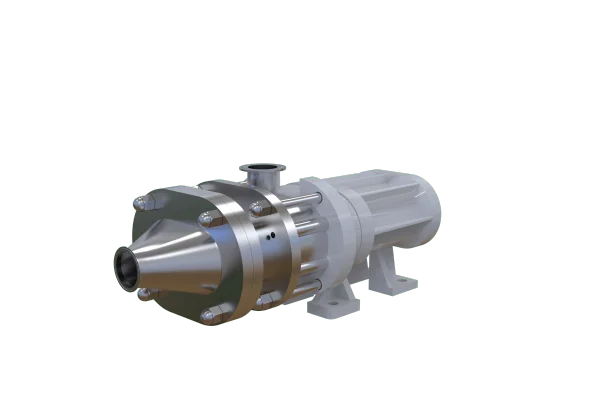
Working Principle: Often referred to as parallel displacement transfer pumps, these systems utilize a pair of specially designed, intermeshing twin screws. As they rotate, they mesh precisely with each other and fit tightly against the internal chamber wall. This interaction creates a series of dynamic, spatially sealed parallel chambers. The rotation continuously drives the material forward in a designated direction, delivering a steady, high-pressure, and pulsation-free output.
Performance Features: The modular design significantly saves installation space and eliminates internal dead corners, making them ideal for both product transfer and automated CIP/SIP (Clean-in-Place/Sterilize-in-Place) processes. Because the custom-engineered rotors never touch, there is virtually no mechanical wear, ensuring an exceptionally long service life. They support adjustable speeds, forward/reverse operation, and dry-running capabilities. They excel at the stable mixing and transferring of non-uniform materials (such as gas-liquid or solid-liquid mixtures), adapt to wide viscosity ranges without causing shear degradation, and can easily handle fluids containing large particulates.
Gear Pumps
Working Principle: Sanitary gear pumps utilize the meshing action of two rotating gears (a drive gear and an idler gear) inside a closely fitted casing. As the gears unmesh on the suction side, they create a vacuum that draws liquid into the pump. The fluid becomes trapped within the spaces between the gear teeth and the pump housing, moving along the perimeter to the discharge side. When the teeth mesh again on the outlet side, the fluid is forced out of the pump.
Advantages: Highly compact and simple design, small footprint, excellent self-priming capability, capable of delivering a constant, pulseless flow, highly efficient when handling high-viscosity liquids, capable of bi-directional operation, and can be used for precise metering applications.
Disadvantages: Generates higher shear forces compared to lobe or sine pumps, highly sensitive to solids or abrasive particles which cause rapid internal wear, tight tolerances increase the risk of galling if run dry, and can become noisy at high operating speeds.
Screw Pumps (Progressive Cavity Pumps)
Working Principle: Common variations include single-screw (progressive cavity) and twin-screw configurations. A single-screw pump features only one screw rotor that moves inside a flexible stator. When the motor drives the pump shaft, the screw rotates around its own axis while rolling along the internal surface of the stator liner, creating continuously moving sealed cavities. In a twin-screw pump, one driven screw rotates to power the other; the liquid is trapped within the meshing chambers and propelled axially toward the central discharge outlet.
Advantages: Excellent suction performance with reliable self-priming capabilities; delivers a uniform, continuous flow with minimal vibration and low noise; less sensitive to entrained gases and minor impurities compared to other rotary pumps; highly versatile across an extensive range of fluid types and viscosities.
Disadvantages: Large physical dimensions require a significant footprint; the manufacturing and assembly tolerances for the screws are highly demanding; performance is relatively sensitive to sudden changes in fluid viscosity; the screws and stators experience mechanical wear over time and require routine replacement; they cannot change running directions freely and must operate in their designated orientation.
Rotary Lobe Pumps
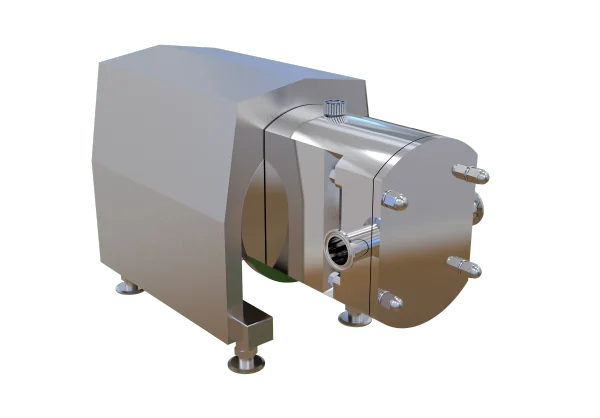
Working Principle: These pumps generate suction through the synchronized, counter-rotating movement of two lobes that never make contact. As the lobes turn, they draw material into the pump chamber. The rotor housing is divided into multiple small compartments. When one compartment fills with the medium, the adjacent compartment seals immediately, creating a continuous, cyclic transfer process.
Advantages: Perfectly suited for transporting high-viscosity media and shear-sensitive products; features extra-large inlets to easily handle semi-solid materials; the non-contacting, counter-rotating design ensures products are never squeezed or damaged during transfer; operates at low rotational speeds to preserve the physical structure and composition of the medium.
Disadvantages: Inefficient at transferring low-viscosity fluids; fixed internal clearances mean that wear between the rotors and the casing over time can cause a rapid decline in pumping efficiency; can still exert noticeable shear stress on highly delicate materials; unsuited for fluids with hard, highly abrasive solid particles.
Diaphragm Pumps
Working Principle: During operation, a motor-driven crank-and-connecting-rod mechanism drives a plunger in a reciprocating motion. This plunger movement transfers force through a working fluid (usually oil) inside the hydraulic cylinder to a flexible diaphragm, causing the diaphragm to deflect back and forth to pull and push fluid through check valves.
Advantages: Ideal for handling chemically unstable or highly volatile fluids; provides total isolation between hazardous or corrosive materials and the external environment; highly compact, portable, and requires no permanent foundation, making them exceptionally easy and cost-effective to deploy as mobile transfer units.
Disadvantages: Discharge pressure is inherently limited by the driving air or mechanism source (often capping out around 6 bar); produces noticeable pipe vibration and noise, especially at high flow rates; the diaphragms have a shorter service life and are more prone to fatigue failure compared to parallel displacement systems; flow rates are generally modest, restricting their use to smaller localized systems.
High-Shear Pumps (Emulsifying Pumps)
Working Principle: Also known as emulsification pumps, these sanitary units combine the functions of dispersing, homogenizing, emulsifying, and blending. They feature a rotor-stator assembly that spins at exceptionally high speeds within a highly confined chamber. This rapid motion generates intense mechanical impact, hydraulic shear, and tangential friction forces. Advanced machining and specially treated alloys allow these teeth structures to break down, homogenize, and blend particulate matter down to the microscopic level.
Performance Features: All wetted parts are constructed from premium 316L stainless steel. They deliver incredibly high shear velocities and forces. Equipped with 5 to 8 sets of inline homogenization systems working simultaneously, they ensure highly stable, high-speed dispersion and emulsification without suffering from severe internal equipment wear.
Sine Pumps (Sinusoidal Pumps)
Working Principle: The sine pump is a rotary positive displacement pump. It features a uniquely designed sinusoidal rotor that works in tandem with a replaceable scraper gate. This interaction gently carries the medium through the pump without causing pulsations or destructive impacts. The wave-like profile of the rotor means that four distinct displacement cavities are formed and discharged with every full rotation. This smooth, continuous movement pushes the fluid forward like a gentle wave.
Performance Features: Compact design saves valuable footprint; exerts virtually zero impact or destructive force on delicate or shear-sensitive media during transfer; supports large flow rates and low-shear processing; the low-pulsation flow prevents pipeline vibration and ensures steady, orderly delivery, allowing the pump to prime or drain systems much faster. Depending on the specific industrial environment, it can serve both sanitary and heavy-duty processing needs.
Roots Vacuum Pumps
Working Principle: Driven by the continuous counter-rotation of two symmetrical lobes, gas is drawn from the inlet into the sealed space between the rotors and the pump housing, then pushed through to the exhaust port. Because this cavity is completely sealed after suction, the gas undergoes no internal compression or expansion inside the main pump chamber. However, as the tip of the rotor clears the edge of the exhaust port, the higher-pressure gas from the discharge side rushes back into the cavity, causing a sudden rise in pressure before the gas is fully expelled.
Performance Features: Delivers massive pumping speeds across a wide pressure range; features quick startup times for immediate operation; highly resilient against dust and water vapor contained in the drawn gas; requires no lubrication inside the pumping chamber, ensuring an entirely oil-free vacuum environment; low vibration levels due to excellent dynamic rotor balancing; low mechanical friction losses result in minimal power consumption, a compact footprint, and very low routine maintenance costs.


