


An impeller does more than rotate the liquid. It determines how fluid moves through the vessel, how quickly ingredients disperse, and how effectively the mixing process achieves its target.
For a top-mounted magnetic agitator, selecting the right impeller involves matching the flow pattern to the process objective while ensuring that the drive and magnetic coupling can handle the resulting load. An impeller designed for rapid liquid circulation may not be the best choice for dispersing a small quantity of powder, suspending dense particles, or mixing a viscous formulation.
The starting point is therefore not the impeller's appearance or diameter alone. It is the result the process needs to achieve.
Start with the Mixing Objective
Different mixing tasks require different flow patterns. Before selecting an impeller, define whether the process primarily needs bulk circulation, solid suspension, ingredient dispersion, or high-viscosity blending.
Liquid blending and uniformity
When combining two or more miscible liquids, the priority is to establish circulation throughout the vessel and reduce concentration differences. Axial-flow impellers are often suitable because they move liquid along the impeller shaft, creating circulation between different regions of the tank.
This is useful in buffer preparation, liquid formulation, and many general-purpose blending operations. The appropriate design still depends on the vessel dimensions, liquid properties, and required mixing time.
Powder wetting and dissolution
When adding powders to a liquid, the challenge is to draw liquid toward the powder and distribute the particles before they form persistent lumps. Impeller selection should account for where the powder enters the tank, how quickly it wets, and whether the flow pattern can carry material away from the addition point.
A strong vortex is not necessarily the goal. Excessive surface swirling can draw air into the liquid without improving powder incorporation. The better choice is an impeller and operating arrangement that promote effective circulation and wetting.
Solid suspension
For processes involving insoluble or slowly dissolving particles, the impeller must generate enough circulation to prevent excessive settling. Axial-flow designs are frequently considered for suspension duties because they can move liquid toward the lower vessel region and help keep particles distributed.
Particle size, density difference, solids concentration, and the required suspension level all affect the final selection. A design that maintains fine particles in suspension may not be sufficient for dense or coarse solids.
High-viscosity mixing
Viscous liquids resist movement more strongly, and conventional impellers may create effective circulation only near the blades while leaving slower-moving regions elsewhere. Depending on the formulation, a larger impeller, a specialized blade geometry, or a different mixing arrangement may be required.
For creams, concentrated syrups, polymer solutions, and other viscous products, the impeller should be evaluated against the actual rheological behavior rather than viscosity alone.
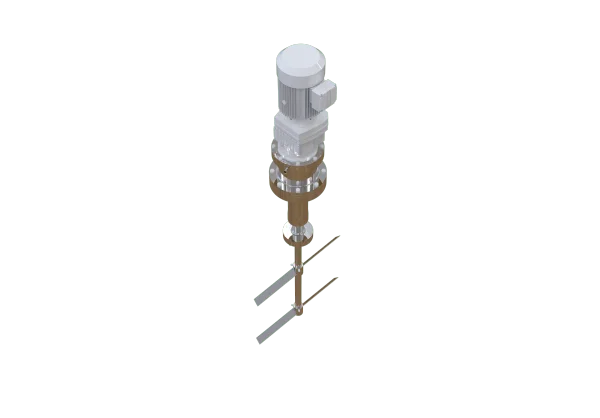
Understand Axial Flow and Radial Flow
One of the most important distinctions in impeller selection is the direction in which the impeller primarily moves the liquid.
Axial-flow impellers
Axial-flow impellers move liquid mainly parallel to the shaft. This creates circulation between the upper and lower portions of the vessel and can support bulk blending, heat distribution, and particle suspension.
They are often a practical starting point for low- to moderate-viscosity liquids when the process needs circulation throughout the tank rather than intense local shear.
Radial-flow impellers
Radial-flow impellers discharge liquid outward from the impeller, toward the vessel wall. This produces stronger local flow and shear near the impeller region and can be useful for certain dispersion tasks.
However, radial flow does not automatically mean better mixing. Depending on the vessel and formulation, it may provide less effective top-to-bottom circulation than an appropriately selected axial-flow arrangement.
The choice should reflect the required flow pattern and processing objective, not simply the desire for stronger agitation.
Match Impeller Geometry to Fluid Viscosity
Fluid viscosity influences both circulation and the torque required to rotate the impeller. An impeller that works well in water may perform poorly in a highly viscous formulation.
For low-viscosity liquids, impellers designed for efficient bulk circulation can often distribute ingredients without requiring excessive power. In more viscous fluids, liquid movement may become increasingly localized, making impeller diameter, blade geometry, and clearance more important.
Non-Newtonian fluids require additional consideration. For example, a shear-thinning liquid may become less viscous as the local shear rate increases. Its resistance during startup may therefore differ from its resistance after the impeller has established circulation.
Before finalizing the impeller, identify the viscosity range across the complete batch cycle, including temperature changes and ingredient additions. If viscosity varies significantly during processing, the impeller and drive should accommodate the most demanding stage.
Consider Tank Diameter, Liquid Depth, and Impeller Position
An impeller cannot be selected independently of the vessel in which it will operate. Tank diameter, working volume, liquid depth, bottom geometry, and the presence of baffles all influence the circulation pattern.
Impeller diameter affects the volume of liquid influenced by each rotation, but a larger impeller also increases the demand on the drive system. Its position determines how effectively liquid circulates through the upper and lower parts of the vessel.
For example, an impeller positioned too high may leave the lower region poorly mixed in some configurations. An arrangement that produces strong circulation near the bottom may be more suitable for a suspension process, while another position may better serve a particular blending or heat-transfer duty.
Baffles can help reduce bulk swirling and improve mixing in certain vessel configurations. Their effect depends on the impeller type and process conditions, so they should be evaluated as part of the overall vessel design.
When specifying a top-mounted magnetic agitator, provide the supplier with the vessel drawing, working volume range, liquid level, and internal obstructions. These details are more useful for impeller selection than tank capacity alone.
Check Torque and Magnetic Coupling Capacity
An impeller must not only produce the required flow; it must also operate within the drive system's mechanical limits.
Increasing impeller diameter, changing blade geometry, or raising rotational speed can increase power consumption and torque demand. The effect varies with the flow regime and impeller design, so the load should be assessed using appropriate engineering calculations or manufacturer data.
For a magnetic agitator, two limits need to be checked:
- Drive output: The motor and any gearbox must provide sufficient torque at the intended operating speed.
- Magnetic coupling capacity: The coupling must transmit the required torque without exceeding its rated operating limits.
Startup conditions deserve particular attention when the liquid is viscous or solids may have settled. A design that operates successfully after circulation is established may still experience excessive load during startup.
Selecting an impeller with the right flow characteristics but excessive torque demand can undermine the performance of the complete agitator. Impeller and magnetic-drive specifications should therefore be confirmed together.
Avoid Common Impeller Selection Mistakes
Several common assumptions can lead to poor mixing results.
Choosing the largest available impeller: A larger diameter does not automatically improve mixing. It can increase torque requirements and may produce an unsuitable flow pattern for the vessel.
Using higher speed to compensate for poor circulation: Increasing speed may raise power consumption and promote air entrainment without resolving poorly distributed flow. Impeller geometry and position should be reviewed first.
Selecting based only on viscosity: Two fluids with similar viscosity may require different impellers if one contains suspended solids, another must incorporate powder, or their flow behavior differs under shear.
Ignoring the batch cycle: Changes in temperature, concentration, and solids loading can alter the mixing load. Selection should account for the most demanding process stage, not just the initial liquid condition.
Treating the impeller as a standalone component: Vessel dimensions, baffles, working volume, drive torque, and magnetic coupling capacity all influence the final result.
Information Needed for Impeller Selection
To evaluate an impeller for a top-mounted magnetic agitator, prepare the following process information:
- Vessel details: Tank diameter, total and working volume, liquid depth, bottom shape, and baffle arrangement.
- Fluid properties: Density, viscosity range, temperature, and whether the fluid is Newtonian or non-Newtonian.
- Mixing objective: Liquid blending, powder dissolution, solid suspension, heat-transfer support, or another defined task.
- Operating requirements: Target speed, mixing time, batch cycle, and expected changes in material properties.
- Special conditions: Solids concentration, particle characteristics, foam sensitivity, and startup after settling.
With these details, the equipment supplier can assess suitable impeller geometries, dimensions, operating speeds, and drive requirements.
Selecting an Impeller That Fits the Process
The right impeller for a top-mounted magnetic agitator is the one that generates the required circulation or dispersion within the vessel while staying within the drive system's operating limits. Axial-flow designs are commonly considered for bulk circulation and suspension, while radial-flow designs may suit applications that need stronger local flow or shear.
The final decision should account for the mixing objective, fluid behavior, vessel geometry, and torque demand as one engineering problem. This approach is more reliable than choosing an impeller by diameter or speed alone, and it helps establish a mixing configuration suited to the actual production process.


