


When selecting a top-mounted magnetic agitator, motor power is only part of the equation. The agitator must also generate sufficient torque to overcome the resistance of the liquid and maintain the required impeller speed throughout the process.
Torque is the rotational force that enables the impeller to move the fluid. If the available torque is insufficient, the agitator may struggle to start, fail to reach its target speed, or experience magnetic coupling slip in designs where the coupling can disengage under excessive load.
For magnetic agitators, the selection process involves two related questions: how much torque does the mixing process require, and how much torque can the magnetic coupling reliably transmit under the intended operating conditions?
The answers depend on the fluid, impeller design, operating speed, vessel configuration, and changes that occur during startup and processing.
Liquid Viscosity and Flow Resistance
Viscosity is one of the most important factors affecting agitator torque. Low-viscosity liquids, such as water-like solutions, generally offer less resistance to impeller rotation than viscous liquids such as concentrated syrups, polymer solutions, creams, and certain chemical intermediates.
As viscosity increases, the impeller must overcome greater fluid resistance to maintain circulation. The resulting torque requirement depends not only on the viscosity value but also on the flow pattern created by the impeller.
For Newtonian fluids, viscosity remains approximately constant under a given temperature and pressure. For non-Newtonian fluids, apparent viscosity can change with shear rate. A shear-thinning formulation, for example, may resist movement more strongly at low shear rates than it does once circulation is established.
This distinction matters when selecting a magnetic agitator for cosmetic formulations, concentrated biological solutions, or other fluids whose rheological behavior differs from that of water. A viscosity value measured under one condition may not fully represent the load experienced by the impeller during startup or operation.
Temperature must also be considered. If a process liquid becomes more viscous as it cools, the agitator may face a higher load during cold startup than during normal operation at the target temperature.
Impeller Diameter, Geometry, and Operating Speed
The impeller determines how rotational energy is transferred to the liquid. Its diameter, blade shape, blade angle, and pumping characteristics all influence the torque required.
A larger impeller generally interacts with a greater volume of fluid and can produce a substantial increase in mixing load. Increasing impeller diameter is therefore not simply a way to improve circulation; it can also increase the mechanical demands on the drive system.
Operating speed has a similarly important effect. Higher rotational speed can improve circulation and dispersion in some applications, but it also increases the power required by the mixing process.
For turbulent mixing, the approximate relationship is:
P=N_P\rho N^3D^5
where:
- (P) is the power required for mixing.
- (N_P) is the impeller power number.
- (\rho) is the liquid density.
- (N) is the rotational speed in revolutions per second.
- (D) is the impeller diameter.
The equation illustrates why impeller dimensions and speed must be evaluated together. It applies under the assumptions associated with the relevant turbulent-flow regime and impeller configuration; it should not be applied indiscriminately to laminar or transitional mixing.
Torque and power are related, but they are not interchangeable. At a given rotational speed, greater power demand means greater torque demand. Consequently, selecting an impeller and speed combination should account for both the desired mixing performance and the drive system's torque capacity.
Liquid Density and Solids Loading
Liquid density affects the amount of power required to accelerate and circulate the fluid. Under otherwise comparable turbulent-flow conditions, a denser liquid generally requires more mixing power, which translates into greater torque at the same rotational speed.
The effect becomes more complicated when the vessel contains suspended solids. The agitator may need to circulate liquid and particles together, prevent settling, or maintain a specified suspension condition. The resulting load depends on particle concentration, size, density difference, and the required suspension level.
For example, dissolving a small quantity of readily soluble powder in water presents a different mixing challenge from suspending a high concentration of dense particles. In the latter case, the agitator may experience a greater load, especially during startup if solids have settled at the vessel bottom.
When specifying a magnetic agitator for slurry preparation or solid-liquid mixing, engineers should evaluate the expected solids concentration and whether the equipment must restart after an idle period. The torque needed to maintain an established suspension may differ considerably from the torque needed to mobilize settled material.
Vessel Geometry and Internal Flow Conditions
Torque requirements cannot be determined from liquid properties and impeller dimensions alone. The vessel itself affects the flow pattern and the resistance encountered by the impeller.
Tank diameter, liquid depth, impeller clearance, baffles, and the position of internal components all influence circulation. Baffles, for instance, can suppress bulk swirling and promote more effective mixing, but they also alter the flow field and may increase the power required under certain conditions.
An impeller positioned too close to the vessel bottom may behave differently from one installed at a higher clearance. In a vessel with internal coils or other obstructions, local flow resistance and circulation patterns can also change.
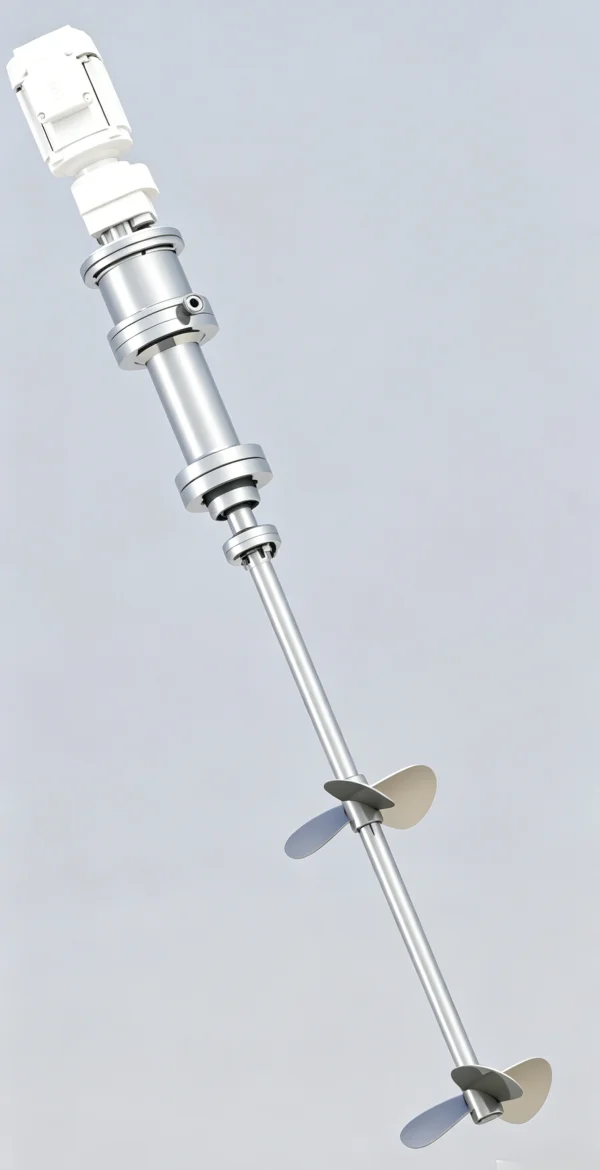
For a top-mounted magnetic agitator, the mounting arrangement must therefore be considered alongside the vessel design. The objective is not simply to provide enough torque to rotate the impeller, but to establish the required mixing pattern throughout the working volume.
Startup Torque and Changes During Processing
One of the most easily overlooked factors is the difference between startup and steady-state operation.
At startup, the impeller must accelerate from rest and establish circulation. The required torque includes the torque needed to accelerate rotating components as well as the resistance imposed by the fluid. In viscous systems, or vessels containing settled solids, the process load can be particularly demanding.
The load may also change during a batch. A powder addition can temporarily increase the solids concentration, a reaction can change the liquid's viscosity, and cooling can alter fluid properties. A formulation that mixes easily at one stage may impose a substantially different load later.
For this reason, agitator selection should account for the most demanding expected operating condition rather than relying solely on the average load. Engineers should identify whether the highest torque demand occurs during cold startup, initial powder dispersion, suspension of settled solids, or a later stage of the process.
Magnetic Coupling Capacity and Motor Selection
A magnetic agitator has two important torque limits: the torque available from the drive system and the torque that the magnetic coupling can transmit.
The motor and gearbox, where fitted, must provide the required output torque at the intended operating speed. At the same time, the magnetic coupling must transmit that torque without exceeding its rated capacity under the specified operating conditions.
If process resistance exceeds the coupling's transmission capability, some magnetic-drive designs may lose synchronization or experience coupling slip. This can interrupt mixing even if the motor itself has sufficient rated power.
A larger motor does not automatically solve the problem. If the magnetic coupling is undersized, increasing motor power alone will not ensure that the required torque reaches the impeller. Conversely, choosing an unnecessarily large coupling and motor without evaluating the process load can increase equipment cost without improving the actual mixing outcome.
A sound specification therefore considers motor output, gearbox ratio, coupling torque capacity, operating speed, and the expected peak load as a coordinated system. The manufacturer's torque ratings and operating limits should be checked for the selected configuration.
How to Determine the Required Torque for a Magnetic Agitator
A practical torque assessment begins with the process rather than the motor nameplate.
First, define the fluid properties across the expected operating temperature range, including viscosity, density, and non-Newtonian behavior where applicable. Next, establish the working volume, vessel dimensions, impeller type, diameter, and target speed.
The process engineer should then identify the most demanding operating stage, including startup, powder addition, solids suspension, or changes in viscosity during processing. For established impeller designs, appropriate power-number correlations or validated manufacturer calculations can help estimate mixing power. Computational analysis or testing may be appropriate for complex rheology, unusual vessel geometry, or demanding suspension duties.
Once the required mixing power has been estimated, the corresponding running torque can be calculated from:
T=\frac{P}{2\pi N}
where (T) is torque in newton-metres, (P) is power in watts, and (N) is rotational speed in revolutions per second.
This relationship describes the torque associated with power at a given speed. Startup acceleration, transient loads, transmission losses, and design margins must be evaluated separately as applicable. The resulting requirement should then be checked against both the drive output and magnetic coupling capacity.
Matching Torque Capacity to the Actual Process
The torque requirement of a magnetic agitator is determined by the combined effects of fluid properties, impeller design, rotational speed, vessel geometry, solids loading, and operating conditions. These factors interact, so changing one design parameter can affect both the required torque and the resulting mixing performance.
For top-mounted magnetic agitators, correct sizing means matching the impeller and drive system to the process load while ensuring that the magnetic coupling can transmit the required torque. This approach helps avoid underpowered mixing systems, unnecessary oversizing, and interruptions caused by excessive operating loads.
For applications involving viscous formulations, variable batch conditions, or suspended solids, providing the actual process details to the equipment supplier is an important step toward selecting a suitable agitator configuration.


