


Bottom-entry Internal Circulation Emulsifier


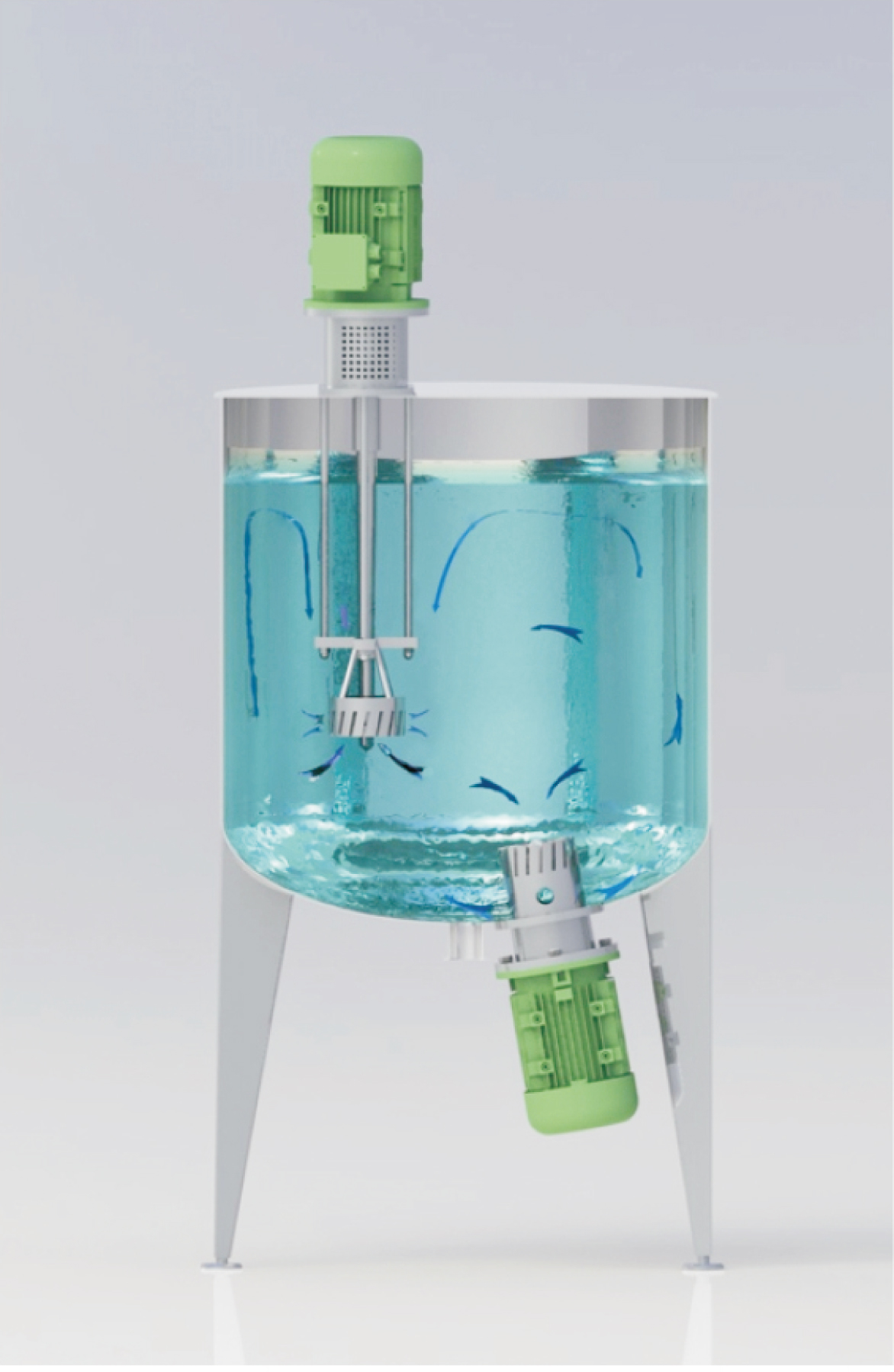
Achieving ultra-fine particle dispersion within compact sterile production tanks demands mechanical design that delivers powerful fluid shear while conserving limited workshop space. External circulation pipelines deliver stable performance for certain liquid transfer workflows, yet high-purity production formulas require fully self-contained processing structures to cut residual material retention and streamline regulatory validation work. The BOFRD-2 Series Bottom-entry Internal Circulation Emulsifier offers a pipeline-free processing solution for hygienic fluid manufacturing. Installed directly at the lowest cone of mixing tanks without external bypass pipelines, this compact high-shear unit supports fast homogenization, micro-emulsification and precise particle size reduction. It serves as a reliable processing tool for high-purity pharmaceutical manufacturing, cosmetic production and high-grade food processing.
In-Situ Fluid Kinetics and Vortex Suppression
The core mechanical advantage of pipeline-free bottom-mounted emulsifiers lies in concentrated energy dissipation near the tank bottom cone. High-speed rotors draw raw materials axially from the tank central zone and push fluids radially through micro-sized stator gaps, with linear rotor tip speeds exceeding 20 meters per second. This movement generates intense hydraulic shear, material collision and cavitation effects. Unlike traditional equipment that diverts fluid into external pipelines, the BOFRD-2 Series releases treated materials along the inner wall of the tank base. The upward flowing fluid drives continuous vertical material turnover inside the tank, eliminates static layered liquid zones and guarantees consistent batch quality without auxiliary transfer pumps or material stratification.
Mitigating Cross Contamination and Residual Material Retention
Sterile pharmaceutical blending and high-end cosmetic batch production face prominent operational risks brought by residual raw materials trapped inside external circulation pipelines. The pipeline-free structural design of the BOFRD-2 Series resolves these hidden hazards thoroughly.
External circulation pipelines create blind zones where temperature-sensitive raw materials and pharmaceutical active ingredients remain stagnant. Such trapped substances may degrade unevenly and fail to receive complete shear treatment. The BOFRD-2 Series removes all such pipeline dead spaces to achieve zero material retention.
The equipment minimizes welding seams, elbow joints and sanitary pipe fittings. All fluid contact surfaces concentrate on the bottom mounting flange, cutting the scope of testing documents required to meet strict GMP validation standards.
The compact rotor-stator assembly enables full contact with automatic CIP cleaning spray coverage. Complete residue removal can be finished in standard flushing cycles, lowering water and chemical detergent consumption during batch switching.
Stable Mechanical Performance Under Vacuum and High Temperature
Modern cosmetic preparation and chemical synthesis often require mixing under deep vacuum to avoid air bubble mixing, or positive pressure environments to support gas-liquid reaction processes. The BOFRD-2 Series maintains stable structural tightness and sealing performance under such harsh working conditions. The low-position flange installation reduces rotor shaft deflection significantly, allowing mechanical seals to run smoothly even when processing high-viscosity raw materials. The equipment supports long-term thermal processing at temperatures up to 160 degrees Celsius, and handles hot melt wax emulsification and SIP high-temperature sterilization cycles without seal jamming or component aging damage.
Modular Customized Configuration System
Raw material chemical properties vary greatly across different production lines, so the BOFRD-2 Series adopts a fully modular design system to match custom hardware combinations for unique formulation demands.
All raw material contact components adopt premium 304 or 316L stainless steel. Clients can choose high-gloss mirror mechanical polishing or electrochemical passivation treatment for inner surfaces to secure inert, gap-free contact surfaces.
Single mechanical seal structures meet standard non-hazardous atmospheric production needs. Vacuum sterile workshops and production lines with abrasive solid particles can select pressurized double mechanical seals, with optional friction pairs including silicon carbide matched surfaces and tungsten carbide matched surfaces.
Static and dynamic sealing rings adopt FDA compliant elastic materials. Available options cover EPDM, high temperature resistant silicone and chemically inert fluororubber to fit various pharmaceutical active ingredients and solvent carriers.
Consistent Scalability From Lab Trials to Mass Production
The complete BOFRD-2 product line enables stable process scaling from laboratory formula testing to large tonnage continuous commercial manufacturing. The smallest BOFRD2-60 model uses a 0.75 kW drive motor and fits 20 to 50 liter small pilot tanks. The heavy-duty BOFRD2-380 industrial model carries a 90 kW high torque motor and supports batch volumes up to 10000 liters. All models retain consistent rotor-stator geometry and rotor tip speed proportional relationships. Production factories can expand tank capacity without adjusting homogenization cycle parameters, and keep uniform finished product quality across all production scales.
Manufacturers planning to purchase customized pipeline-free Bottom-entry Internal Circulation Emulsifier may share key production parameters to receive targeted configuration suggestions. You can provide details covering tank total volume and internal structure, operating environment including vacuum positive pressure or normal atmospheric pressure, as well as mechanical seal and sealing ring material requirements determined by raw material chemical characteristics. Our technical team can provide custom flange structure drawings and full material compatibility evaluation reports for internal engineering reference.

Description
Achieving ultra-fine particle dispersion within compact sterile production tanks demands mechanical design that delivers powerful fluid shear while conserving limited workshop space. External circulation pipelines deliver stable performance for certain liquid transfer workflows, yet high-purity production formulas require fully self-contained processing structures to cut residual material retention and streamline regulatory validation work. The BOFRD-2 Series Bottom-entry Internal Circulation Emulsifier offers a pipeline-free processing solution for hygienic fluid manufacturing. Installed directly at the lowest cone of mixing tanks without external bypass pipelines, this compact high-shear unit supports fast homogenization, micro-emulsification and precise particle size reduction. It serves as a reliable processing tool for high-purity pharmaceutical manufacturing, cosmetic production and high-grade food processing.
In-Situ Fluid Kinetics and Vortex Suppression
The core mechanical advantage of pipeline-free bottom-mounted emulsifiers lies in concentrated energy dissipation near the tank bottom cone. High-speed rotors draw raw materials axially from the tank central zone and push fluids radially through micro-sized stator gaps, with linear rotor tip speeds exceeding 20 meters per second. This movement generates intense hydraulic shear, material collision and cavitation effects. Unlike traditional equipment that diverts fluid into external pipelines, the BOFRD-2 Series releases treated materials along the inner wall of the tank base. The upward flowing fluid drives continuous vertical material turnover inside the tank, eliminates static layered liquid zones and guarantees consistent batch quality without auxiliary transfer pumps or material stratification.
Mitigating Cross Contamination and Residual Material Retention
Sterile pharmaceutical blending and high-end cosmetic batch production face prominent operational risks brought by residual raw materials trapped inside external circulation pipelines. The pipeline-free structural design of the BOFRD-2 Series resolves these hidden hazards thoroughly.
External circulation pipelines create blind zones where temperature-sensitive raw materials and pharmaceutical active ingredients remain stagnant. Such trapped substances may degrade unevenly and fail to receive complete shear treatment. The BOFRD-2 Series removes all such pipeline dead spaces to achieve zero material retention.
The equipment minimizes welding seams, elbow joints and sanitary pipe fittings. All fluid contact surfaces concentrate on the bottom mounting flange, cutting the scope of testing documents required to meet strict GMP validation standards.
The compact rotor-stator assembly enables full contact with automatic CIP cleaning spray coverage. Complete residue removal can be finished in standard flushing cycles, lowering water and chemical detergent consumption during batch switching.
Stable Mechanical Performance Under Vacuum and High Temperature
Modern cosmetic preparation and chemical synthesis often require mixing under deep vacuum to avoid air bubble mixing, or positive pressure environments to support gas-liquid reaction processes. The BOFRD-2 Series maintains stable structural tightness and sealing performance under such harsh working conditions. The low-position flange installation reduces rotor shaft deflection significantly, allowing mechanical seals to run smoothly even when processing high-viscosity raw materials. The equipment supports long-term thermal processing at temperatures up to 160 degrees Celsius, and handles hot melt wax emulsification and SIP high-temperature sterilization cycles without seal jamming or component aging damage.
Modular Customized Configuration System
Raw material chemical properties vary greatly across different production lines, so the BOFRD-2 Series adopts a fully modular design system to match custom hardware combinations for unique formulation demands.
All raw material contact components adopt premium 304 or 316L stainless steel. Clients can choose high-gloss mirror mechanical polishing or electrochemical passivation treatment for inner surfaces to secure inert, gap-free contact surfaces.
Single mechanical seal structures meet standard non-hazardous atmospheric production needs. Vacuum sterile workshops and production lines with abrasive solid particles can select pressurized double mechanical seals, with optional friction pairs including silicon carbide matched surfaces and tungsten carbide matched surfaces.
Static and dynamic sealing rings adopt FDA compliant elastic materials. Available options cover EPDM, high temperature resistant silicone and chemically inert fluororubber to fit various pharmaceutical active ingredients and solvent carriers.
Consistent Scalability From Lab Trials to Mass Production
The complete BOFRD-2 product line enables stable process scaling from laboratory formula testing to large tonnage continuous commercial manufacturing. The smallest BOFRD2-60 model uses a 0.75 kW drive motor and fits 20 to 50 liter small pilot tanks. The heavy-duty BOFRD2-380 industrial model carries a 90 kW high torque motor and supports batch volumes up to 10000 liters. All models retain consistent rotor-stator geometry and rotor tip speed proportional relationships. Production factories can expand tank capacity without adjusting homogenization cycle parameters, and keep uniform finished product quality across all production scales.
Manufacturers planning to purchase customized pipeline-free Bottom-entry Internal Circulation Emulsifier may share key production parameters to receive targeted configuration suggestions. You can provide details covering tank total volume and internal structure, operating environment including vacuum positive pressure or normal atmospheric pressure, as well as mechanical seal and sealing ring material requirements determined by raw material chemical characteristics. Our technical team can provide custom flange structure drawings and full material compatibility evaluation reports for internal engineering reference.
Application


Specifications
| Model | BOFRD2-60 | BOFRD2-90\t | BOFRD2-100 | BOFRD2-110 | BOFRD2-120 | BOFRD2-140 | BOFRD2-160\t | BOFRD2-185 | BOFRD2-200 | BOFRD2-260 | BOFRD2-320 | BOFRD2-350 | BOFRD2-380 | |
|---|---|---|---|---|---|---|---|---|---|---|---|---|---|---|
| Power | 0.75 | 1.5 | 2.2 | 3 | 4 | 7.5 | 11 | 18.5 | 22 | 22 | 37 | 55 | 90 | kw |
| Capacity2 | 20-50 | 50-100 | 80-200 | 100-250 | 150-300 | 200-400 | 300-500 | 500-1000 | 800-1500 | 1000-2000 | 1500-3000 | 2000-5000 | 3000-10000 | L |
| Speed | 2800-2900 | 2800-2900 | 2800-2900 | 2800-2900 | 2800-2900 | 2800-2900 | 2800-2900 | 2800-2900 | 2800-2900 | 1470 | 1470 | 1470 | 1470 | rpm |
| Outlet Pressure | 0.03 | 0.04 | 0.05 | 0.06 | 0.07 | 0.08 | 0.10 | 0.15 | 0.20 | 0.20 | 0.30 | 0.35 | 0.40 | mpa |
| Outlet Size | 20 | 25 | 32 | 32 | 40 | 40 | 40 | 50 | 65 | 80 | 100 | 125 | 150 | mm |
| Circulation Flow Rate | 1 | 2 | 3 | 4 | 5 | 7 | 10 | 15 | 20 | 40 | 50 | 80 | 120 | t/h |
Advantage Comparison


GET IN TOUCH NOW


