


Oral liquid medicines require more than simple liquid transfer. Syrups, oral solutions, suspensions, concentrated formulations, and other liquid pharmaceutical products must move between process stages under controlled and hygienic conditions. Flow stability, product viscosity, temperature, formulation sensitivity, and the cleanliness of product-contact surfaces can all influence the reliability of the manufacturing process.
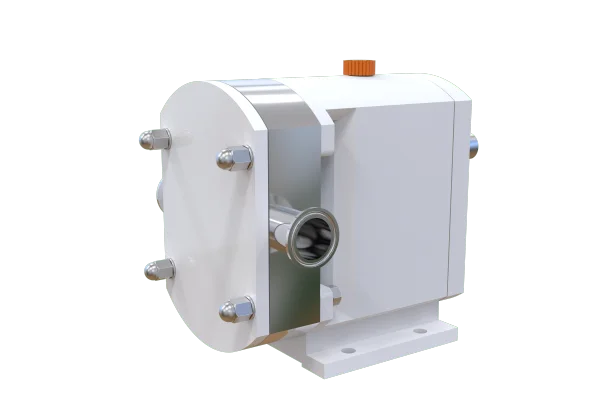
In an oral liquid production line, a sanitary rotary lobe pump can serve as an important transfer component between formulation, holding, storage, and filling stages. Its positive displacement operating principle provides controlled displacement, while variable speed configurations allow the transfer rate to be adjusted according to the requirements of different process stages.
Why Oral Liquid Production Requires Controlled Fluid Transfer
The manufacturing route for oral liquids commonly involves several connected stages. Ingredients may first be dissolved, dispersed, or blended in a preparation vessel before the formulated liquid is transferred to an intermediate holding tank. From there, the product may move toward additional processing or filling equipment.
The pump used between these stages needs to accommodate the actual characteristics of the formulation. Some oral liquids are relatively low in viscosity, while others contain sugars, polymers, suspended ingredients, or concentrated active and functional components that increase resistance to flow.
A rotary lobe pump is a positive displacement pump. Its rotating lobes create a controlled pumping action that can maintain product transfer as viscosity changes. This makes the technology applicable to pharmaceutical liquids where stable and predictable movement between process stages is important.
Controlled Transfer and Adjustable Flow
The term accurate dosing should be considered in the context of the complete pharmaceutical system. A lobe pump can provide controlled displacement and adjustable flow, but final dosing accuracy depends on the complete dosing architecture, including pump selection, speed control, instrumentation, formulation properties, and the downstream filling or dosing equipment.
For oral liquid production, this distinction is important. A pump may be responsible for transferring product from a preparation vessel to a holding tank, while a dedicated filling system performs the final package dosing operation.
The supplied lobe pump series supports mechanical speed regulation and variable frequency drive control depending on the selected configuration. This allows the operating speed to be adapted to different transfer requirements. Lower speeds can be selected when the process requires controlled movement of viscous or sensitive products, while higher flow settings can be used when process conditions permit.
Hygienic Design for Pharmaceutical Transfer
For oral liquid manufacturing, the pump is part of a hygienic fluid path. Product-contact materials, sealing arrangements, connections, and cleaning requirements therefore need to be considered together.
The pump body can be manufactured from 304 or 316L stainless steel according to the characteristics of the conveyed medium and process requirements. Single or double mechanical seal configurations are available, with seal materials selected according to temperature, chemical compatibility, and operating conditions.
Different connection configurations can also be selected, including sanitary clamp connections, flanges, threaded connections, DIN hygienic connections, and welded connections. These options allow the pump to be incorporated into different pharmaceutical process piping arrangements.
The supplied pump series is designed with hygienic construction principles and has CE and 3-A certification information associated with the product range. For pharmaceutical applications, however, equipment selection should still be evaluated against the specific GMP requirements, cleaning procedures, validation strategy, and material requirements of the production facility.
Integrating the Pump into an Oral Liquid Solution
A lobe pump should not be selected independently from the rest of the oral liquid production line. Its value becomes clearer when it is considered as one part of an integrated process solution.
A typical oral liquid system may involve formulation vessels, mixing equipment, holding tanks, sanitary pipelines, temperature control, transfer pumps, filtration or other process stages, and filling equipment. The pump provides the controlled movement required between these stages, while the complete system determines how the product is processed and ultimately packaged.
For facilities producing several oral liquid formulations, adjustable-speed pumping can also provide greater process flexibility. Different products may have different viscosities, solids concentrations, temperatures, and transfer rates. A speed-controlled lobe pump can therefore be configured according to the process conditions rather than being restricted to one fixed operating point.
Selecting the Pump for Oral Liquid Formulations
Pump sizing should be based on the actual formulation and process rather than flow capacity alone. Important factors include required flow, viscosity, product temperature, inlet conditions, pipeline resistance, discharge pressure, and the characteristics of any suspended or soft particulate material.
The supplied pump range covers approximately 0.15 to 127 tons per hour, with applicable viscosity ranging from approximately 0.2 to 100,000 cP. Maximum outlet pressure varies by model and operating conditions and can reach approximately 0.6 to 1.5 MPa under applicable high-viscosity conditions.
Temperature capability also needs to be considered when selecting seals, elastomers, and other wetted components. The supplied product information indicates a general material temperature range extending to 150 C, with higher sterilization temperatures possible for applicable configurations.
From Transfer Equipment to a Complete Oral Liquid Process
For oral liquid manufacturers, reliable pumping is only one part of process control. The objective is to establish a coordinated fluid path in which formulation, transfer, holding, and filling stages operate consistently with one another.
A sanitary rotary lobe pump can provide the controlled transfer function needed within this system while accommodating different viscosities and production requirements. With appropriate speed control, sanitary connections, material selection, sealing configuration, and process integration, it can be incorporated into oral liquid manufacturing lines where hygienic handling and controlled product movement are essential.
The final equipment configuration should therefore be developed around the specific oral liquid formulation and the complete production process. Rather than treating the pump as an isolated component, pharmaceutical manufacturers can evaluate its flow characteristics, hygienic configuration, control method, and integration points as part of the overall oral liquid solution.


