


For craft breweries, flavor profile is everything. Master brewers spend years perfecting precise recipes, selecting specific hops, and meticulously managing sensitive yeast strains to create a unique, memorable sensory experience. However, even the most immaculate recipe can be completely ruined during the final production stages if the wrong fluid-handling equipment is chosen. One of the most overlooked enemies of craft beer quality is physical stress—specifically, shear stress. Standard industrial pumps can beat, agitate, and violently churn your product, leading to devastating off-flavors, visual cloudiness, and poor head retention.
In this comprehensive engineering guide, we will explore why an open impeller low-shear sanitary pump is an essential piece of equipment for preserving the taste, aroma, and visual appeal of your craft beer throughout the entire brewing process.
What is Shear Stress and How Does It Damage Beer?
In fluid dynamics, shear stress occurs when adjacent fluid layers slide past one another at varying relative speeds under a localized force. Inside a standard industrial centrifugal pump, high rotational speeds, abrupt directional changes, and exceptionally tight internal clearances subject the moving liquid to intense molecular friction, extreme velocity gradients, and violent turbulence.
While these rugged industrial pumps excel at moving inert water or chemical solutions, they are highly destructive to the delicate organic compounds and living micro-organisms found in unpasteurized craft beer. High shear forces act almost like a high-speed blender, physically tearing apart the complex, long-chain molecular structures and biological cells that define a premium, well-crafted brew.
3 Ways High Shear Force Ruins Craft Beer Quality
Choosing the wrong transfer pump can directly impact your final product's shelf life, aesthetic appearance, and taste in three major ways:
Loss of Head Retention (Foam Stability)
The beautiful, creamy, and persistent foam head on a freshly poured beer relies heavily on delicate, hydrophobic proteins derived from barley and grains (such as Lipid Transfer Protein 1 or LTP1). High-shear pumping forces physically denature and break down these complex protein structures. Once these long-chain molecules are fragmented, they lose their ability to trap gas, leaving your consumers with a flat, uninspiring pour that dissipates in seconds.
Acceleration of Oxidation and Off-Flavors
The localized vacuum pockets and severe turbulence caused by high-velocity impeller rotation can pull micro-pockets of dissolved oxygen into active reaction zones. This accelerated oxidation introduces a stale, cardboard-like or wet-paper taste to the beer, quickly deadening and destroying the subtle, volatile hop aromas that brewers work so hard to preserve.
Premature Yeast Cell Lysis (Death)
When transferring green beer, harvesting slurry, or moving active fermentation broth, keeping yeast cells intact and healthy is absolutely vital. Standard closed-impeller pumps can physically crush and rupture (lyse) yeast cells due to intense mechanical impact. This cellular rupture releases intracellular autolytic compounds into the beer, triggering permanent haze, unpredictable cloudiness, and uncharacteristic, autolyzed, bitter off-flavors.
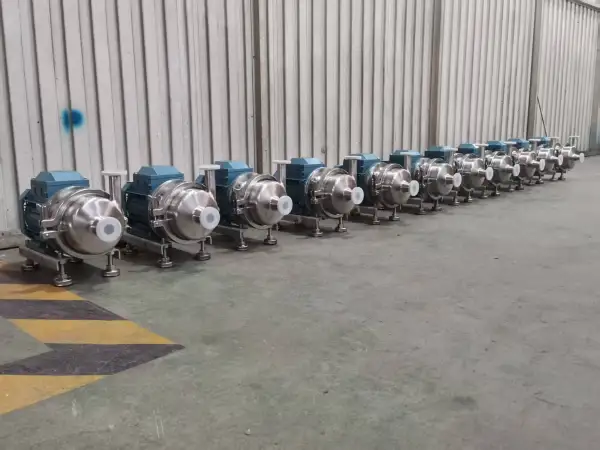
3. How an Open Impeller Low-Shear Sanitary Pump Protects Your Brew
An advanced sanitary centrifugal pump engineered with an open impeller design solves these processing challenges through intelligent mechanical engineering, transforming high-wear fluid transfer into a gentle, stable process.
Gentle Dynamic Coaxing via Open Vanes
The open impeller features completely exposed, smoothly curved vanes with no front or rear shrouds. Unlike closed impellers that trap and smash liquids under high pressure within a tight metal channel, the open design gently coaxes the liquid forward. This significantly minimizes internal friction and velocity gradients, ensuring a smooth, low-shear laminar flow stream that protects sensitive grain proteins and living yeast cells from mechanical degradation.
Exceptional Resistance to Clogging and Solid-Induced Turbulence
Brewery fluids are rarely pure liquids; they frequently contain hop pellets, heavy trub, fruit purees, and residual grain particulates. An open impeller allows these solids to pass through the pump casing smoothly without binding, grinding, or creating violent hydraulic shockwaves. This prevents the solids from being pulverized into micro-particles that cause permanent haze, perfectly maintaining product integrity.
Unmatched Hygienic Performance and Cleanability
With no hidden crevices, internal pockets, or structural shrouds to obstruct flow, the open impeller ensures that Clean-in-Place (CIP) sanitizing fluids can directly wash every single millimeter of the internal surface. Manufactured from premium AISI 316L stainless steel and polished to an ultra-smooth finish, it guarantees zero bacteria or biofilm buildup between batches, allowing your brewery to transition flawlessly between a delicate blonde ale and a heavy stout.
Secure Your Brew: Total Material and Mechanical Integrity
Investing in a high-specification, low-shear sanitary pump is a strategic business decision that directly secures your brewery's output. By utilizing an open impeller system, processing plants drastically minimize the risk of product degradation, protect delicate ingredients, and streamline their automated CIP validation processes.
Every piece of fluid processing machinery shipped from our sanitary fabrication facility is backed by a comprehensive technical validation package, ensuring your facility operates with complete peace of mind:
- AISI 316L Stainless Steel Construction: For maximum corrosion resistance against acidic beers and harsh CIP chemicals.
- Traceable Elastomer Components: All internal O-rings and gaskets comply fully with food-grade standards, ensuring zero chemical leaching during long production runs.
- Fully Drainable Volute Design: Ensuring complete gravity drainage so that no residual cleaning chemicals or rinse water remain trapped inside the pump to contaminate the next batch.
- Are you upgrading your existing brewhouse transfer loops, or are you searching for verified, high-performance sanitary machinery for a new cellar expansion? Explore our comprehensive catalog of Sanitary Open-Impeller Centrifugal Pumps, or contact our fluid engineering experts today for a tailored technical consultation. Protect your brand, your flavor profile, and your bottom line with equipment built to last and designed to brew safely.
Engineering Selection & Brewery Equipment Checklist
Before approving your next cellar or brewhouse pump procurement, ensure your equipment meets these vital technical checkmarks to protect your long-term production security:
- Is the pump impeller design explicitly fully open rather than semi-open or closed to guarantee low-shear transfer?
- Can the manufacturer provide verified profilometer data proving an internal Ra < 0.4 µm surface finish across the product-contact areas?
- Is the pump volute engineered to facilitate 100% complete gravity drainage when mounted horizontally to prevent chemical pooling?
Contact our dedicated sanitary fluid application engineering team today to review your system piping schematics and secure a premium, low-shear fluid loop!


