


The Vortex Effect: What Does It Really Tell You?
When an industrial mixer operates, a visible funnel often forms on the liquid surface. As rotational speed increases, the vortex may become deeper and more pronounced. It is tempting to interpret this as evidence of stronger mixing, but surface movement alone does not reveal how uniformly the entire tank is mixed.
A vortex mainly indicates that the liquid is rotating around the impeller axis. Effective mixing, however, requires sufficient circulation throughout the vessel to distribute ingredients, reduce concentration differences, and move liquid between different regions.
In some situations, a deep vortex can develop while parts of the tank remain poorly circulated. The liquid near the surface may rotate rapidly, while the bottom, corners, or areas behind internal structures experience weaker movement. Increasing speed can make the vortex more visible without resolving these dead zones.
For food, beverage, and pharmaceutical preparation tanks, the relevant question is therefore not how impressive the liquid surface looks, but whether the mixing process achieves the required uniformity within an acceptable time.
Why a Strong Vortex Can Reduce Mixing Effectiveness
Excessive rotational flow
A mixer generates flow according to its impeller design, installation position, rotational speed, and interaction with the tank. If the flow becomes dominated by rotation around the central axis, a large proportion of the liquid may circulate along a similar path rather than moving effectively between different tank regions.
This can limit the exchange of liquid between the upper and lower sections of the vessel. A stronger vortex may therefore coexist with uneven ingredient distribution.
Air entrainment
When a vortex becomes sufficiently deep, its center may draw air into the liquid. Whether this occurs depends on vortex depth, liquid level, rotational speed, and the distance between the liquid surface and the impeller.
Air entrainment is not necessarily desirable in every process. In beverage preparation, unnecessary air incorporation can increase foaming or contribute to oxidation-sensitive product concerns. In other processes, controlled aeration may be intentional, so the acceptable level of surface disturbance depends on the application.
If air entrainment is not part of the process objective, increasing rotational speed simply to create a deeper vortex can be counterproductive.
Poor circulation near the tank bottom
A visible surface vortex does not guarantee that ingredients at the bottom are being lifted and dispersed effectively. Powders, dense particles, or incompletely dissolved solids may accumulate in regions where the local flow is insufficient.
This is especially important in ingredient preparation tanks. A vortex can form before the mixer has established enough circulation to prevent sedimentation or distribute newly added material throughout the working volume.
The impeller must generate a flow pattern suited to the material and vessel—not merely create strong surface rotation.
What Determines Mixing Performance Beyond the Vortex?
Several engineering factors influence whether a mixer can produce effective bulk circulation.
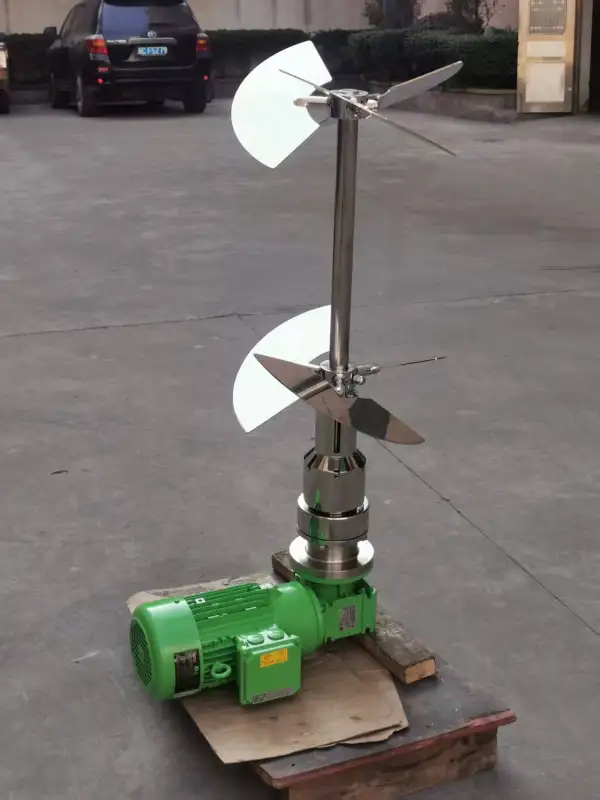
Impeller design: Different impellers generate different combinations of axial, radial, and tangential flow. An impeller that produces strong rotational movement may not provide the circulation pattern required for every mixing task.
Impeller position: The distance between the impeller and the tank bottom, liquid surface, and vessel walls affects how liquid moves through the tank. Incorrect positioning can leave poorly mixed regions even when the surface is highly active.
Tank geometry: Tank diameter, bottom shape, liquid height, and internal components all influence circulation. A mixing arrangement that performs well in one vessel may not deliver the same results in another.
Liquid properties: Viscosity, density, and the presence of suspended solids affect how readily the liquid moves. A low-viscosity liquid may develop a pronounced vortex, while a more viscous product may show little surface deformation despite substantial resistance to flow.
Operating speed: Increasing rotational speed can strengthen circulation, but it may also increase power consumption, air entrainment, and mechanical loading. The best operating point is the one that achieves the required process result, not necessarily the highest available speed.
These factors should be evaluated together when diagnosing poor mixing. A vortex is a visible flow feature, not a complete measurement of mixing quality.
How to Improve Mixing Without Simply Increasing Speed
If a tank develops a deep vortex but still shows uneven ingredient distribution, several corrective measures may be worth investigating.
First, review the impeller position and configuration. The objective is to improve liquid exchange throughout the vessel, especially in regions where ingredients accumulate or concentration differences persist. Depending on the tank design, changing the impeller arrangement may be more effective than increasing speed.
Second, examine the liquid level and ingredient addition method. Adding powders too quickly to one location can create local concentrations that take longer to disperse. A controlled addition method, combined with sufficient circulation near the addition point, may improve the result without requiring a more aggressive vortex.
Third, verify mixing performance using process-relevant indicators. Depending on the application, these may include concentration measurements at different sampling points, dissolution time, particle suspension, or the time needed to achieve a defined level of uniformity. Visual inspection of the surface should be treated as supporting evidence rather than the sole acceptance criterion.
Finally, consider whether the impeller and drive are suitable for the actual liquid properties and working volume. If the mixer is undersized, poorly positioned, or mismatched to the required duty, increasing speed may not solve the underlying problem.
What Role Can a Bottom Magnetic Mixer Play?
A bottom magnetic mixer is installed at the lower part of a tank and transfers rotation to an internal impeller through magnetic coupling. Depending on the impeller design and vessel geometry, it can support bulk circulation and ingredient blending while keeping the tank roof available for other process operations.
Its lower installation position may be useful when the process requires circulation from the bottom region or when overhead space is limited. However, a bottom-mounted impeller does not automatically eliminate surface vortices or guarantee uniform mixing. The resulting flow still depends on impeller geometry, speed, liquid properties, tank dimensions, and operating level.
For hygienic food and beverage applications, a bottom magnetic mixer can also eliminate the conventional rotating shaft seal at the vessel penetration. This can reduce maintenance associated with that particular sealing interface, although the complete assembly still requires appropriate inspection and cleaning provisions.
It is important to distinguish bulk mixing from high-shear processing. A standard bottom magnetic mixer can help distribute ingredients and maintain circulation, but it should not automatically be expected to replace specialized equipment designed for emulsification, homogenization, or intensive particle-size reduction.
How to Tell Whether Mixing Is Actually Improving
A practical assessment should begin with the process requirement. For a sugar solution, the key question may be whether the concentration becomes uniform within the target mixing time. For a suspension, it may be whether particles remain distributed without unacceptable accumulation at the bottom. For a flavor blend, it may be whether samples from different tank locations show consistent composition.
Compare these results at different operating speeds rather than judging the vortex alone. If a higher speed creates a deeper funnel but produces little improvement in uniformity, the process may benefit more from changes to impeller positioning, flow configuration, or ingredient addition.
Operators should also watch for excessive foaming, air incorporation, vibration, and increased power demand. These signs do not independently prove that mixing is poor, but they can indicate that a higher-speed setting is introducing disadvantages without delivering a meaningful process benefit.
A Better Measure of Mixing Success
A strong vortex can be visually striking, but it is not a reliable stand-alone indicator of mixing performance. Effective mixing depends on how well liquid circulates throughout the tank, how quickly ingredients become distributed, and whether the process reaches its required level of uniformity.
For industrial mixing applications, the better approach is to evaluate the full flow pattern, impeller configuration, vessel geometry, and material properties. A suitably selected and positioned mixer should deliver the required mixing result without relying on excessive surface rotation.
For food and beverage processors considering a bottom magnetic mixer, the priority should be effective bulk circulation, appropriate operating conditions, and a design suited to the actual process—not simply the creation of a deeper vortex.


