


Why Mixing Matters in High-Purity Organic Synthesis
In specialty chemical manufacturing, organic synthesis involves more than converting raw materials into a target compound. Reactant distribution, temperature control, catalyst contact, and contamination management all influence the quality of the final product.
These requirements become particularly important in catalytic hydrogenation, gas-liquid reactions, and the production of high-purity organic intermediates. Poor mixing can create local concentration differences, restrict gas transfer into the liquid phase, or allow solid catalysts to settle. Depending on the reaction chemistry, these conditions may affect conversion, selectivity, and batch consistency.
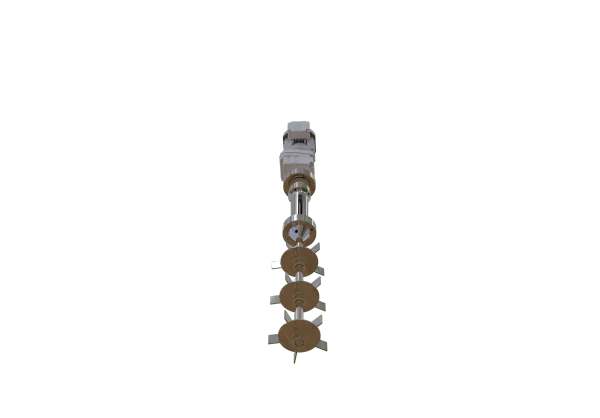
Magnetic top-drive stirrers help address these challenges by maintaining circulation inside the reactor while using magnetic coupling to transmit torque across a stationary containment boundary. For high-value chemical processes, this combines a practical mixing function with a drive arrangement designed to reduce leakage risks at the agitator interface.
Maintaining Product Purity Through Sealed Magnetic Drive Technology
In conventional reactor agitators, the rotating shaft typically passes through the vessel boundary and requires a mechanical seal. Seal wear, leakage, and maintenance can create additional concerns when processing moisture-sensitive reagents, volatile solvents, or high-value intermediates.
Magnetic top-drive stirrers use an external magnet assembly to transmit torque to the internal rotor and impeller without a conventional rotating shaft penetrating the reactor boundary. This arrangement eliminates the dynamic shaft seal at that interface, reducing one potential source of leakage and external contamination.
For organic synthesis, this is particularly relevant when producing specialty intermediates with strict impurity specifications. Maintaining the intended chemical composition is important not only for the reaction itself but also for downstream purification, crystallization, and product finishing.
The SFM and WSCJ externally mounted magnetic stirrers, together with the SFMA internally mounted magnetic stirrer, offer different installation arrangements for reactor applications. The appropriate configuration depends on the vessel design, operating conditions, and process requirements.
Where 316L stainless steel is used for product-contact components, its suitability should be assessed against the actual solvents, reagents, temperature, and cleaning conditions. Appropriate material selection helps reduce corrosion-related contamination and supports consistent product quality.
Improving Gas-Liquid Contact in Catalytic Reactions
Gas-liquid reactions present a distinct mixing challenge. In industrial hydrogenation, for example, hydrogen must transfer from the gas phase into the liquid and reach the catalyst surface before the desired reaction can proceed.
Simply introducing gas into a reactor does not guarantee effective utilization. If gas bubbles disperse poorly or liquid circulation is inadequate, gas-liquid contact may limit the reaction rate. Catalyst distribution and operating temperature also influence the overall process.
A properly configured top-drive magnetic stirrer generates circulation through the reactor and can help disperse gas introduced into the liquid. Impeller geometry, rotational speed, gas introduction method, and vessel dimensions all affect the resulting flow pattern and mass transfer.
Effective agitation can improve contact between the gas, liquid reactants, and catalyst, helping maintain more consistent reaction conditions. This is relevant to hydrogenation and other gas-liquid processes used in specialty chemical and intermediate production.
The required mixing intensity depends on the reaction system. Excessive agitation is not automatically beneficial, and the best configuration is the one that meets the process's gas-transfer and circulation requirements without creating unnecessary energy consumption or operational instability.
Keeping Solid Catalysts Distributed Throughout the Reaction
Some organic synthesis processes rely on suspended solid catalysts. Their availability within the liquid phase affects contact with dissolved reactants, making suspension quality an important consideration.
If catalyst particles settle at the bottom of the reactor, the distribution of active material may become uneven. This can reduce effective contact between the catalyst and reactants and complicate the repeatability of the reaction.
The impeller of a magnetic top-drive stirrer can be selected to generate the circulation required to maintain catalyst suspension. The necessary torque and mixing pattern depend on particle size, solids loading, liquid viscosity, and vessel geometry.
Maintaining a suitable suspension helps support consistent catalyst utilization throughout the batch. In processes where catalyst separation follows the reaction, stable operating conditions can also help make the downstream handling of the reaction mixture more predictable.
For manufacturers producing high-value intermediates, this is a practical connection between agitator performance and process economics: effective suspension helps the reaction operate under the intended conditions and reduces avoidable variation between batches.
Managing Heat and Aggressive Chemical Media
Organic synthesis may involve exothermic reactions, elevated operating temperatures, and solvents with demanding material-compatibility requirements. In these conditions, mixing and equipment selection must be considered together.
Adequate circulation helps distribute heat throughout the reaction mixture and supports heat exchange between the liquid and the reactor jacket. Where reagent addition or reaction kinetics generate localized heat, appropriate agitation can help reduce temperature gradients that may affect reaction selectivity or product quality.
Material compatibility is equally important. Solvents such as toluene and dimethylformamide (DMF), as well as various organic acids, have different compatibility requirements depending on concentration, temperature, and exposure conditions. Product-contact materials, bearing materials, and surface finishes must be selected for the specific process.
Silicon carbide bearings may be suitable for certain chemical mixing applications because of their wear resistance and material properties. Their suitability, however, depends on the process fluid, lubrication conditions, temperature, and mechanical loading.
Matching the magnetic stirrer's materials and operating configuration to the actual reaction environment helps support reliable operation while reducing avoidable maintenance interruptions.
Connecting Reaction Control with Final Product Quality
The quality of a synthesized compound is determined by the chemistry and by how consistently the reaction conditions are maintained. Uneven reactant distribution, insufficient gas-liquid contact, catalyst settling, and temperature variation can all affect process performance, although their impact differs from one reaction to another.
Magnetic top-drive stirrers support the mixing conditions required to control these variables. Their sealed magnetic drive arrangement also helps address leakage risks associated with conventional dynamic shaft seals.
For producers of specialty chemicals, agrochemical intermediates, functional additives, and other high-purity organic compounds, these benefits matter across the full batch cycle. Consistent reactor operation can make it easier to reproduce established processing conditions and maintain predictable material quality before downstream purification.
Selecting the appropriate SFM, WSCJ, or SFMA configuration requires consideration of reactor geometry, viscosity, gas or solid content, operating temperature, and the chemical compatibility of wetted components. The aim is to match the mixing system to the reaction rather than relying on a single agitator configuration for every synthesis process.
Reliable Mixing for High-Purity Chemical Production
High-purity organic synthesis depends on controlled reaction conditions, effective mass transfer, suitable materials, and careful contamination management. Magnetic top-drive stirrers contribute by supporting reactant circulation, gas-liquid contact, and catalyst suspension while eliminating the conventional dynamic shaft seal at the reactor drive interface.
When correctly matched to the reaction and vessel, they provide a practical mixing option for specialty chemical manufacturing, helping producers maintain repeatable process conditions and consistent product quality.


