


In biomanufacturing, fluid transfer sits between many of the operations that give a biological product its final characteristics. Culture media must reach the bioreactor, fermentation broth has to leave the production vessel, intermediates move through downstream processing, and formulated products eventually reach filling or storage equipment. The material changes along the way, so the pumping duty changes with it.
This is why pump performance cannot be separated from the process itself. A transfer pump for a biomanufacturing line needs to accommodate the condition of the material at a particular stage while fitting naturally into the tanks, piping, filtration, formulation, and control equipment around it.
Low-speed rotary lobe pumps offer one way to approach this requirement. Their value is not simply that they can operate slowly. It is that positive displacement pumping, adjustable operating speed, and sanitary construction can be incorporated into a process system where controlled material movement is required.
Upstream Processing Begins with Controlled Material Movement
Before a biological product reaches downstream purification or formulation, the manufacturing process has already passed through several material-handling stages.
Media preparation may involve water, nutrients, sugars, or other ingredients that need to be transferred into a preparation or fermentation vessel. Once biological growth or fermentation begins, the process stream becomes substantially different from the original formulation. The broth may contain cells, biological solids, and other components generated during the process.
At this point, the pump is no longer simply transferring an ingredient. It is handling a biological process stream whose characteristics are determined by the upstream operation.
A rotary lobe pump can provide positive displacement transfer between process vessels while allowing the operating speed to be adjusted to the actual production requirement. This makes it possible to treat pumping as part of the upstream process rather than as a fixed-capacity utility.
Harvest Transfer Marks a Change in Pumping Duty
The transition from fermentation to downstream processing is particularly important.
Once the desired biological material has been produced, the broth may need to be transferred toward separation, clarification, filtration, or other downstream operations. The receiving equipment may have a defined processing capacity, meaning that simply transferring the broth at the highest possible rate is not necessarily useful.
A controlled pump rate allows the transfer stage to be coordinated with what comes next.
This is one reason low-speed operation has practical value. By reducing rotational speed when process conditions call for it, the pump can provide a more measured product feed. Variable frequency control can further connect pump operation with the requirements of downstream equipment.
The pump therefore becomes part of the relationship between two process units: the upstream vessel determines what is available, while the downstream unit determines how quickly that material should be accepted.
Concentration Changes the Character of the Process Stream
Downstream processing can progressively change the physical behavior of a biological product.
After clarification or separation, an intermediate may undergo concentration or formulation steps that increase its solids content. A product that was comparatively easy to transfer at an earlier stage may become significantly more viscous later.
This is where a positive displacement pump becomes particularly useful. Rotary lobe pumps do not depend on the same high-speed impeller action commonly associated with centrifugal pumping. Their displacement mechanism allows viscous products to be transferred while pump speed can be adjusted to suit the process.
The supplied pump series covers viscosities from approximately 0.2 to 100,000 cP and flow capacities from approximately 0.15 to 127 tons per hour, depending on the model and operating conditions. These figures provide the range of the equipment rather than a universal operating recommendation. The actual duty comes from the specific biological material and the process stage in which the pump is installed.
The Pump Should Follow the Process Architecture
A biomanufacturing line is normally made up of connected process units rather than independent machines. Tanks, sanitary pipelines, filtration equipment, formulation vessels, transfer systems, and filling equipment have to work together.
This makes the physical arrangement of the pump important.
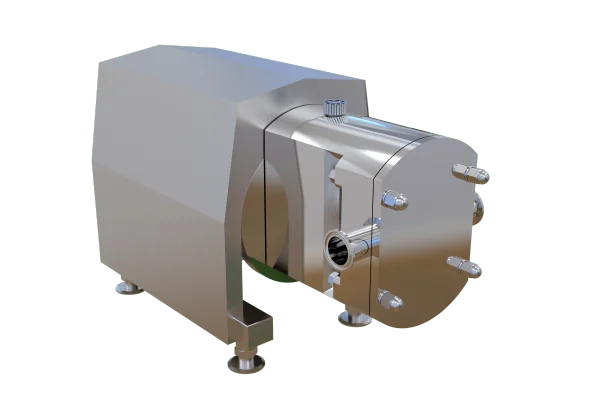
The TRA rotary lobe pump uses an integrated coupling structure developed from the traditional split TR design. Its overall length can be reduced by approximately 100 to 250 mm, creating a more compact arrangement within the production area.
That difference can become useful when several process units need to be positioned within limited space. The stainless steel external finish also suits equipment areas where a clean and consistent sanitary appearance is required.
The integrated drive arrangement reduces the losses, noise, and wear associated with the elastic coupling used in the traditional configuration. In a continuously operating production system, these mechanical details become part of the overall equipment arrangement rather than merely individual pump specifications.
Different Process Stages Can Require Different Pump Configurations
There is no reason for every transfer point in a biological production line to use exactly the same configuration.
A fixed pump may be appropriate where the equipment remains permanently connected to a dedicated vessel. A mobile configuration can make more sense where one pumping unit needs to serve different production positions.
For high-viscosity or poorly flowing materials, the supplied hopper-fed configuration provides another approach. The pump can be equipped with a top inlet hopper for materials that do not readily flow into a conventional suction line.
These options are particularly relevant when a biomanufacturing facility handles different formulations or changes its production arrangement between batches. The pump can be configured around the process layout instead of forcing the process to adapt to a single equipment arrangement.
Hygienic Engineering Extends Beyond the Pump Casing
The sanitary character of a bioprocess system depends on the complete product-contact path.
For the supplied lobe pump, 304 or 316L stainless steel can be selected for the pump body according to the application. Single or double mechanical seals are available, with options including hard alloy, silicon carbide, graphite, and ceramic. O-ring materials can include FKM, silicone, EPDM, PTFE, and NBR.
Connection arrangements can also be matched to the surrounding sanitary piping, including clamp, flange, threaded, DIN hygienic, and welded connections.
The product series carries CE and 3-A certification information. In an actual biomanufacturing installation, however, the complete equipment configuration still needs to correspond with the manufacturer's GMP procedures, cleaning strategy, validation requirements, and process-specific specifications.
From Individual Pump to Biomanufacturing Solution
The importance of a low-speed rotary lobe pump becomes clearer when viewed across the complete production route.
It can support controlled movement around media preparation and fermentation, provide a measured transfer during harvest, accommodate changing conditions in downstream processing, and connect formulation or holding equipment with later stages of production.
The engineering question is therefore not simply whether a pump can move a particular biological liquid. It is whether the pump can become a reliable link between the process units surrounding it.
For biomanufacturing, that means combining appropriate speed control with sanitary materials, suitable sealing, practical installation, and a configuration that fits the physical production layout. In this role, a rotary lobe pump is not merely a transfer machine. It becomes one of the connecting elements that allows a complete biological processing system to operate as an integrated process.


