


In the high-purity dairy, food, and beverage processing industries, consumer safety and shelf-life stability are directly linked to the mechanical cleanability of production machinery. The primary framework governing this sector is the 3-A Sanitary Standards, a comprehensive set of hygienic design criteria formulated by 3-A Sanitary Standards, Inc. (3-A SSI). The core mandate of 3-A certification is to protect public health by ensuring that fluid processing machinery can be completely sanitized, either via automated Clean-in-Place (CIP) systems or manual disassembly. By enforcing specific engineering metrics, these standards ensure equipment does not harbor pathogenic microbes, product residue, or organic biofilms.
Historical Evolution and Tripartite Governance of 3-A SSI
The authoritative status of 3-A certification stems from its structural history. The designation 3-A represents the three foundational associations that originally collaborated in the 1920s to establish unified hygienic guidelines for the dairy industry. This cooperative triad comprised public health regulatory officials, equipment fabricators, and dairy processors.
The modern iteration of 3-A SSI operates as an independent, non-profit organization that maintains this collaborative structure. By combining the oversight of regulatory sanitarians, the material expertise of manufacturers, and the practical requirements of plant operators, 3-A SSI ensures that every standard is technologically viable and optimized for contamination mitigation. This joint oversight prevents the regulatory fragmentation found in standard industrial sectors, providing a single benchmark for hygienic fluid handling across global sanitary supply chains.
Metallurgical and Geometric Principles of 3-A Hygienic Engineering
To achieve 3-A compliance, fluid processing machinery must satisfy precise material science and fluid dynamic criteria. These rules eliminate micro-scale vectors of contamination:
- Material Inertness and Corrosion Resistance: All product-contact components must be fabricated from non-toxic, corrosion-resistant materials. The standard mandates AISI 300 series austenitic stainless steel, typically SS304 or low-carbon SS316L. These alloys resist pitting and intergranular corrosion when exposed to aggressive hot acid and alkaline CIP chemicals. Elastomers and mechanical seals must comply with FDA 21 CFR 177 and USP Class VI metrics to prevent chemical leaching under thermal stress.
- Surface Micro-Topography: Standard machining leaves microscopic fissures and surface porosity where organic particles can lodge. 3-A standards require all product-contact boundaries to be polished to a surface roughness profile of Ra <= 0.8 micrometers (32 microinches). This smooth finish reduces the surface energy of the metal, preventing the adhesion of proteins and fats and allowing CIP fluids to lift contaminants during rinse cycles.
- Elimination of Dead Legs and Crevices: Sharp 90-degree internal corners create boundary layer stagnation where fluid velocity drops to zero. 3-A engineering prohibits these hidden areas, requiring all internal junctions to feature a minimum radius of 6.35 millimeters (1/4 inch). This geometry ensures that the kinetic energy of the cleaning fluid sweeps across every surface, eliminating pockets where microbial colonies can grow out of reach of chemical sanitizers.
Application of 3-A Criteria to Specialized Fluid Machinery
Implementing 3-A criteria requires specific mechanical configurations depending on the hydrodynamics of the processing component:
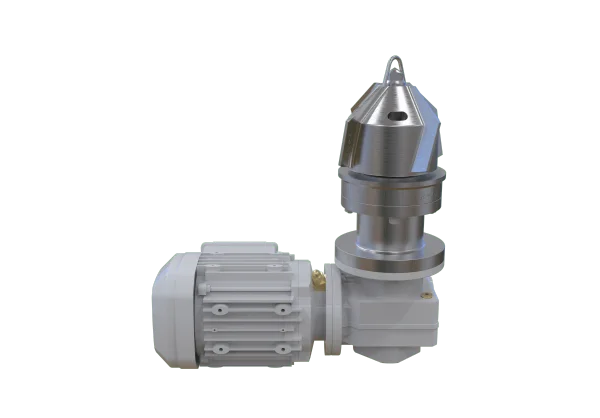
- Sanitary Magnetic Agitators: Traditional mixing vessels use dynamic mechanical shaft seals that inevitably wear down, creating microscopic gaps where product can stagnate. Mag-drive mixers eliminate this risk by using a hermetically sealed isolation shell to transfer torque via synchronous magnetic fields. To meet 3-A requirements, the internal impeller bearings must feature open, self-flushing fluid paths. This allows CIP solutions to circulate through the bearing assembly, eliminating internal friction points and preventing product entrapment.
- Sanitary Rotary Lobe Pumps: Designed for high-viscosity fluids like syrups, dairy solids, and emulsions, these positive displacement pumps must handle delicate products without dead zones. 3-A compliant lobe pumps use front-loading mechanical seals positioned directly in the product stream. The rotor housing features smooth internal arcs and computer-profiled rotors that maintain tight clearances without metal-to-metal contact, ensuring a complete fluid sweep during cleaning.
- Sanitary Centrifugal Pumps: Used for high-velocity transfer of low-viscosity fluids, these pumps use fully open impellers without front or rear shrouds. This exposed configuration ensures all internal parts are swept by the primary flow path. The pump casing is designed with a tangential discharge orientation, making it fully self-draining via gravity. This ensures no residual chemicals, water, or product pools remain inside after a production run, allowing for fast batch validation.
Process Integration Matrix for Food and Beverage Production
Integrating 3-A compliant equipment requires analyzing the physical parameters of the production line. The following matrix details how process variables match mechanical configurations:
• Product Rheology and Viscosity: Low-viscosity fluids under 200 centipoise use 3-A centrifugal pumps to maintain turbulent flow during CIP. High-viscosity fluids require positive displacement rotary lobe pumps operated at lower operational speeds to prevent cavitation and fluid shear.
• Thermal Cycling: Processing applications involving pasteurization or UHT sterilization require premium EPDM or Viton seals. These compounds maintain sealing pressure during transitions from 4 degrees Celsius product transfer to 135 degrees Celsius steam sterilization.
• CIP Velocity Requirements: To achieve mechanical scrubbing during automated cleaning, the system must maintain a minimum fluid velocity of 1.5 meters per second through the fluid pathways. The pump must provide sufficient total dynamic head to overcome backpressure from downstream filters and heat exchangers.
Regulatory Compliance and Validation Framework
Adhering to 3-A criteria simplifies the overall validation process for manufacturing facilities facing third-party inspections. When a facility deploys equipment bearing the official 3-A symbol, it provides immediate documentation to food safety inspectors that the machinery meets verified engineering baselines. This pre-verified compliance drastically accelerates the implementation of Hazard Analysis Critical Control Point (HACCP) programs.
Furthermore, because the internal pathways are optimized for rapid soil release, processing plants can dramatically decrease the duration of their cleaning cycles. This reduction in downtime directly translates to lower water consumption, decreased utilization of aggressive cleaning chemicals, and minimized operational overhead, allowing manufacturers to maximize production efficiency while maintaining complete biosecurity across the processing environment.
Are you upgrading your sanitary processing line or seeking high-performance, 3-A compliant fluid machinery? Explore our comprehensive catalog of 3-A Standard Rotary Lobe Pumps, Sanitary Pumps, and Magnetic Agitators, or contact our engineering experts today for a tailored technical consultation.


