


Food production rarely depends on a single piece of equipment. Milk, cream, sauces, syrups, fruit concentrates, chocolate, beverages, and other food products typically pass through several stages before reaching the filling or packaging line. Storage tanks, mixing systems, heating or cooling units, transfer pumps, valves, pipelines, and filling equipment must work together while maintaining consistent product quality and hygienic conditions.
Within this complete processing system, the pump connects different production stages. It moves ingredients from preparation vessels, transfers intermediate products between tanks, and delivers finished formulations toward filling equipment. When the product contact path must meet strict sanitary requirements, the pump becomes an important part of the overall food processing solution.
This is where FDA requirements and 3-A sanitary standards become relevant. They provide a framework for considering materials, hygienic construction, sanitation, and food contact equipment when building a complete processing line.
Food Processing Is a Connected Process, Not an Isolated Pumping Task
Consider a dairy production line. Raw or prepared ingredients may first enter a storage or preparation tank, followed by mixing, heating, cooling, holding, and filling. A similar multi-stage arrangement can be found in sauce production, beverage manufacturing, fruit processing, and confectionery production.
The transfer points between these stages are critical because every movement of product creates another opportunity for contamination, product residue, or process inconsistency.
A sanitary lobe pump can serve as the transfer link between these operations. Its role may be relatively simple mechanically, but its position within the process makes its construction important. The pump must be compatible with the product, connected correctly to the sanitary pipeline, and integrated with the cleaning and operating procedures used by the production facility.
Therefore, designing a food processing solution starts with understanding the complete material path rather than selecting a pump based only on flow rate.
From Ingredient Preparation to Finished Product
Different food products place different demands on a complete processing system.
In dairy processing, the system may need to handle milk, cream, yogurt ingredients, or other viscous dairy products between tanks and downstream equipment. Beverage production can involve syrups, concentrates, flavoring components, and finished liquid products. Sauce and condiment lines may deal with tomato sauce, jam, jelly, pudding, or other concentrated formulations.
Chocolate and syrup present another type of challenge because viscosity can increase substantially compared with ordinary liquid food products. In these applications, the transfer stage must be considered together with vessel design, pipeline arrangement, temperature control, and downstream filling requirements.
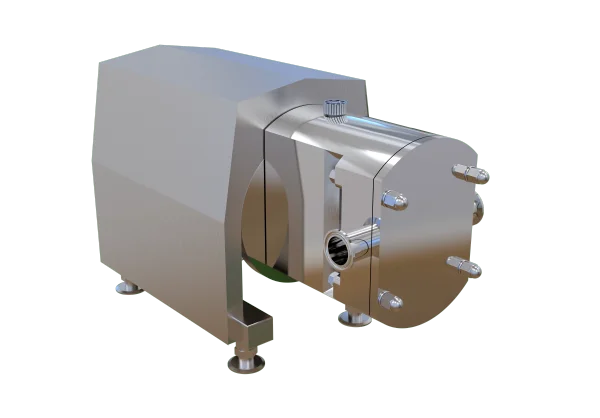
A sanitary lobe pump fits into this process as a controlled positive displacement transfer device. Rather than defining the complete system around the pump, engineers can position the pump according to where controlled product movement is required between two processing stages.
Why the Transfer Stage Matters in a Complete Solution
A processing tank can provide excellent mixing performance, but that does not automatically guarantee stable downstream transfer. The product still has to leave the vessel, enter the pump, pass through the pipeline, and arrive at the next stage under suitable operating conditions.
This is especially important for viscous or concentrated food products.
The supplied rotary lobe pump range can handle material viscosities from 0.2 to 100,000 cP. Depending on the process, the pump can be configured with frequency converter speed control or mechanical speed adjustment. This allows transfer capacity to be adapted to different production stages instead of forcing every operation to run at one fixed pumping condition.
For a complete food processing line, this flexibility can be useful when preparation, holding, and filling stages have different flow requirements.
Designing the Pump Around the Production Equipment
The pump should also match the physical arrangement of the processing line.
The supplied lobe pump can be configured for top inlet and bottom outlet or horizontal inlet and outlet arrangements. Different connection options include sanitary clamp, pipe thread, flange, DIN union, and welded connections.
These choices become important when integrating the pump with tanks, pipelines, valves, heat treatment equipment, filling machines, or mobile processing units.
For poorly flowing, high concentration, paste-like food materials, a top mounted feed hopper can also be used. This configuration provides another way to organize the relationship between the product vessel and pumping section when gravity feeding alone is insufficient.
The objective is not to make the pump perform every function. Instead, the pump should fit naturally into the equipment arrangement so that each stage of the processing line performs its intended task.
Hygiene Has to Continue Across the Whole Product Path
Food safety cannot be isolated to the pump housing.
If a sanitary pump is connected to unsuitable piping, poorly designed fittings, or difficult-to-clean process equipment, the overall sanitary performance of the system can still be compromised. The product contact path includes the pump, seals, connections, valves, pipes, tanks, and downstream equipment.
This is why sanitary design needs to be considered at the system level.
The supplied lobe pump uses 304 or 316L stainless steel pump bodies and can be configured with single or double mechanical seals. Available O-ring materials include Viton, silicone, EPDM, PTFE, and NBR. Mechanical seal options include hard alloy, silicon carbide, graphite, and ceramic.
These configuration choices allow the pump to be incorporated into different food processing environments according to product and operating requirements.
FDA and 3-A as Part of System-Level Food Safety
FDA requirements provide a regulatory framework for sanitary food manufacturing in the United States, including requirements related to equipment, sanitary operations, and production controls.
3-A Sanitary Standards take a more equipment-focused approach to hygienic design. Applicable 3-A standards address food processing equipment and establish criteria related to sanitary construction, cleanability, materials, and other hygienic considerations.
For a complete food processing solution, these requirements should not be treated simply as a label attached to an individual pump. The processing company still needs to evaluate the complete product contact path and its sanitation procedures.
A pump with appropriate sanitary construction can contribute to that system, but the tanks, piping, valves, connections, and other product contact equipment must also support the same hygienic objectives.
Building Complete Solutions Around Different Food Products
A complete processing solution can therefore be configured differently according to the product being manufactured.
For liquid dairy products, the focus may be on hygienic transfer between storage, processing, and filling equipment. For viscous sauces, concentrates, and syrups, the system may require greater attention to pump displacement, pipeline resistance, and temperature conditions. Chocolate and other highly viscous products may require additional consideration of heating or insulation to maintain suitable flow characteristics.
The supplied pump can be equipped with an optional jacket for insulation or heating, which can become useful when the transfer characteristics of the product are strongly affected by temperature.
This approach changes the role of the pump from a standalone machine into one component of a process-specific equipment package.
What a Food Processing Equipment Package Should Accomplish
A well-designed food processing system should allow product to move logically from one stage to the next without creating unnecessary transfer points or difficult sanitation areas.
The pump should match the required product viscosity and flow conditions. The connection system should correspond with the sanitary pipeline. Tank outlets and pump inlets should provide reliable product feeding. Heating or insulation should be considered where product temperature affects transfer behavior. Speed control should correspond with the requirements of mixing, holding, and filling stages.
Most importantly, these elements should be designed together.
For equipment suppliers and food manufacturers, this system-level approach makes it possible to develop solutions around actual production processes rather than simply adding a pump to an existing line after the major equipment has already been selected.
From Sanitary Pump to Complete Food Processing Solution
The importance of an FDA and 3-A compliant sanitary approach becomes clearer when the lobe pump is viewed as part of a complete food processing system.
The pump may transfer milk between tanks, move syrup toward filling equipment, handle concentrated fruit products, or transport viscous chocolate through a controlled process line. But its performance and hygienic value depend on how it interacts with the surrounding equipment.
A complete solution therefore brings together product handling, tank configuration, sanitary piping, pump selection, heating or insulation, speed control, sealing, cleaning, and downstream equipment.
For food manufacturers, this integrated approach provides a more practical foundation for developing hygienic processing lines. The goal is not simply to install a sanitary lobe pump. It is to create a connected processing system in which every product contact stage supports reliable transfer, efficient sanitation, and consistent food production.


