


In modern biopharmaceutical manufacturing, the mechanical energy applied during fluid compounding directly governs the physical stability, encapsulation efficiency, and biological activity of the final parenteral product. Traditional mixing mechanisms often introduce localized thermal stress or air entrainment, which can denature complex macromolecular structures.
Implementing targeted bottom-entry fluid shearing technology provides pharmaceutical engineers with precise control over fluid dynamics within a completely sealed, aseptic environment. This technical review evaluates the specific processing outcomes achieved when integrating these bottom-mounted high-shear systems into the production of high-value sterile preparations, target drug delivery vehicles, and diagnostics.
Optimization of Nano-Targeted Drug Delivery Systems (Liposomal Formulations)
The production of advanced liposomal drug delivery systems, such as Liposomal Doxorubicin or Amphotericin B, requires strict control over mean particle size and the polydispersity index (PDI). Achieving a uniform particle distribution at approximately 100 nanometers is critical to ensuring correct in-vivo pharmacokinetics and avoiding premature clearance by the reticuloendothelial system.
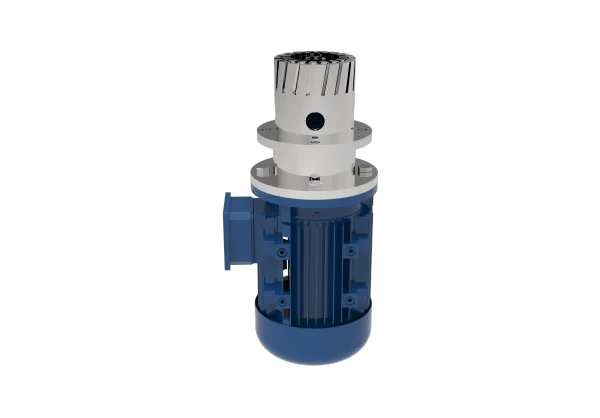
To process these delicate lipid bilayers without structural degradation, facilities deploy a Bottom-entry Internal Circulation Emulsifier. Because the high-shear rotor-stator assembly is integrated at the base of the processing vessel, natural hydraulic head pressure and gravity continuously force the crude lipid mixture through the high-shear zone.
By modulating the peripheral tip speed within the 2800–2900 rpm operating range, the internal circulation configuration delivers uniform energy density throughout the fluid matrix. This precise energy dissipation shatters larger multilamellar vesicles into homogeneous unilamellar liposomes with a highly constricted PDI, maximizing active ingredient encapsulation while eliminating cold spots where unprocessed vesicles might bypass the shear field.
Preservation of Antigen Potency in Sub-Micron Vaccine Adjuvants
Vaccine manufacturing utilizing oil-in-water emulsion adjuvants, such as MF59 or AS03, presents distinct processing challenges. These adjuvants rely on long-term emulsion stability to effectively stimulate the host immune response. A critical variable in this process is the complete exclusion of air from the fluid path, as micro-bubbles trigger protein oxidation and the subsequent denaturation of delicate antigen segments.
Utilizing a bottom-mounted shearing layout solves this problem by performing all high-shear dispersion completely submerged below the liquid surface level. When continuous multi-vessel processing or inline chemical blending is required, a sanitary Bottom Entry Inline Mixer is integrated directly into the closed loop.
This inline configuration loop-shears the emulsion through precisely machined stator slots without generating a surface vortex. The absence of a vortex prevents atmospheric air from being drawn into the fluid. The result is a sub-micron emulsion adjuvant with enhanced droplets stability that maintains antigen potency throughout its shelf life, passing strict pharmacopeia visual and structural validation checks.
Aggregation Prevention in Monoclonal Antibodies and Recombinant Proteins
High-concentration monoclonal antibodies (mAbs) and recombinant protein injectables are highly sensitive to mechanical shear stress and localized friction heat. Excessive or uncontrolled energy input during excipient dissolution can trigger protein unfolding, leading to the formation of sub-visible particulates and dangerous immunogenic aggregates.
Bottom-entry shearing systems protect these macromolecular chains through micro-adjustable frequency conversion and streamlined flow path geometries. The compact rotor assembly minimizes the total surface area in contact with the product, reducing frictional heat generation.
During the compounding stage, the system rapidly dissolves stabilizers and buffers while uniformly distributing the antibody molecules. Operating under controlled low-shear or high-shear cycles depending on the process stage, the equipment yields a clear, aggregate-free parenteral solution that complies with global regulatory mandates for sub-visible particulate counts.
Processing Sub-Micron Intravenous Fat Emulsions
Parenteral nutrition lipids and intravenous anesthetics, such as Propofol injectable emulsions, require the oil phase to be pulverized to a strict sub-micron droplet size (typically under 500nm). Any droplet exceeding the safe threshold presents a direct risk of micro-embolism in clinical applications.
The high energy density generated within the localized rotor-stator zone of a bottom-entry system instantly cleaves the coarse oil-water interface. The continuous recycling of the fluid through the emulsifying head ensures that the oil phase is uniformly broken down into fine droplets. This structural uniformity prevents phase separation and lipid coalescence, allowing the final emulsion to maintain its physical and chemical integrity even after undergoing terminal high-temperature steam sterilization at 121°C.
Suspension Uniformity in Solid-Liquid Diagnostic Reagent Compounding
The manufacturing of diagnostic reagents involving solid phase suspensions, such as surface-coated magnetic microbeads or fluorescent microspheres used in chemiluminescence assays, requires continuous, uniform particle suspension. High-density microspheres tend to sediment rapidly under standard agitation, causing batch stratification and inconsistent bead concentrations per milliliter.
Bottom-mounted shearing technology provides continuous axial suction at the absolute lowest point of the tank. This hydraulic suction pulls high-density particles from the base and propels them vertically through the fluid column.
By maintaining a continuous, non-depositing fluid velocity without dead corners, the system ensures an identical distribution of surface functional groups and bead concentrations across every single vial filled from the batch, directly enhancing the reproducibility and calibration accuracy of the terminal diagnostic kit.
The selection of bottom-entry high-shear technology represents a direct investment in the structural and biochemical integrity of the final pharmaceutical product. By aligning specific equipment configurations—such as the in-situ containment of the bottom-entry internal circulation emulsifier or the closed-loop transport capacity of the bottom entry inline mixer—with the distinct fluid properties of liposomes, vaccines, proteins, and emulsions, manufacturers can achieve predictable, validation-ready batch consistency that meets global regulatory standards.


