


In upstream and downstream biopharmaceutical processing, maintaining cell viability is the single most critical benchmark for production success. Whether cultivating mammalian cells (such as Chinese Hamster Ovary or CHO cells) for monoclonal antibodies (mAbs), transferring fragile CAR-T immune cells, or piping sensitive delivery vesicles like Lipid Nanoparticles (LNPs) and viral vectors, protecting cellular structures and molecular coatings from mechanical trauma is paramount.
Traditional fluid transfer technologies—specifically conventional vane-style centrifugal pumps and high-clearance positive displacement pumps—subject these delicate biological materials to violent mechanical friction, aggressive velocity changes, and severe hydraulic chopping. This localized fluid shear leads to instant cell lysis, intracellular debris contamination, and a sharp decline in overall harvest viability.
To resolve these vulnerabilities and secure high-potency outputs, biopharmaceutical facilities are widely adopting Sanitary Disc Pumps. By utilizing the precise fluid dynamics of laminar boundary layers, these specialized pumps deliver a completely non-shear, non-impact passage that guarantees exceptionally high viability for live cell products and modern biologics throughout downstream transport.
The Shear Stress Crisis for Specific Biopharmaceutical Formulations
Biopharmaceutical cell cultures and macromolecular formulations are highly complex fluid matrices that cannot tolerate rapid acceleration or turbulent fluid friction. During commercial scale-up, diverse bioprocess products must be transferred continuously across bioreactors, ultrafiltration skids, chromatography columns, and automated filling manifolds.
When passed through standard pumping infrastructure, specific premium formulations undergo immense mechanical degradation:
- T-Cells and Stem Cells: In advanced cell therapies, live human cells are the final therapeutic product. Sharp, fast-spinning centrifugal impellers physically crush these cells, rupturing the cell membranes and destroying the therapeutic potency of personalized batches.
- Monoclonal Antibodies (mAbs) and Recombinant Proteins: High-shear pump friction can unfold or break down the delicate tertiary structures of complex protein chains. This molecular denaturation causes aggregation, rendering high-value drug batches completely ineffective.
- mRNA Vaccines and Lipid Nanoparticles (LNPs): Modern gene therapies rely on delicate lipid capsules to deliver fragile mRNA strands into human cells. Traditional pumps shear these fragile nano-coatings apart, prematurely releasing the genetic material and ruining the vaccine formulation.
Beyond the immediate loss of primary living assets, cell lysis introduces a secondary operational crisis: the release of sticky intracellular Host Cell Proteins (HCP) and genomic DNA into the product stream. This cellular debris drastically increases fluid viscosity, fouls delicate filtration membranes prematurely, clogs downstream chromatography columns, and complicates the purification sequence. Consequently, using an unoptimized, high-shear pump forces biopharmaceutical manufacturers to endure a severe reduction in active active product yields while experiencing exponentially higher purification costs.
The Physics of Cellular Protection: Non-Impact Laminar Passage
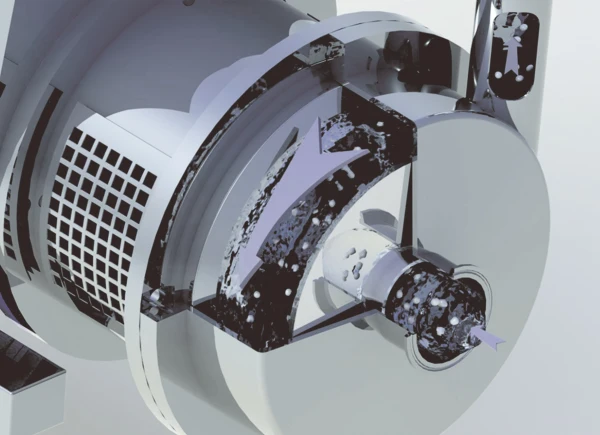
The Sanitary Disc Pump re-engineers fluid transport by replacing violent impellers and tight-clearance scraping rotors with an assembly of smooth, parallel flat discs. This open geometry utilizes fluid molecular properties to move materials without mechanical impact, working through two co-dependent force principles:
- Viscous Adhesion and Synchronized Boundary Layers: As the flat disc impeller rotates within the sanitary casing, the natural molecular viscosity of the biopharmaceutical fluid causes it to adhere closely to the smooth metal faces of the discs. This creates a highly stable, microscopic laminar boundary layer that travels in perfect synchronization with the velocity of the rotating discs.
- Viscous Drag and Linear Velocity Gradients: Rather than pushing the biological formulation through physical force, the spinning boundary layer utilizes viscous drag to pull successive layers of the medium forward in smooth parallel sheets. This gradient establishes a friction-free flow field where the relative velocity between the disc surface and the immediately adjacent fluid layer is effectively zero.
Because the cells glide inside a protective, synchronized sheet of fluid parallel to the disc faces, they never collide with the spinning components or the internal pump body. Mechanical compression, grinding forces, and turbulent shear zones are eliminated, allowing delicate CHO cells, CAR-T cultures, and delicate protein strings to cross the pump chamber completely intact.
Strategic Systemic Benefits for Biopharmaceutical Processing
Integrating flat disc laminar pumping systems into active bio-pharma lines provides substantial technical and validation advantages across high-value operations:
Guaranteed Maximum Cell Viability (CFU & Target Potency)
For live cell therapy products and advanced biologics, final therapeutic potency is inextricably linked to cell viability. The non-shear laminar flow mechanism of the disc impeller ensures that living microorganisms, stem cells, and mammalian cultures pass through terminal transfer lines without cell mortality. This allows processing plants to maintain maximum viable cell counts and achieve predictable batch efficacy without over-formulating raw ingredients to compensate for pump damage.
Elimination of Downstream Purification Bottlenecks
By switching to non-impact disc technology, facilities eliminate the root cause of cell lysis during processing. Minimizing the release of Host Cell Proteins (HCP) keeps the product stream clean and highly uniform. This uniformity extends the operational lifespan of expensive Tangential Flow Filtration (TFF) membranes and downstream chromatography resins, accelerating purification cycle times and improving total active yield.
Compliant Hygienic Architecture for Sterile Validation
Because these pumps are deployed in sterile, ultra-pure manufacturing environments, their mechanical design strictly satisfies international biopharmaceutical compliance standards. The interior of the flat disc assembly contains no hidden crevices, dynamic friction seals, or dead zones where organic contamination can hide.
The pump casing and disc components are precision-fabricated from premium forged SS316L stainless steel, featuring an option for advanced electrolytic polishing (electropolishing) to achieve a surface roughness rating below Ra 0.4 μm. This highly reflective, ultra-smooth surface profile facilitates seamless Clean-in-Place (CIP) and Sterilize-in-Place (SIP) operations, allowing high-velocity sanitizing fluids and saturated steam to flush the entire internal flow path perfectly. This ensures unconditional adherence to GMP and FDA regulatory standards, eliminating cross-contamination and assuring absolute consumer safety.


