


In biopharmaceutical manufacturing, no single ingredient or utility is more critical to process integrity and consumer safety than Water for Injection (WFI). As the foundational solvent used in the formulation of life-saving vaccines, plasma fractions, parenterals, and intravenous medicines, WFI must strictly adhere to the uncompromising standards set by international pharmacopeias, including the United States Pharmacopeia (USP), European Pharmacopoeia (Ph. Eur.), and Chinese Pharmacopoeia (ChP).
Because a WFI distribution system operates as a continuous, high-temperature dynamic loop under strict sterile conditions, choosing the right circulation machinery is paramount. Specifically, selecting the right WFI loop centrifugal pump is one of the most critical decisions a pharmaceutical engineer can make.
A standard sanitary pump is simply not engineered to withstand the unique, high-stakes operational parameters of this environment. WFI circulation demands highly specialized fluid engineering to continuously prevent microbial growth, resist the onset of high-temperature rouging, and maintain flawless hydraulic performance over years of continuous operation.
This comprehensive technical guide explores the essential design features, material requirements, and engineering principles necessary when selecting a high-performance WFI loop centrifugal pump for your pharmaceutical pure water system.
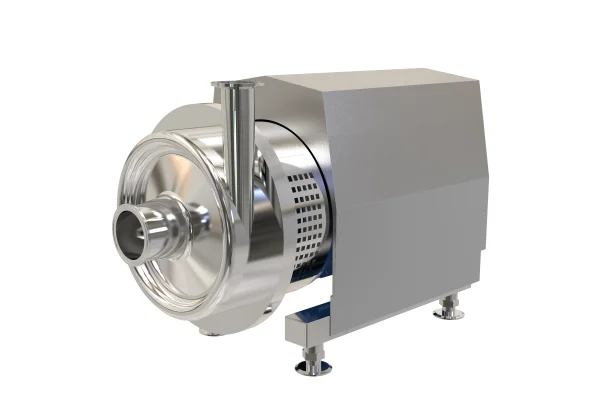
1. Zero Dead-Leg Casing Design to Eliminate Biofilm Formation
The absolute greatest threat to any pharmaceutical pure water distribution loop is microbial contamination. When fluid flow stagnates or slows down within an isolated pocket of a system, free-floating bacteria can anchor themselves to the stainless steel walls. Once attached, these microorganisms secrete a protective matrix known as a biofilm. Biofilms are incredibly resilient, often completely resisting standard thermal sanitization cycles and aggressive ozone treatments, leading to chronic batch contamination.
A premium WFI loop centrifugal pump eliminates this risk at the microscopic level through a strict zero dead-leg hydraulic design.
- Volute and Geometry: The internal pump casing features smooth, sweeping radiuses with completely optimized volute geometry. Every internal fluid path is designed to ensure continuous high-velocity movement, completely removing low-flow dead zones or internal micro-crevices where water could stagnate.
- Total Gravity Drainability: The entire pump assembly must be engineered for total drainability. When the pump is mounted at its specified pitch angle (typically using a 45-degree or vertical casing orientation), the internal chamber must empty completely via gravity during routine system maintenance, sampling, or blowdown. This absolute evacuation ensures that no residual moisture or water puddles remain trapped inside the volute to harbor opportunistic bacteria.
2. 316L Stainless Steel with Electropolishing and Ultra-Low Ra Finishes
WFI water is an extraordinary fluid because it is heavily purified, deionized, and mineral-free. This high level of purity makes the water highly aggressive. Lacking natural ions, hot WFI acts as a powerful solvent that actively hungers for minerals, meaning it will aggressively leach ions out of lower-grade metals, accelerating chemical corrosion and material degradation.
To withstand this aggressive leaching action, all product-contact (wet) parts of a WFI circulation pump must be forged or machined from premium-grade AISI 316L Stainless Steel featuring ultra-low carbon content to prevent intergranular corrosion during welding. For exceptionally aggressive pure water loops, specialized high-purity alloys like Hastelloy are used.
However, selecting the correct metallurgy is only half the engineering battle. The internal surface topography of the pump volute, backplate, and impeller must undergo a multi-stage refinement process consisting of precision mechanical grinding followed by advanced electropolishing (EP).
- The Ra < 0.4 µm Standard: The internal product-contact surfaces must achieve a verified surface roughness profile of Ra < 0.4 µm.
- The Structural Micro-Barrier: This mirror-like, featureless finish significantly reduces fluid friction, which lowers the overall energy required for continuous loop circulation. More importantly, it minimizes the available surface area for micro-adhesion, making it virtually impossible for pyrogens, endotoxins, or living microorganisms to securely anchor to the pump internals. Furthermore, the uniform chromium-rich passive layer generated by the electropolishing process drastically reduces the risk of rouging (the localized oxidation of iron atoms), which is a common operational headache in hot (80°C) pure water distribution networks.
3. Advanced Hygienic Shaft Seals for Flawless Containment
The dynamic shaft seal represents the most vulnerable mechanical interface in any centrifugal pump. In a biopharmaceutical WFI loop, the pump is subjected to extreme thermal stresses, typically circulating water continuously at 75°C to 85°C while periodically climbing even higher during hot-water or clean-steam sanitization cycles. Under these hot, non-lubricating, and low-conductivity conditions, conventional liquid-lubricated seals can degrade prematurely, presenting a major risk of external leakage or fluid contamination from external seal flush loops.
To counter these challenges, our standard configuration incorporates advanced dry-running mechanical seals (dry-running seals) specifically engineered for ultra-pure hygienic environments:
- Elimination of External Liquid Flush Loops: Traditional mechanical seals rely on a constant liquid flush to lubricate and cool the seal faces. In a WFI system, this introduces the risk of cross-contamination if the barrier fluid fails. Our dry-running mechanical seals are engineered to run entirely dry without any liquid lubrication, utilizing specialized face material combinations (such as silicon carbide vs. high-purity diamond-like carbon coatings) that generate near-zero friction and minimal thermal buildup.
- Prevention of Particulate Shedding: A common concern with dry seals in industrial settings is the generation of wear debris. Our hygienic dry-running seals utilize advanced face geometry and gas-lubricated or low-friction dry topography to ensure virtually zero particulate shedding. This eliminates the risk of introducing micro-contaminants or carbon dust into the WFI loop.
- Self-Venting and Sanitary Configuration: The seal chamber is designed to be completely self-venting and self-draining, fully aligning with sanitary guidelines. All auxiliary elastomer rings and static gaskets within the seal assembly are manufactured from certified, high-purity materials (such as USP Class VI EPDM or PTFE), ensuring that no toxic chemical leaching can occur even under continuous high-temperature exposure.
Designing for Long-Term Pure Water Security
Selecting a WFI loop centrifugal pump is not an area where engineering teams can afford to cut corners or settle for standard industrial hardware. The continuous operation, aggressive ionic nature, and extreme temperature demands of a pharmaceutical pure water loop require a machine designed from the ground up to prevent microbial adherence, resist mechanical wear, and maintain absolute fluid containment.
By prioritizing a zero dead-leg geometry, a verified electropolished Ra < 0.4 µm finish, and our standard high-performance dry-running mechanical seals, biopharmaceutical processors ensure a secure, reliable, and validation-ready fluid infrastructure that protects product batches, guarantees consumer safety, and ensures trouble-free regulatory audits for years to come.


