


In the commercial manufacturing of personal care formulations and cosmetics, achieving stable, uniform emulsions requires a precise balance of mechanical shear, thermal control, and fluid dynamics. Standard top-entering mixers often encounter operational challenges when processing low-volume batches, handling high-viscosity lipid phases, or operating within confined cleanroom environments. To address these structural and processing constraints, process engineers frequently implement bottom-entry inline emulsifier technology. By deploying the BOFRD series bottom-entry emulsifier, which integrates the rotor-stator assembly directly into the base of the processing vessel, plants can choose between the external pipeline circulation configuration or localized in-situ homogenization. This technology effectively merges high-shear dispersion with reliable fluid turnover, presenting a verified sanitary solution for modern cosmetic production lines.
Liquid Serums and Low-Viscosity Essences: Mitigating Aeration and Fluid Vortexing
Low-viscosity cosmetic formulations, such as clear serums, hydrating essences, and aqueous active solutions, are highly susceptible to air entrainment during high-speed agitation. Traditional top-mounted agitators running at high rotational speeds often generate a deep fluid vortex. This vortex pulls atmospheric air or tank blanketing gases into the liquid matrix, creating micro-bubbles that can be difficult to remove. This entrained air can alter the visual clarity of transparent formulations and accelerate the oxidation of sensitive active compounds, including ascorbic acid (Vitamin C) derivatives and specific retinoids.
Utilizing a bottom-mounted dispersion system changes the fluid dynamics within the vessel completely. Because the rotor-stator mechanism is positioned at the absolute lowest point of the tank shell, the shearing zone remains fully submerged under the hydro-static head of the fluid, even during small-batch operations or initial ingredient feeding when volume is low.
The system draws the liquid phase axially into the high-shear chamber and expels it back into the formulation. This closed-loop configuration provides continuous fluid turnover without creating a surface vortex. The result is a consistent, air-free dispersion of thickening agents like hyaluronic acid salts and hydrocolloids, maintaining product clarity and active stability without requiring lengthy downstream de-aeration steps.
High-Viscosity Luxury Creams: Eliminating Stagnant Zones in Lipid-Wax Emulsifications
Formulating heavy skin creams, night balms, and barrier repairs requires blending materials with disparate physical properties, such as vegetable butters, synthetic waxes, and aqueous phases. As these Oil-in-Water (O/W) or Water-in-Oil (W/O) systems cool, their viscosity rises significantly. In a standard mixing tank, this viscosity increase can create stagnant "dead zones" near the vessel walls or upper surfaces, where the fluid velocity drops to near zero. Insufficient shear in these areas can lead to uneven droplet distribution, resulting in a grainy product texture, lipid recrystallization, or phase separation during shelf-life testing.
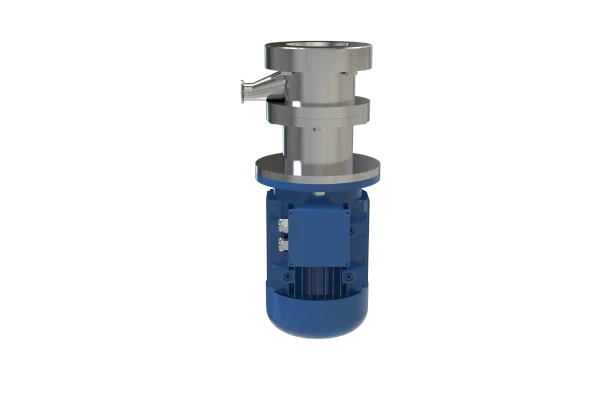
To solve this viscosity-driven stratification, engineers select between two distinct configurations based on plumbing requirements. For setups requiring auxiliary pumping head and external loop integration, the Bottom Entry Inline Mixer ( BOFRD-1 ) draws the thick phase through its localized chamber and drives it through a recirculating pipeline back to the upper dome. This configuration develops a continuous discharge pressure ranging from 0.03 to 0.40 MPa, effectively moving high-viscosity mediums.
Conversely, for sterile or batch operations where any product hold-up inside external plumbing must be entirely avoided, the Bottom-entry Internal Circulation Emulsifier ( BOFRD-2 ) performs the high-shear homogenizing work directly at the tank base without an external bypass. The sheared product is discharged along the internal contours of the tank bottom, creating a vertical layer turnover that forces the dense components upward. Both variations ensure that the entire batch passes through the mechanical shear gaps with equal probability, delivering a smooth cream with predictable viscosity and long-term emulsion stability.
Color Cosmetics and Liquid Foundations: Managing Pigment Agglomeration and Sedimentation
Liquid foundations, concealers, and tinted primers present a distinct processing challenge: the uniform suspension of solid mineral pigments, such as titanium dioxide and iron oxides, within a liquid vehicle. Due to their high surface energy, these fine powder pigments tend to form agglomerates during the initial wetting phase. If these clumps are not mechanically broken down, they can settle at the bottom of storage tanks or shipping containers, causing shade variations between production batches or uneven color layout upon application.
The BOFRD-2 targets these heavy particulate phases directly as they settle toward the base of the vessel. The high-speed rotor draws the pigment slurries into the stator slots, where mechanical impact and intense hydraulic shear break down agglomerates into fine, discrete particles.
Simultaneously, whether utilizing the in-situ blending dynamics of the BOFRD-2 or the continuous external loop of the BOFRD-1, the system maintains a steady fluid velocity throughout the tank. This constant movement prevents pigment sedimentation during extended compounding cycles and ensures that no impurities contaminate the raw materials, delivering uniform color distribution from the beginning of the batch to the final container fill.
Sunscreen Formulations: Optimizing UV Filter Dispersion for Consistent SPF Performance
The efficacy of modern sunscreens relies on the uniform distribution of inorganic UV filters, such as zinc oxide and titanium dioxide, or organic UV absorbers within the emulsion matrix. If these particulate filters clump together, the protective layer formed on the skin can have microscopic gaps, which may lower the overall Sun Protection Factor (SPF) and alter the product's skin feel.
The high-shear dynamics of a bottom-entry inline system provide the mechanical energy needed to wet and disperse micronized mineral particulates thoroughly. By routing the sunscreen matrix repeatedly through the precision gaps of the rotor-stator via the integrated circulation or localized turnover paths, the system breaks up particle aggregates and distributes the UV filters evenly throughout the continuous phase. This uniform dispersion helps ensure consistent SPF values across production runs while eliminating the gritty or chalky texture sometimes associated with poorly processed sunscreens.
Technical Configurations and Engineering Compliance for Cosmetic Plant Integration
Integrating high-shear bottom-entry equipment into a GMP-compliant cosmetic manufacturing line requires careful selection of mechanical components and surface treatments to match specific process chemistries:
• Hygienic Surface Metallurgy: To meet standard GMP and FDA hygiene specifications, all product-contact components are machined from high-grade AISI 304 or AISI 316L stainless steel. The machine structure is straightforward, and internal surfaces undergo mechanical mirror polishing or electrochemical sandblasting to create a smooth, crevice-free finish. This surface treatment reduces product adhesion and allows for efficient Clean-in-Place (CIP) and Sterilize-in-Place (SIP) routines at processing temperatures up to 160°C.
• Mechanical Seal Engineering: This equipment is built with high-quality components and powered by internationally recognized motor brands to ensure low noise and smooth operation. For standard water-soluble cosmetic batches, a single mechanical seal provides effective isolation. When processing volatile ingredients, alcohol-based lotions, or formulations under vacuum or positive pressure, a pressurized double mechanical seal with an integrated barrier fluid loop is recommended. Sealing friction pairs can be configured with Carbon-to-Silicon Carbide, Carbon-to-Hard Alloy, or Hard Alloy-to-Hard Alloy combinations to resist wear from abrasive mineral pigments.
• Elastomer and Process Tailoring: Static O-rings and sealing gaskets are selected based on the chemical profile of the carrier phases and surfactants, including FDA-compliant EPDM, high-temperature Silicone, or Fluororubber (FKM). Key processing metrics—such as rotor diameter, motor power, operating speed, and matching vessel capacity—can be fully customized to integrate seamlessly into existing manufacturing setups.


