


In bioreactor design, achieving adequate oxygen transfer is only part of the mixing challenge. The fermentation broth also needs to circulate effectively throughout the vessel so that oxygen, nutrients, temperature, and other process conditions remain sufficiently uniform.
Poor circulation can create areas with limited movement, sometimes referred to as dead zones. These regions may experience lower gas-liquid contact or different local process conditions than the rest of the vessel. For biopharmaceutical production, where process consistency and hygienic operation are critical, equipment selection needs to address both aeration and circulation as part of the complete system.
A bottom-mounted aerator provides one approach to this challenge. The BOAO DAWT series combines air induction, gas-liquid mixing, and mechanical dispersion at the bottom of the vessel. Its self-aspirating rotor-stator structure draws air through a dedicated air pipe and disperses it into the liquid while promoting circulation around the aeration zone.
Why Dead Zones Matter in Bioreactor Systems
A bioreactor is not simply a container for fermentation. Its geometry, mixing equipment, gas distribution, and operating conditions all influence how the liquid moves inside the vessel.
When circulation is insufficient, some regions may receive less mixing than others. Depending on the process, this can contribute to local differences in:
- Dissolved oxygen
- Nutrient concentration
- Temperature
- pH
- Gas-liquid contact
- Microbial or cell distribution
The significance of these variations depends on the particular bioprocess. Not every process requires the same mixing intensity, and a dead zone cannot be eliminated simply by increasing agitator speed.
A more useful approach is to consider where mechanical energy enters the vessel and how effectively it interacts with the working liquid.
This is where a bottom-mounted configuration can provide a different mixing arrangement.
Bringing Aeration and Mixing to the Bottom of the Vessel
The DAWT is installed at the bottom of the fermentation tank, placing the rotor-stator assembly directly in the lower region of the working liquid.
During operation, the rotor creates a low-pressure zone inside the stator. Atmospheric air is drawn through the air pipe and enters the rotor-stator area together with the liquid.
The rotating impeller then provides the mechanical energy needed to mix the two phases. As the gas-liquid mixture passes through the stator channels, the air is dispersed into fine bubbles and the mixture is discharged back into the vessel.
This creates a localized zone of intensive gas-liquid mixing at the tank bottom while contributing to overall liquid circulation.
The objective is not simply to force more air into the reactor. Instead, the equipment combines air induction, gas dispersion, and liquid movement within the same assembly.
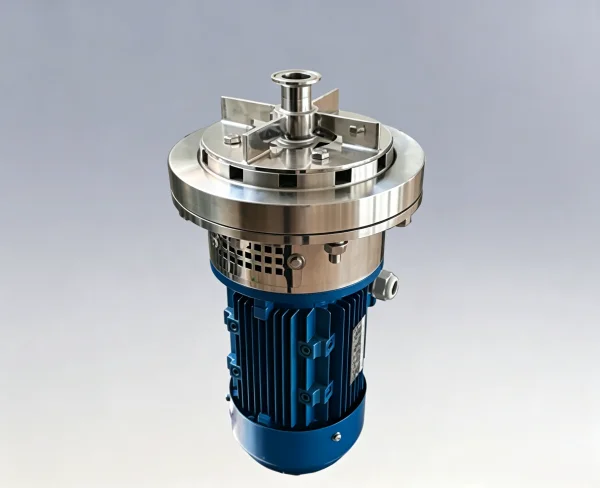
Self-Aspiration Reduces Dependence on a Separate Gas-Mixing Device
A defining feature of the DAWT is its self-aspirating principle.
The rotating rotor generates the pressure conditions required to draw atmospheric air through the dedicated air pipe. This means the aerator itself performs the initial gas induction rather than relying on a passive submerged diffuser to distribute externally supplied air.
The gas and liquid meet in the rotor-stator assembly, where mechanical energy is used to disperse the air before it enters the surrounding liquid.
For bioreactor system designers, this integrated configuration can simplify the way aeration and mixing are incorporated into the vessel.
It does not eliminate the need for an appropriately designed air supply, filtration, control, or other supporting equipment where these are required. Instead, it provides a combined gas-liquid mixing point within the reactor.
Fine Bubble Dispersion Supports Gas-Liquid Contact
Dead zones and oxygen-transfer limitations are often connected to the way gas and liquid interact.
If air passes rapidly through a liquid in relatively large bubbles, the available gas-liquid interface can be limited. The DAWT rotor-stator assembly is designed to disperse incoming air into finer bubbles, with the product information specifying a typical bubble diameter of approximately 100 μm.
A greater gas-liquid interfacial area can support oxygen transfer when the process requires it.
However, bubble size should not be considered independently. Actual oxygen-transfer performance is influenced by broth properties, gas flow, rotor speed, vessel geometry, temperature, dissolved oxygen demand, and other operating conditions.
For this reason, the DAWT should be selected as part of the complete bioreactor design rather than based on bubble size alone.
Bottom-Mounted Aeration in Biopharmaceutical Systems
Biopharmaceutical processes can include fermentation, cell cultivation, media preparation, and other liquid-handling stages with very different mixing requirements.
For aerobic microbial fermentation, oxygen transfer may be a major process consideration. In such applications, the DAWT can combine oxygen introduction with mechanical gas-liquid mixing.
For other bioprocesses, particularly those involving sensitive biological materials, aeration intensity and mechanical stress need to be evaluated carefully. A bottom-mounted aerator should only be used where the process actually requires gas-liquid contact and the selected operating conditions are compatible with the biological system.
This process-specific approach is important because more aeration does not automatically mean better bioprocess performance.
Designing Around the Complete Bioreactor
The ability of any aerator to reduce poorly mixed regions depends on the complete vessel configuration.
Important factors include:
- Tank diameter and liquid height
- Working volume
- Fermentation broth characteristics
- Rotor and stator configuration
- Operating speed
- Air demand
- Existing agitation equipment
- Temperature-control arrangement
- Internal vessel geometry
A bottom-mounted aerator can provide a strong mixing source at the lower section of the vessel, but the resulting circulation pattern should be evaluated against the actual tank design.
For larger or more complex bioreactors, the aerator may also need to work together with other mixing equipment rather than being treated as the sole source of circulation.
Hygienic Construction for Integrated Bioprocess Equipment
For biopharmaceutical equipment, mixing performance is only one part of the equipment specification. Hygienic construction, material compatibility, and cleaning requirements also need to be considered.
BOAO DAWT aerators are available in 304 or 316L stainless steel, with electropolishing available as an option. Seal materials can include EPDM, silicone rubber, and fluororubber according to the application requirements.
When the aerator is incorporated into a complete bioreactor, these choices should be evaluated together with the vessel material, cleaning method, process chemistry, temperature range, and overall hygienic design.
The aerator therefore becomes part of the broader equipment solution rather than an isolated component.
From Local Mixing to More Consistent Process Conditions
The purpose of eliminating dead zones is not simply to create more movement inside the vessel. The larger objective is to provide a more consistent process environment.
When gas and liquid are distributed effectively, the bioreactor can maintain more uniform conditions where the process requires them. This can support better control of dissolved oxygen and other critical process variables.
The DAWT contributes to this objective by placing gas-liquid mixing at the tank bottom and combining self-aspiration with mechanical dispersion.
It should be emphasized that the aerator itself does not guarantee the elimination of all dead zones. Vessel geometry, operating conditions, and the overall mixing system determine the actual circulation pattern. Engineering evaluation is therefore essential when applying the technology to a specific bioreactor.
Building a Complete Biopharmaceutical Aeration Solution
For biopharmaceutical equipment manufacturers, the value of a bottom-mounted aerator lies in how it integrates several process functions within the same unit.
The DAWT provides:
self-aspirating air induction → rotor-stator gas-liquid mixing → fine bubble dispersion → liquid circulation
This integrated approach can be incorporated into complete fermentation and bioreactor systems where controlled aeration and mixing are required.
The equipment can be configured with different construction materials, sealing options, surface treatments, and motor arrangements according to the application.
Ultimately, reducing poorly mixed areas is a system-design objective rather than a single-equipment claim. The bottom-mounted aerator provides one important tool for achieving that objective by combining aeration and mechanical mixing at the lower section of the vessel.
For biopharmaceutical manufacturers, the appropriate solution should be determined from the actual process requirements, vessel geometry, biological characteristics, cleaning strategy, and desired operating conditions.


