


A production problem often appears after formulation is complete: the product is ready to leave the mixing vessel, but it does not behave like an ordinary liquid. Toothpaste can resist movement because of its high viscosity and structured formulation. Clay masks can become even more difficult to transfer when mineral or clay ingredients create a dense paste with limited flowability. If the transfer system is designed as though these products were low viscosity liquids, unstable feeding, pressure fluctuations, line blockage, or filling interruptions can follow.
For thick personal care products, reliable pumping starts with understanding why the material becomes difficult to move.
When a Cosmetic Formula Stops Behaving Like a Liquid
Toothpaste is a structured product rather than a simple homogeneous liquid. Its viscosity, fine solid content, and formulation structure affect how readily it leaves a vessel and enters a transfer line. The product may move slowly after standing, while narrow passages can create additional resistance.
Clay masks present a different challenge. Clay, mineral powders, pigments, and other functional ingredients can produce a concentrated paste that does not readily level or flow under gravity. After a production pause, material near an outlet may be particularly difficult to mobilize. The issue is therefore not viscosity alone. Solids concentration, product structure, residence time, and the condition of the suction side all influence transfer behavior.
Clogging Often Starts Before the Pump
When a thick paste fails to reach a pump, replacing the pump is not necessarily the first answer. The suction inlet may be too restrictive, the pipe may be undersized, or several elbows and valves may create excessive resistance. A poorly positioned vessel outlet can also leave a layer of settled or poorly flowing material around the inlet.
For toothpaste and clay masks, the section between the process vessel and pump deserves close attention. Shorter suction paths, suitable pipe dimensions, practical valve arrangements, and an inlet that remains properly fed can reduce the risk of starving the pump. A pump cannot continuously compensate for a product that cannot reach its inlet.
Toothpaste and Clay Masks Need Different Transfer Thinking
Toothpaste transfer is closely connected with filling consistency. Excessive mechanical action or unstable flow can make downstream filling more difficult, particularly when the product must arrive at a predictable rate. A controlled transfer rate can help the filling stage receive a more consistent supply.
Clay masks require greater attention to solids distribution and flow after periods of standing. The pump must receive material rather than air or a partially settled layer. Pipeline design should also consider residual product because thick pastes can remain in low points, fittings, or poorly drained sections.
Why Positive Displacement Changes the Transfer Equation
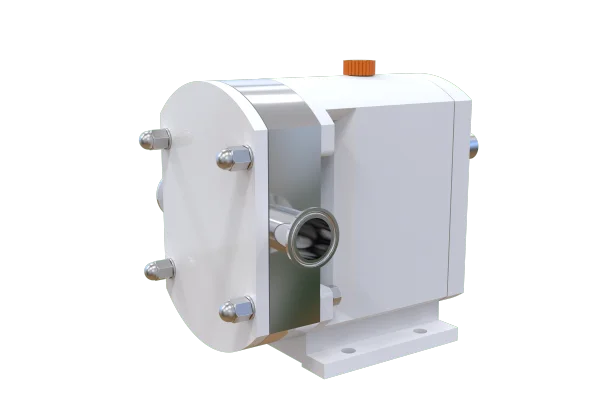
A rotary lobe pump uses rotating lobes to move a defined volume of product with each operating cycle. Unlike a centrifugal pump, which depends strongly on fluid velocity and pressure conditions, a positive displacement pump is well suited to moving viscous products through a controlled transfer process.
This operating principle is useful when toothpaste, clay masks, creams, gels, and other formulated pastes resist ordinary liquid handling methods. The supplied rotary lobe pump range can handle material viscosities from 0.2 to 100,000 cP, with actual selection depending on the product and operating conditions. The pump can also be paired with frequency converter speed control or mechanical speed adjustment when the process requires changes in transfer rate.
Keeping the Pump Fed When the Product Barely Flows
A high viscosity rating does not automatically mean that a pump will receive product reliably. The feeding arrangement on the inlet side can be decisive.
For high concentration and poorly flowing paste-like materials, a top mounted feed hopper can provide a practical way to improve product entry into the pumping area. This configuration is particularly relevant when gravity alone does not provide stable feeding from the main vessel. For production environments where the equipment location changes, a mobile installation can also be considered when compatible with the process layout.
The objective is simple: the pump should be supplied with a continuous body of product instead of repeatedly pulling against an empty or poorly fed inlet.
The Transfer Line Can Decide Whether a Good Pump Works Well
Once the product enters the pump, the discharge line introduces another set of conditions. Thick pastes experience greater resistance in long or narrow pipelines, especially when the route contains multiple direction changes or restrictive fittings. These effects can become more significant as viscosity rises.
Installation orientation also matters. The supplied pump configuration can support top inlet and bottom outlet arrangements or horizontal inlet and outlet arrangements, allowing the transfer layout to be adapted to the production line. Sanitary clamp, threaded, flange, DIN union, and welded connections are available according to the required process interface.
What Happens When You Simply Increase Pump Speed
Increasing speed may appear to be an easy response when a filling line is not receiving enough product. It is not always the correct response. If the suction side cannot supply material at the required rate, increasing pump speed can leave the real bottleneck unchanged.
Speed control is more useful when it is treated as a process variable. A frequency converter can provide adjustable operation so the pump output can be matched to formulation behavior and downstream demand. This approach is especially useful when one production line handles products with different viscosities or filling requirements.
From Mixing Vessel to Filling Machine
A typical thick paste process begins with formulation and mixing in a production vessel. Once the product reaches the required condition, it must be transferred to a holding vessel or directly toward the filling stage. The rotary lobe pump becomes the controlled transfer point between these operations.
For toothpaste, the priority is a steady supply of formulated paste to filling equipment. For clay masks, the transfer arrangement must also maintain dependable feeding of a concentrated product containing fine mineral ingredients. In both cases, sanitary construction is important because the equipment forms part of a product contact path. The supplied pump range uses 304 or 316L stainless steel pump bodies and can be configured with single or double mechanical seals and different seal materials according to the process.
A Thick Paste Transfer System Is More Than a Pump
The most useful way to evaluate toothpaste or clay mask pumping is to look beyond the viscosity number. Product structure, solids content, time at rest, vessel outlet conditions, suction piping, transfer distance, filling demand, and speed control all interact.
A rotary lobe pump provides the positive displacement mechanism needed for viscous product transfer, but stable operation depends on the complete path into and out of the pump. When the suction side is properly fed and the transfer line is designed around the actual formulation, thick personal care products can move from formulation vessels to filling operations with less risk of interruption.
For manufacturers dealing with especially dense toothpaste or clay based masks, the engineering question is therefore not simply whether the pump can handle high viscosity. It is whether the entire transfer route allows that specific paste to reach, pass through, and leave the pump consistently.


