


At the end of a fermentation batch, getting the product out of the vessel is only part of the job. The transfer line, pump, valves, and downstream equipment also need to be cleared before the system moves into cleaning.
This is where drainability becomes a practical equipment issue rather than a specification on a datasheet. If product remains in pockets inside the transfer route, the next cleaning cycle has more material to remove. In sterile processing, that can make changeover more demanding and place greater importance on the design of every product-contacting component.
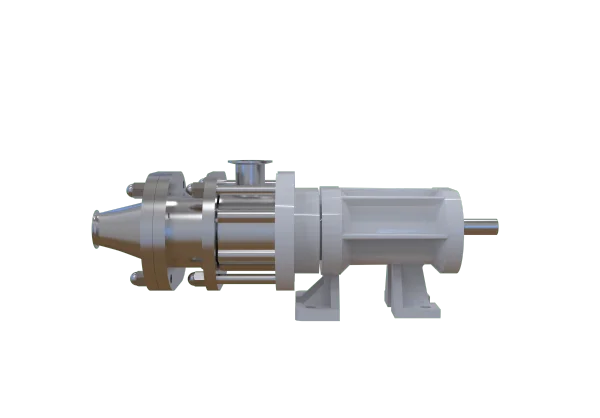
A sanitary twin-screw pump can be designed into this part of the fermentation system with the internal flow path, product discharge, reverse operation, and CIP/SIP cycle considered together.
The End of the Batch Is Where Drainability Gets Tested
During production, the pump is primarily expected to move fermentation media or process liquid at the required rate. Once the batch is finished, the priorities change.
The remaining product needs to leave the transfer route before cleaning begins. A small amount of retained material may be particularly relevant when the next batch uses a different formulation or when the fermentation process requires strict hygienic control between cycles.
For the pump itself, this means avoiding unnecessary recesses or dead areas in the product-contacting passage. The SLGP is designed with a flow passage without dead corners, giving the pump a structure that supports product discharge and subsequent cleaning.
That is one reason drainability should be considered when the pump is selected—not added as an afterthought once the rest of the fermentation system has already been designed.
What Happens Inside the Pump During Transfer
The SLGP does not depend on an impeller throwing the liquid outward. Two screws rotate inside the pump chamber and form enclosed cavities that move the product continuously from the suction side to the discharge side.
The screws do not contact the pump housing. As a result, there is no metal-to-metal contact between the rotating screws and casing during normal operation.
For fermentation equipment, this arrangement provides a continuous positive-displacement transfer mechanism while leaving the internal flow path open to the cleaning cycle. The same product-contacting surfaces used during production can subsequently be exposed to cleaning media.
The distinction is important: drainability is not simply about how quickly a pump can move liquid. It also concerns what remains inside the pump when normal product transfer has ended.
Emptying the Transfer Route Before Cleaning
A fermentation system rarely ends at the pump outlet. The pump may connect the fermenter to holding vessels, filtration equipment, filling equipment, or another processing stage.
When the product transfer is complete, some material can remain in the connected line. The ability to reverse the pump can provide another option for dealing with this residual product.
The SLGP supports forward and reverse operation by changing shaft rotation. The pumping direction can therefore be changed without modifying the pump itself.
Depending on the piping arrangement, reverse operation can be incorporated into product recovery or line-emptying procedures. The pump can move material back toward a designated vessel instead of leaving the final section of the transfer route dependent entirely on gravity.
This is particularly useful when designing a complete fermentation installation, because the pump's reversible function can be considered alongside the routing of the process piping.
A Pump That Stays in the Cleaning Circuit
Once product has been removed, the system moves into cleaning. A separate CIP pump is often used in conventional arrangements, but that also means additional piping, valves, installation space, and equipment interfaces.
The SLGP can be used for both product transfer and CIP/SIP circulation. Where the process layout permits, the same pump can remain in the cleaning loop instead of being bypassed.
The cleaning medium passes through the pump's internal flow passages, including the areas that were in contact with the fermentation product. This gives the equipment designer a simpler way to incorporate the pump into the overall cleaning route.
The SLGP is designed for cleaning temperatures up to 140°C and can handle media temperatures up to 130°C. The applicable temperature limits should always be considered together with the selected seal arrangement and actual process conditions.
Why Dead-Corner-Free Construction Matters
The phrase “easy to clean” is often used broadly in equipment descriptions. For a fermentation system, the more useful question is what happens to the product-contacting surfaces when cleaning starts.
The SLGP's internal flow passage has no dead corners. This reduces the number of geometrical areas where product can remain isolated from the normal flow path.
That does not mean the pump alone guarantees complete drainage of an entire installation. Pipe orientation, valve design, connections, tank outlets, and the position of the equipment all affect the final result.
Instead, the pump should be treated as one part of a drainable product-contacting system. Its internal geometry needs to work with the rest of the installation rather than against it.
Keeping Cleaning and Production in the Same Equipment
Another consideration is the operating range required from a pump that handles both production and cleaning duties.
During fermentation transfer, the required speed may be relatively low or may change according to the process stage. During cleaning, the operating conditions can be different.
The SLGP provides a speed range of 100 to 3,600 rpm. Different pump body and screw sizes are also available, allowing the pump configuration to be matched to the intended duty.
This gives the equipment designer more freedom to use one pump across different stages of the process rather than treating production transfer and cleaning as completely separate equipment functions.
The pump can also be supplied with different shaft seal configurations, including single mechanical seals, double mechanical seals, rubber shaft seals, and packing seals, depending on the application.
From Fermenter Outlet to a Clean Process Line
A drainable pump only makes sense when the surrounding equipment follows the same principle.
For example, a fermentation system may include a vessel outlet, transfer pump, valves, elbows, sampling points, and downstream equipment. Any one of these components can influence how much product remains after the batch.
For that reason, the pump should be positioned and connected with the complete transfer route in mind. The goal is to give the product a clear path out of the process and give the cleaning medium access to the same product-contacting route afterward.
The SLGP supports this approach through its dead-corner-free flow passage, reversible pumping direction, and ability to participate in CIP/SIP circulation.
A Practical Design Consideration for Batch Changeover
For sterile fermentation equipment, drainability has a direct connection with what happens between batches.
A well-designed system should not rely on the cleaning cycle to compensate for unnecessary product retention. First, the product should be transferred out as completely as the overall equipment layout allows. The remaining product-contacting surfaces can then be exposed to the planned cleaning and sterilization procedure.
This is why pump selection should be made together with the process piping and cleaning strategy. Looking only at flow rate or pressure can miss an important part of the equipment's day-to-day operation.
The sanitary twin-screw pump provides several features that can support this approach: a dead-corner-free flow passage, non-contacting screws, reversible operation, adjustable speed, and suitability for CIP/SIP circulation.
For sterile fermentation systems, these features are most useful when they are incorporated into the equipment layout from the beginning. The pump does not create drainability on its own; rather, it becomes part of a transfer system designed to empty, clean, and prepare the process line for the next batch with as little retained product as practical.


