


Oral liquid manufacturing can involve materials that are far more difficult to transfer than their appearance suggests. Concentrated syrups, medicated pastes, suspensions, and other high-viscosity formulations can place greater demands on the transfer system, particularly when viscosity changes with temperature, concentration, or formulation conditions.
For pharmaceutical equipment engineers, the challenge is not simply moving a thick product from one vessel to another. The pump must work reliably within a hygienic process, maintain controlled product movement, accommodate different operating conditions, and support cleaning between production batches. A sanitary twin-screw pump can address these requirements while serving as part of a complete oral liquid processing system.
Why High-Viscosity Oral Liquids Require a Different Transfer Approach
Low-viscosity oral liquids can often be transferred with conventional centrifugal pumping equipment. As viscosity rises, however, the operating conditions change significantly. The material becomes more resistant to movement through pipes and equipment, while suction conditions become increasingly important.
Thick syrups and medicated pastes may also need to pass through several stages of production, including formulation, intermediate holding, transfer, filtration or processing, and filling. A pump selected only for a nominal flow rate may therefore perform differently when the product concentration or temperature changes.
This is where positive-displacement pumping becomes valuable. Instead of depending primarily on velocity generated by an impeller, a twin-screw pump moves the product through enclosed cavities formed by two rotating screws. The continuous axial movement provides a controlled transfer path that is well suited to viscous pharmaceutical materials.
Building the Transfer Section Around the Product
In an oral liquid production line, the transfer pump should be considered together with tanks, pipelines, valves, heating arrangements, filling equipment, and cleaning circuits. The objective is to create a transfer section that can handle the product without introducing unnecessary restrictions into the process.
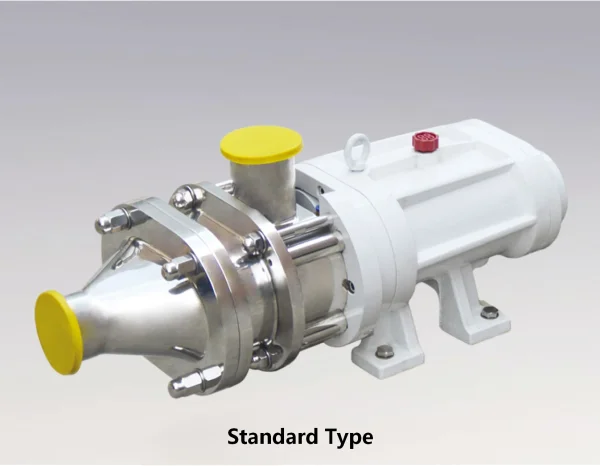
The SLGP sanitary twin-screw pump uses two non-contacting screws to form sealed cavities inside the pump body. As the screws rotate, these cavities carry the medium from the inlet toward the discharge side. Because the screws do not make metal-to-metal contact with the pump housing, the pump can also be applied to non-lubricating media and materials containing impurities.
For high-viscosity oral liquid systems, this structure provides flexibility when the formulation does not behave like a simple low-viscosity liquid. The pump can be configured with different pump body and screw sizes, allowing the transfer section to be matched more closely to the required operating conditions.
Managing Thick Syrups Without Making the System Overly Complex
Concentrated syrups can become substantially more difficult to transfer as their solids content and viscosity increase. Pipeline resistance becomes more significant, and the pump must maintain stable product movement while working against the pressure of the downstream system.
The wide speed range of the SLGP, from 100 to 3,600 rpm, provides an operating range for adjusting transfer according to process requirements. Different screw configurations can also produce different flow rates under the same viscosity, pressure, and speed conditions.
This flexibility is useful when one oral liquid production line handles more than one formulation. Instead of designing the entire transfer section around a single fixed operating point, the pump can be selected and configured according to the characteristics of the products being processed.
When Medicated Pastes Change the Pumping Requirement
Medicated pastes introduce another challenge. Their high viscosity can make suction feeding and continuous transfer more demanding than conventional liquid handling. In these conditions, a pump needs sufficient self-priming capability as well as the ability to accommodate significant viscosity changes.
The SLGP can provide a vacuum level of up to 0.8 bar when the pump chamber contains product, supporting self-priming during product transfer. Its positive-displacement operating principle allows the material to be continuously conveyed through the enclosed pumping chamber rather than relying on high-speed impeller action.
For pharmaceutical equipment designers, this can simplify the connection between a product tank and downstream processing equipment, particularly where the formulation has limited flowability.
One Pump for Product Transfer and Hygienic Cleaning
An oral liquid system must be designed around more than production transfer. Cleaning between batches is an equally important part of equipment operation.
The SLGP is designed with a flow passage without dead corners, supporting hygienic cleaning and meeting GMP, 3-A, and FDA requirements. Its wide operating range also allows the same pump to participate in both product transfer and CIP/SIP cleaning operations.
The practical advantage is system simplification. Instead of installing a separate CIP pump with additional piping and valves, the same pump can be used for both production transfer and the cleaning circulation process where the system design permits it.
During cleaning, the cleaning medium passes through the internal flow passages of the pump. This allows the pump to form part of the overall CIP/SIP circulation route rather than remaining outside the cleaning circuit.
For complete oral liquid equipment, this approach can reduce the number of dedicated components and help conserve installation space.
Reversible Transfer for More Flexible Pharmaceutical Systems
Another useful feature for oral liquid equipment is reversible pumping.
The SLGP can change pumping direction simply by changing shaft rotation. The inlet and outlet functions are therefore exchanged without requiring mechanical modification to other pump components.
This capability can be useful in a complete transfer system where product movement and cleaning circulation require different flow directions. It can also support product recovery from sections of the process line, depending on the overall piping arrangement.
Rather than treating forward and reverse pumping as an isolated pump feature, equipment designers can incorporate it into the layout of tanks, pipelines, and cleaning circuits.
Designing for Different Pharmaceutical Operating Conditions
Oral liquid formulations do not always remain at the same viscosity throughout processing. Temperature, concentration, formulation stage, and product composition can all affect how the material behaves inside the transfer system.
The SLGP is available in standard and jacketed configurations. The jacketed option can be considered where temperature management is part of the transfer requirement. The pump supports media temperatures up to 130°C and cleaning temperatures up to 140°C, subject to the applicable equipment configuration and process conditions.
A broad viscosity range, up to 500,000 cSt, also provides flexibility for systems handling both relatively fluid oral liquids and substantially thicker pharmaceutical formulations.
The objective is not to use one pump for every possible product, but to select the appropriate pump configuration so that the transfer equipment remains compatible with the actual formulation and operating window.
A Transfer Solution for Complete Oral Liquid Equipment
High-viscosity syrups and medicated pastes demonstrate why pharmaceutical fluid handling cannot be separated from overall equipment design. Pump selection affects suction conditions, pipeline resistance, transfer control, cleaning arrangements, and the number of components required in the system.
A sanitary twin-screw pump provides a combination of positive-displacement transfer, wide speed control, reversible operation, self-priming capability, and hygienic flow-path design. With configurable pump bodies and screw sizes, the SLGP can be incorporated into oral liquid production systems handling different viscosity and process requirements.
For equipment manufacturers and pharmaceutical processors, the key is to design the pump as part of the complete transfer and cleaning architecture—not simply as a standalone machine. When the pump, piping, tanks, filling equipment, and CIP/SIP circulation are considered together, high-viscosity oral liquid handling can become a more manageable part of the overall pharmaceutical production system.


