


In the modern food, beverage, and dairy processing industries, fluid handling networks are continuously subjected to complex, multi-phase operational challenges. Production lines often require the rapid transfer of highly aerated liquids, high-viscosity ingredient matrices, and aggressive chemical foams under variable pressure constraints. Standard sanitary centrifugal pumps fail under these conditions due to air-binding, mechanical fatigue, and systemic pressure drops, leading to line stoppages and product batch failures.
Resolving these volatile multi-phase issues requires a comprehensive equipment strategy that treats the pump not merely as a standalone component, but as an engineered system. The BOZPY series sanitary self-priming pump functions as an advanced solution for complex process fluidics. By optimizing fluid mechanical behaviors, materials science, and automated system integration, this technology provides plant operators with a reliable method to stabilize processing runs, maximize production yield, and ensure total microbiological food safety.
The Engineering Challenge: Analyzing Complex Fluid Conditions
Modern food process lines rarely transport homogeneous, air-free liquids. Instead, system designers must engineer piping networks capable of handling volatile fluid dynamics without destabilizing the system. The primary technical vulnerability in standard food piping networks is managing multi-phase fluid flows where gases or atmospheric air become entrained in the liquid stream. This condition occurs frequently during rapid tank bottom scavenging, line clearing, pumping carbonated beverages, or transferring fermenting yeast sediments.
When standard centrifugal pumps encounter these gas-liquid mixtures, the lighter gas pockets separate from the liquid and pool at the center of the impeller eye. This blocks the fluid path, causes an immediate loss of discharge pressure, and leads to air-binding, which stalls fluid movement entirely.
The BOZPY sanitary self-priming pump resolves this processing crisis through its specialized liquid-ring hydraulic design. The internal pump casing features an engineered separation chamber that maintains a residual liquid reservoir even when the system is shut down. Upon startup, the rotating impeller mixes this liquid with the entrained air drawn from the suction piping, creating a temporary gas-liquid emulsion.
Internal geometric structures then isolate the gas, venting it through the discharge line while returning the denser liquid to continue the priming loop. This automated priming cycle generates a powerful continuous vacuum, allowing the pump to draw fluids from liquid levels located well below the pump inlet and handle highly aerated liquids without binding.
Turnkey System Architecture and Skid Integration
In large-scale food manufacturing, individual pumps must be integrated into automated, modular skids to maximize processing efficiency and maintain consistent batch control. The most critical systems-level application for the BOZPY pump is serving as the core return mechanism within automated Clean-In-Place systems.
During a cleaning cycle, high-temperature chemical detergents are sprayed into process vessels via rotating spray balls. The return pump must evacuate this spent liquid from the vessel floor at a rate that matches or exceeds the forward inlet spray feed. Because this scavenging process draws a massive volume of air and chemical foam into the suction line, standard pumps instantly air-bind. This causes hot caustic or acid solutions to pool at the bottom of the process tank, which cushions the floor, reduces the physical impact of the spray wash, and drops the chemical temperature below critical sterilization thresholds.
The BOZPY CIP return pump solves this processing bottleneck. It handles high gas-to-liquid ratios smoothly, ensuring continuous evacuation of the air-heavy chemical foam. By keeping the tank floor dry, the BOZPY system allows chemical sprays to strike internal walls with full mechanical force, ensuring absolute sterility and reducing total water and chemical usage by preventing unnecessary cleaning cycle overruns.
For bulk ingredient receipt blocks, such as tank truck unloading stations for raw milk, liquid sugar, or fruit juice concentrates, the BOZPY series is integrated into mobile or stationary material recovery skids. Equipped with automated linear positioners and flow sensors, these skids adjust motor speeds via Variable Frequency Drives to match changing line pressures. As the delivery tank empties and air enters the line, the BOZPY pump maintains a steady suction vacuum, recovering valuable raw material down to the final drop without requiring manual line clearing or external priming mechanisms.
Integrated Process Equipment Selection Logic
Selecting and configuring the proper BOZPY pump skid requires precise matching of motor capacities, flow performance, and physical line footprints to the processing facility's layout. Rather than relying on rigid static configurations, engineers evaluate selection through dynamic operational variables. Power ratings for the BOZPY series scale from entry-level configurations of one point one kilowatts and one point five kilowatts, designed for compact lines with twenty-five to thirty-two millimeter pipe diameters, up to high-capacity industrial variants of eleven kilowatts and fifteen kilowatts for large eighty to one hundred millimeter process loops.
The full-load current draw must be synchronized with the plant’s standard three-hundred-and-eighty-volt electrical infrastructure to prevent regional power grid overloads during frequent motor startups. When sizing the suction and discharge ports, engineers balance line velocities against friction losses. For smaller models like the BOZP3-140 or BOZP5-150, nominal pipe diameters are kept tighter to preserve high velocity for self-priming lift.
For high-capacity models like the BOZP50-192, larger diameters are critical to accommodate the intense multi-phase volumes generated during massive industrial vessel flushings. The engineering goal is to ensure the return velocity within the discharge line remains high enough to prevent fluid fallback, keeping the dynamic system loop completely balanced.
Material Engineering and Mechanical Configurations for Extreme Environments
Food processing skids operate under demanding mechanical, chemical, and thermal conditions, requiring heavy-duty material selections and automated safety enclosures. To prevent chemical corrosion from acidic food matrices and aggressive CIP chemicals, all wetted components within the BOZPY pump assembly—including the shell, casing cover, and impeller—are fabricated from forged 304 or 316L stainless steel. The low-carbon content prevents intergranular corrosion during manufacturing welds, while the added molybdenum in 316L steel prevents surface pitting from hot nitric acid or sodium hydroxide flushes.
The internal wetted chambers undergo intensive polishing to achieve an ultra-smooth internal surface roughness profile of Ra less than or equal to zero point twenty-eight micrometers. This mirror finish eliminates microscopic pits where bacteria or biofilms could form, ensuring thorough sanitization during automated chemical rinses.
The dynamic and static seals deployed inside the BOZPY pump housing must be non-toxic, non-leaching, and fully compliant with global food safety standards. Depending on the process chemistry, skids can be configured with specialized compounds. Food-grade EPDM is the standard choice for aqueous fluid processing, offering high resistance to hot water, steam, and polar CIP chemicals.
Alternatively, FKM is mandatory for lines processing high-fat matrices, animal lipids, vegetable oils, or high-proof alcohols at elevated temperatures, preventing seal swelling and downstream particle contamination. The structural engineering of the BOZPY series accommodates extreme thermal cycling, maintaining full operational tolerances from cold fluid handling at minus ten degrees Celsius up to steam sterilization at one hundred and forty degrees Celsius during automated Steam-In-Place cycles without experiencing mechanical warping or seal displacement.
In processing environments where volatile vapors are present, such as alcohol distillation plants and spirit blending facilities, standard electrical motors pose a serious ignition hazard. To ensure full facility compliance, the BOZPY series is configured with certified explosion-proof motors that safely isolate internal electrical arcs.
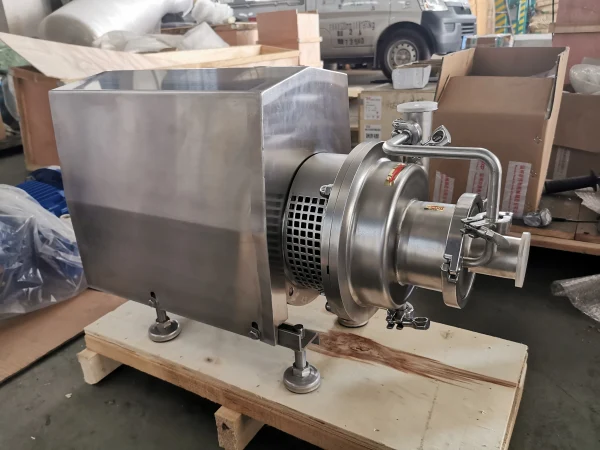
Furthermore, the entire motor assembly is enclosed within a heavy-duty stainless steel protective shroud featuring a brushed matte finish. This enclosure protects electrical components from high-pressure water jets during daily washdowns and prevents dust and moisture accumulation on the cooling fins, maximizing equipment lifespan in humid production environments.
Automated Controls and Piping Layout Optimization
Achieving maximum performance from a BOZPY self-priming skid requires careful optimization of the surrounding piping network and control infrastructure. Modern food plants rely on advanced automation to monitor process flows. BOZPY pump modules are designed to integrate with centralized Distributed Control Systems via digital industrial communication positioners. By monitoring real-time motor current draw, suction pressure, and temperature spikes, the centralized control system can dynamically adjust the Variable Frequency Drive to optimize pump performance during transitions between high-density fluid transfer and high-airflow CIP scavenging phases.
To prevent cavitation and maximize the self-priming lift of the BOZPY series, system engineers adhere to strict piping design rules. Suction lines must be kept as short as possible, with minimal horizontal distances to reduce frictional head losses, ensuring the pump can pull its target continuous vacuum efficiently. Unnecessary ninety-degree bends close to the pump inlet must be avoided to prevent fluid separation and turbulent flow before the liquid enters the impeller eye.
Finally, the volumetric capacity of the return pump must always be sized twenty percent to thirty percent higher than the forward supply feed pump to accommodate the volume expansion that occurs when air becomes entrained in the cleaning solution, ensuring the process system achieves total volumetric balance.


