


What Makes Luxury Cream Production So Demanding?
A luxury face cream should feel consistent from the first application to the last. It should spread smoothly, maintain its intended body, and leave no unexpected greasy patches, graininess, or visible separation. These qualities depend not only on the formulation but also on how the ingredients are incorporated and how the emulsion develops during processing.
A typical cream may contain purified water, plant oils, emollients, emulsifiers, fatty alcohols, thickeners, and functional ingredients. Each component contributes differently to the finished product. Oils provide richness and softness, emulsifiers help stabilize the oil-water interface, and structuring agents influence viscosity and the way the cream feels on the skin.
The difficulty is that these ingredients do not automatically form a uniform product when combined. The oil and water phases must be brought together under suitable conditions, while mixing needs to remain effective as the formulation changes from a relatively fluid mixture into a thicker cream.
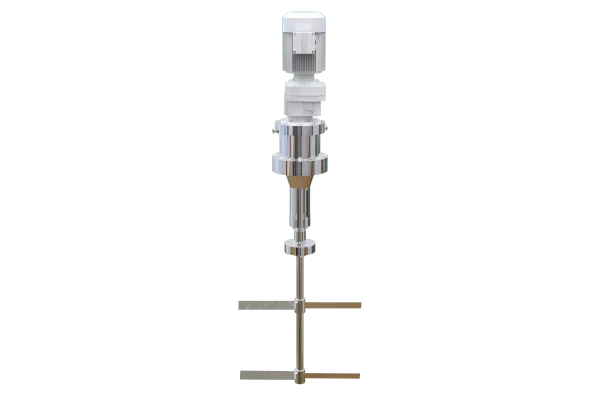
This is where a top-drive magnetic agitator becomes valuable. Its role is to maintain effective circulation inside the vessel and help distribute the ingredients throughout the batch. In premium cosmetic production, that circulation supports a more controlled manufacturing process, particularly when consistency of texture and appearance is commercially important.
Bringing Oil and Water Together Without Uneven Distribution
The oil phase and water phase are commonly prepared separately before being combined. Depending on the formulation, the oil phase may contain oils, waxes, fatty alcohols, and oil-soluble emulsifiers, while the water phase carries water-soluble ingredients and other functional components.
When the two phases meet, mixing must distribute one phase through the other sufficiently for the emulsification process to proceed. If circulation is weak, the incoming material may remain concentrated around the addition point. The resulting local differences in composition can make it harder to achieve a consistent batch.
A top-drive magnetic agitator creates circulation through the vessel, helping move the phases away from the addition area and into the surrounding liquid. Impeller design, rotational speed, and position within the tank all influence how effectively the material circulates.
The aim is not simply to make the liquid move quickly. It is to achieve a mixing pattern that suits the vessel and formulation, allowing the phases to combine evenly without introducing unnecessary air.
For creams requiring very fine droplets, bulk agitation can be paired with a high-shear emulsifier or homogenizer. The agitator supports circulation and phase distribution, while the high-shear stage provides the localized energy needed to reduce droplet size. Together, these operations help establish the emulsion structure on which the finished cream's appearance and texture depend.
Controlling Texture as the Emulsion Cools
A cream does not reach its final consistency immediately after the oil and water phases have been combined. Its texture continues to develop as the batch cools.
During heating, waxes and fatty alcohols may melt and disperse into the formulation. After emulsification, cooling changes the physical state of these ingredients and can promote the formation of a structured internal network. This contributes to the cream's thickness, body, and spreadability.
Mixing during this stage requires attention. If circulation becomes inadequate as viscosity increases, material near the vessel wall or in less active regions may not follow the same temperature and mixing history as the rest of the batch. This can contribute to variations in consistency or the appearance of the finished product.
A top-drive magnetic agitator supports continued bulk movement during this transition. The operating speed can be adjusted to suit the changing viscosity and the formulation's sensitivity to agitation. The objective is to keep the batch moving effectively while allowing the intended cream structure to develop.
This is particularly relevant to rich night creams, nourishing moisturizers, and barrier creams, where the final body of the product is a defining characteristic. The mixing process must support uniformity without unnecessarily disrupting the structure being formed during cooling.
For manufacturers, evaluating the mixing stage only while the emulsion is hot can give an incomplete picture. The later cooling stage is equally important when determining whether the agitator can handle the complete production cycle.
A Sealed Magnetic Drive for Cleaner Cosmetic Manufacturing
The quality of a luxury cream depends on the formulation, but the equipment used to process it also influences how the manufacturing environment is managed.
Traditional top-entry agitators commonly use a rotating shaft that passes through the vessel boundary. This arrangement relies on a mechanical shaft seal to control the interface between the rotating shaft and the vessel. Over time, seal wear and maintenance can create additional demands for production and equipment cleaning.
A top-drive magnetic agitator transfers torque through magnetic coupling. The external drive rotates an outer magnet assembly, which transmits torque magnetically to the internal rotating assembly. The product-contact mixing components operate inside the vessel without requiring a conventional rotating drive shaft to pass through the vessel boundary.
This arrangement removes the conventional dynamic shaft seal from the drive interface and reduces one potential route for leakage. For cosmetic manufacturers processing high-value oils, fragrances, and specialty ingredients, that can simplify contamination-control considerations around the agitator drive.
The sealed drive arrangement is also relevant when equipment is cleaned between different formulations. Premium cosmetic facilities may alternate between products with different fragrances, colors, oils, and active ingredients. Reducing the number of exposed mechanical interfaces at the agitator drive can support a cleaner equipment design and more straightforward maintenance planning.
The benefit is practical: fewer concerns associated with a conventional rotating shaft seal, alongside a mixing arrangement suited to controlled cosmetic processing.
Incorporating Active Ingredients Without Compromising the Batch
Not every ingredient is added at the beginning of cream production. Some fragrances, botanical extracts, preservatives, and temperature-sensitive functional ingredients are introduced after the main emulsification or during cooling, depending on the formulation.
This late-stage addition presents a different mixing challenge. The cream may already be viscous, and the newly added ingredient must be distributed without leaving concentrated streaks or pockets.
Consider a moisturizer containing a concentrated botanical extract. If the extract enters a poorly circulating region, it may remain locally concentrated even when the overall batch appears to be moving. Adequate circulation helps carry the ingredient into the surrounding cream and promotes a more uniform composition.
A top-drive magnetic agitator provides the bulk mixing needed for this operation. Its speed and mixing duration can be selected according to the viscosity of the cream and the sensitivity of the ingredient being incorporated.
Air entrainment also deserves attention at this stage. Excessive air can produce visible bubbles or affect the appearance of the cream during filling. A suitable mixing arrangement helps avoid unnecessarily aggressive agitation, particularly once the formulation has developed its final body.
When fragrance, color, or active ingredients are important to the product's identity, controlled addition and distribution help maintain the intended appearance and formulation consistency across batches.
From Mixing Vessel to a Consistent Finished Cream
The manufacturing process does not end when the cream reaches its target viscosity. The batch must retain its intended characteristics through the remaining handling stages, including transfer and filling.
A cream that has been mixed unevenly may show differences in appearance or consistency between samples taken from different parts of the vessel. Inconsistent distribution can also make it more difficult to reproduce the same product characteristics from one production batch to the next.
Effective agitation helps reduce these variations by maintaining circulation during the relevant stages of processing. The agitator's contribution is especially important when ingredients are added late in the cycle or when the cream becomes more resistant to movement as it cools.
The sealed magnetic drive complements this process by addressing the mechanical interface between the drive system and the product vessel. Together, the mixing arrangement and the drive design support two practical priorities in premium cosmetics manufacturing: consistent ingredient distribution and a cleaner equipment configuration.
For a luxury cream, these priorities affect more than production efficiency. They help manufacturers reproduce the appearance, body, and application characteristics that customers expect from a premium product.
Matching the Agitator to the Cream Formulation
Different creams place different demands on the mixing system. A lightweight facial lotion may require relatively easy circulation, while a rich anti-aging cream or intensive moisturizer can become substantially more viscous during cooling.
Selection should therefore begin with the formulation's behavior throughout the production cycle. Expected viscosity, vessel dimensions, batch volume, ingredient addition sequence, and required mixing intensity all influence the appropriate agitator configuration.
Impeller geometry and position are particularly important because they determine how the liquid moves through the vessel. A suitable arrangement should support circulation across the working volume rather than producing strong movement in only one region.
The required emulsification quality must also be considered. If the formulation depends on a fine, stable droplet structure, the agitator should be evaluated as part of the overall mixing process, alongside any high-shear emulsification equipment. The goal is to assign each operation the right role instead of expecting bulk agitation alone to deliver every aspect of the desired texture.
With the appropriate configuration, a top-drive magnetic agitator can support phase incorporation, ingredient distribution, and controlled mixing as the cream develops its final consistency.
Clean Mixing for Premium Cosmetic Quality
Luxury cream manufacturing depends on the relationship between formulation design and process control. Ingredient ratios establish the intended product, while mixing, temperature management, and the timing of additions help determine whether that product can be reproduced consistently.
A top-drive magnetic agitator supports this work through controlled vessel circulation and a magnetic torque-transfer system that avoids a conventional dynamic shaft seal at the drive interface. These characteristics make it a relevant option for cosmetic processes where uniform mixing and a cleaner equipment arrangement are priorities.
When matched to the cream's viscosity profile and emulsification requirements, the agitator helps maintain ingredient distribution through the different stages of production. For manufacturers of premium face creams and intensive moisturizers, that makes it a useful part of a process designed to deliver consistent texture, appearance, and finished-product quality.


