


In biopharmaceutical manufacturing, cleaning is not a secondary operation after production. It is an essential part of maintaining process consistency, preventing cross-contamination, and supporting validated production cycles. From buffer preparation and media handling to intermediate transfer and final formulation, every component in the fluid path must be designed with hygiene and cleanability in mind.
Among these components, pumps play a critical role because they are directly connected with product contact surfaces and are often involved in both material transfer and cleaning circulation. A pump that transfers process fluids efficiently but leaves residual areas inside the flow path can increase cleaning difficulty and complicate CIP/SIP procedures.
A sanitary twin-screw pump provides a different approach by combining continuous low-pulse transfer with a hygienic internal structure. Through optimized flow channels, non-contact screw operation, and flexible operating capabilities, it can support pharmaceutical systems where cleanability and process reliability are equally important.
Dead-Leg Control in Pharmaceutical Fluid Systems
Dead-leg areas are sections within a fluid system where product or cleaning fluid movement becomes limited. In pharmaceutical equipment design, these areas require careful consideration because stagnant zones may reduce cleaning effectiveness and increase the challenge of maintaining hygienic conditions.
For pump systems integrated into biopharmaceutical production lines, internal flow path design directly affects how completely cleaning solutions can circulate through the equipment. A sanitary twin-screw pump adopts a streamlined internal structure with reduced stagnant regions, allowing cleaning media to pass through the pump chamber more effectively during CIP cycles.
The hygienic design of the SLGP series focuses on smooth product-contact surfaces and a flow channel structure that supports GMP-oriented processing requirements. By minimizing areas where materials can remain trapped, the pump helps improve cleaning consistency and simplifies integration into validated pharmaceutical process systems.
Supporting CIP and SIP With One Hygienic Pump System
Modern pharmaceutical facilities often require equipment that can handle both production transfer and cleaning operations. Traditionally, separate pumps may be used for product transportation and cleaning circulation, increasing the number of components, connection points, and maintenance requirements.
A sanitary twin-screw pump provides greater flexibility through reversible operation and a wide speed adjustment range. By changing the shaft rotation direction, the pump can achieve forward and reverse transfer without additional structural modifications. This capability allows engineers to design more compact process layouts and improve equipment utilization.
The SLGP series can operate across a broad range of conditions, with speeds up to 3600 rpm, maximum differential pressure up to 16 bar, and compatibility with high-viscosity materials up to 500,000 cSt. These characteristics allow the pump to adapt to different stages of pharmaceutical processing, including product transfer, circulation, and cleaning procedures.
For integrated CIP/SIP systems, the ability to use the same hygienic pump for multiple process requirements can reduce system complexity while maintaining cleaning performance.
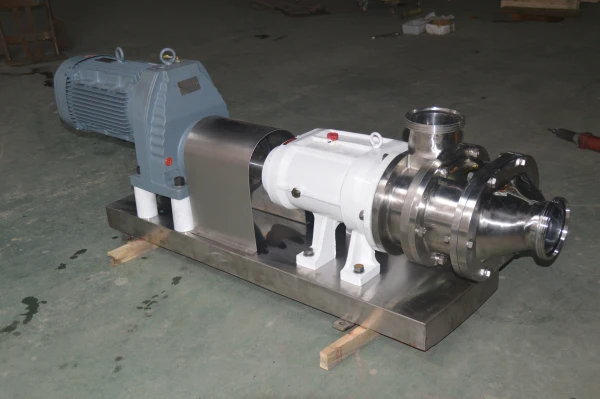
Non-Contact Twin-Screw Technology for Sensitive Pharmaceutical Fluids
The internal working principle of a sanitary twin-screw pump is based on two screws rotating inside the pump chamber to create continuous sealed cavities that move fluid from the inlet toward the outlet.
Unlike designs where rotating components contact each other directly, the SLGP twin-screw structure uses a non-contact metal-to-metal-free operating design between the screws and pump chamber. This reduces mechanical wear and supports reliable operation when handling sensitive pharmaceutical materials.
The continuous axial conveying movement also creates lower pulsation compared with many traditional positive displacement pumping methods. For pharmaceutical fluids where product uniformity, formulation stability, and controlled transfer are important, maintaining gentle handling conditions can help protect product characteristics during transportation.
This makes twin-screw technology suitable for applications involving:
- pharmaceutical liquid preparation
- buffer and solution transfer
- bioprocess intermediate handling
- high-viscosity formulation movement
- hygienic circulation systems
Designing Complete Biopharmaceutical Systems Beyond Pump Selection
In pharmaceutical production, selecting a pump is not only about achieving required flow rates. The pump must work together with the entire process system, including storage tanks, pipelines, heating or cooling units, CIP/SIP modules, and filling equipment.
A sanitary twin-screw pump provides flexibility for complete equipment integration because of its wide operating range and adaptable configuration options. Different screw sizes can be selected according to viscosity, pressure requirements, speed conditions, and expected flow performance.
For temperature-sensitive applications, optional jacketed configurations can support process temperature management. Different sealing solutions, including single mechanical seals, double mechanical seals, rubber seals, and packing seals, allow engineers to match the pump configuration with specific production requirements.
This system-level approach helps ensure that the pump is not an isolated component but a coordinated part of the pharmaceutical manufacturing process.
Reliable Cleaning Performance Under High-Purity Processing Requirements
CIP and SIP procedures place demanding requirements on sanitary equipment. Pumps must withstand repeated cleaning cycles while maintaining stable operation under elevated temperatures and chemical cleaning conditions.
The SLGP sanitary twin-screw pump supports cleaning requirements with:
- maximum medium temperature up to 130°C
- cleaning temperature up to 140°C
- hygienic flow channels designed for easier cleaning
- support for GMP, 3-A, and FDA-oriented sanitary applications
Its ability to handle both high-viscosity materials and cleaning processes provides pharmaceutical equipment designers with greater flexibility when developing complete production systems.
For biopharmaceutical manufacturers, improving CIP/SIP efficiency is not simply about reducing cleaning time. It is about creating a more controlled and repeatable production environment. A sanitary twin-screw pump with optimized flow design, reversible operation, and gentle product handling can become an important element in achieving reliable hygienic processing from preparation to final transfer.


