


Pectin is widely used in jams, fruit preparations, dessert toppings, and sauces to control texture, viscosity, and stability. However, incorporating pectin into a liquid formulation can be challenging. When powder contacts water too quickly, its outer layer may hydrate and form a sticky coating while dry powder remains trapped inside. These lumps are difficult to disperse and can lead to uneven viscosity, extended mixing times, and inconsistent finished products.
A jet mixer can help improve pectin incorporation by generating high-velocity liquid flow that promotes powder wetting and solid-liquid dispersion. For food manufacturers preparing sauces, fruit fillings, and hydrocolloid-based formulations, selecting the right mixing configuration helps streamline hydration and achieve more consistent batch quality.
Why Pectin Forms Lumps During Hydration
Pectin does not behave like an ordinary soluble ingredient during mixing. Its hydration rate depends on the pectin grade, particle characteristics, liquid temperature, concentration, and formulation conditions.
When pectin powder is added directly to a liquid without sufficient dispersion, particles can stick together. The outside of each cluster hydrates first, creating a viscous layer that slows liquid penetration into the center. The resulting lumps may remain even after prolonged mixing.
This creates several production problems. Undispersed pectin can cause uneven viscosity throughout a batch, while operators may need to extend mixing time or repeat processing to achieve the target texture. In fruit sauces and fillings, poor hydration can also affect smoothness, flow behavior, and consistency during filling.
The challenge becomes more pronounced as the formulation thickens. As viscosity increases, liquid circulation may become less effective, making it harder to incorporate additional powder uniformly.
How a Jet Mixer Improves Pectin Dispersion
A jet mixer generates high-speed liquid flow to promote circulation and contact between the liquid and powder. When the powder is introduced at an appropriate location and rate, the moving liquid helps wet particles, distribute them through the batch, and reduce localized powder accumulation.
For pectin hydration, three process considerations are particularly important.
Faster powder incorporation: Strong liquid movement helps bring incoming pectin into contact with the liquid phase instead of allowing it to accumulate in one area. Controlled powder feeding is still essential; adding powder faster than the system can incorporate it may recreate the same lumping problem.
More uniform distribution: Once wetted, pectin must be distributed throughout the formulation. Effective circulation reduces concentration differences and helps produce a more consistent base for subsequent heating, blending, or ingredient addition.
Better control of mixing time: If the original bottleneck is poor powder incorporation, improving the feeding and dispersion stages may reduce the time needed to achieve a uniform batch. The actual improvement depends on the formulation and should be verified during production trials.
A jet mixer supports the physical mixing process, but pectin hydration also depends on the recipe and operating sequence. Powder preparation, liquid temperature, sugar concentration, pH, and the specific pectin grade may all influence the final result.
Applications in Sauces and Fruit Preparations
Hydrocolloid hydration is important across several food-processing applications, although the target viscosity and process sequence vary by product.
Fruit Sauces and Fillings
Pectin helps provide body and texture in fruit sauces, jam fillings, and fruit preparations used in bakery products or desserts. Poor dispersion can leave visible lumps or create uneven thickening, affecting both appearance and portioning.
A jet mixer can be incorporated into the preparation stage to improve powder distribution before the formulation proceeds to its next processing step. The equipment configuration should reflect whether the process begins with water, fruit puree, a sugar solution, or another liquid base.
Table Sauces and Condiments
Sauces often combine water, sugars, acids, starches, gums, and suspended ingredients. When pectin is used as a thickener or stabilizer, it must be incorporated without creating concentrated gel-like clusters.
A suitable mixing arrangement helps distribute pectin through the liquid phase before the formulation reaches its final viscosity. This is especially relevant when manufacturers need repeatable texture across production batches.
High-Viscosity Formulations
As a sauce thickens, its resistance to flow increases. A mixing configuration that performs well during initial powder addition may not provide the same circulation once the formulation becomes more viscous.
For these products, engineers should assess the viscosity profile across the entire process, not just the initial liquid conditions. The point at which pectin is added, the order of ingredient addition, and the required final texture all influence equipment selection.
Choosing Between FRK and FRJ Jet Mixers
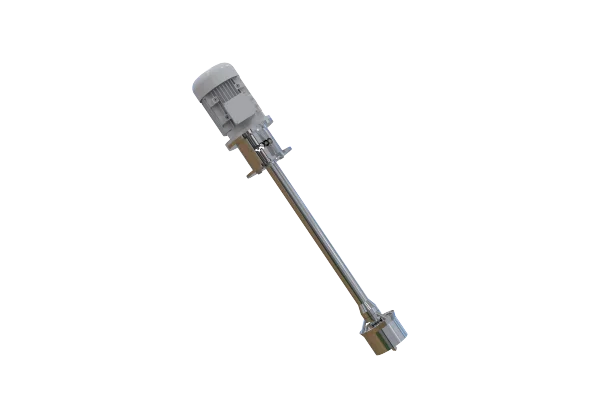
BOAO offers two jet stream mixer configurations with different flow characteristics. The appropriate model depends on whether the process places greater emphasis on local dispersion or overall circulation.
The FRK Radial Flow High Shear Jet Mixer emphasizes radial flow and stronger dispersion characteristics, with a smaller mixing flow than the FRJ. It is worth evaluating when powder incorporation and localized dispersion are the main priorities.
The FRJ Axial-Radial Flow Jet Mixer provides a larger mixing flow and is more focused on overall mixing performance. It may be suitable when hydrocolloid ingredients need to be distributed throughout a larger batch or when pectin incorporation is part of a broader sauce-blending process.
For example, a formulation that struggles with powder clusters near the feeding point may warrant evaluation of the FRK. A process in which uniform distribution throughout the vessel is the main concern may place greater emphasis on the FRJ's mixing flow.
Neither configuration should be selected solely on the assumption that greater mixing intensity always produces faster hydration. The pectin grade, liquid viscosity, feeding method, vessel geometry, and target texture must be considered together.
Integrating the Mixer into a Food Production Process
For sauce and fruit preparation lines, the jet mixer should be matched to the surrounding equipment and process sequence.
The mixing vessel must accommodate the batch volume and allow suitable powder addition. The liquid supply and powder-feeding arrangements should deliver ingredients at a controlled rate, while the mixer position should support circulation throughout the working volume.
FRJ and FRK series cover nominal processing volumes from approximately 10 L to 10,000 L per batch, depending on the selected model. Vertical, eccentric, and inclined installation arrangements can be considered according to vessel design, with extended configurations available for suitable applications.
Material selection is also important in food processing. Stainless steel 304 or 316L is available, depending on the formulation, cleaning requirements, and operating environment. Electropolishing can be specified when the required surface finish justifies it.
Before finalizing a configuration, manufacturers should identify the pectin type, powder addition rate, liquid viscosity, batch size, temperature conditions, and required final texture. These details help determine whether the main process limitation is powder wetting, batch circulation, or hydration under the formulation's specific conditions.
Achieving Consistent Hydrocolloid Hydration
Reliable pectin hydration starts with preventing powder agglomeration and maintaining effective liquid circulation as the formulation thickens. A jet mixer can support these objectives by improving powder incorporation and solid-liquid dispersion during sauce and fruit preparation.
The FRK Radial Flow High Shear Jet Mixer is worth evaluating when stronger dispersion is required, while the FRJ Axial-Radial Flow Jet Mixer offers a larger mixing flow for processes that prioritize overall batch mixing. Matching the mixer to the formulation and feeding sequence helps food manufacturers pursue shorter processing cycles and more consistent sauce texture.


