


Solid-liquid mixing is a critical operation in many industrial processes, including chemical production, food processing, pharmaceutical manufacturing, and the preparation of industrial suspensions. Whether the objective is to dissolve a powder, disperse insoluble particles, or prepare a uniform mixture, the quality of mixing directly affects product consistency and processing time.
However, achieving effective solid-liquid mixing is not always straightforward. Powders may remain on the liquid surface, solid particles can settle at the bottom of a tank, and some ingredients require excessive processing time before reaching the desired condition. These problems are not necessarily caused by insufficient mixer power. Material properties, flow patterns, feeding methods, and equipment selection all influence the final result.
Understanding the most common challenges helps manufacturers improve mixing efficiency without relying solely on higher speeds or longer operating times.
Common Problems in Solid-Liquid Mixing
Uneven Solid Distribution
One of the most frequent problems is the uneven distribution of solid particles throughout the liquid. Depending on their density, particles may float, sink, or accumulate in particular regions of the vessel.
When the liquid flow cannot transport solids effectively, the mixture may contain different concentrations at different locations. This can affect downstream operations such as pumping, filling, filtration, and further processing.
The problem is often related to the relationship between particle properties and the mixing flow pattern. A mixer may generate movement near its mixing element without creating sufficient circulation throughout the entire vessel. As a result, some solids remain poorly distributed even when the liquid appears to be moving vigorously.
Improving distribution requires a mixing configuration that matches the particle characteristics, tank geometry, and required level of uniformity.
Slow Powder Incorporation and Dissolution
When powders are added to a liquid, they must first make contact with the liquid and become wetted. Soluble ingredients then need to dissolve, while insoluble materials must be dispersed to the required degree.
These processes are related but not identical. A powder can be distributed through the vessel without dissolving completely, and an insoluble solid can form a suspension without becoming a solution.
Slow incorporation may occur when powder feeding exceeds the system's capacity, when the liquid has high viscosity, or when the equipment cannot provide sufficient contact between the solid and liquid phases. In some cases, the material forms agglomerates that further delay wetting and dissolution.
A more controlled feeding strategy, combined with an appropriate mixing flow and dispersion capability, can help shorten processing time. The actual improvement depends on the ingredient's solubility, particle characteristics, and operating conditions.
Solid Sedimentation
Sedimentation occurs when solid particles settle faster than the mixing system can keep them suspended. It is particularly relevant when the solid phase is denser than the liquid or when particles are relatively large.
Once solids accumulate at the bottom of a vessel, the mixture may become less uniform. Deposits can also complicate discharge, increase cleaning requirements, and make it difficult to maintain a consistent concentration during processing.
Increasing mixer speed may help in some applications, but it is not always the most efficient response. The required mixing action depends on particle size, density difference, liquid viscosity, and vessel geometry. The objective is to create enough movement to maintain the required suspension without consuming unnecessary energy or introducing excessive air.
For processes that are sensitive to sedimentation, manufacturers should evaluate the mixing pattern and confirm that solids remain adequately distributed under actual operating conditions.
Excessive Mixing Time and Energy Consumption
A mixing process becomes inefficient when it requires more time or energy than necessary to achieve the target result. This may happen when the equipment is poorly matched to the material, when powder feeding is too rapid, or when the flow pattern does not bring solids into effective contact with the liquid.
Longer operation does not always produce better results. Once the required level of dissolution or dispersion has been achieved, additional mixing may offer little benefit while increasing energy use and production cycle time.
Efficiency should therefore be assessed against a defined process endpoint, such as dissolution completion, concentration uniformity, or a specified dispersion quality. This provides a more meaningful basis for evaluating performance than mixing duration alone.
How to Improve Solid-Liquid Mixing Efficiency
Optimize the Feeding Method
The way solids enter the liquid has a significant effect on the overall process. Feeding a large amount of powder at once can create locally concentrated regions that the mixer cannot incorporate quickly enough.
A controlled feeding rate allows the liquid to contact the incoming material more effectively. The feeding point should also be selected according to the vessel's circulation pattern, helping move solids into the active mixing region rather than allowing them to accumulate in stagnant areas.
For automated systems, metered feeding can improve repeatability between batches. The optimum rate should be determined according to the powder's wetting behavior, the liquid's properties, and the equipment's mixing capacity.
Match the Mixing Action to the Process
Different solid-liquid applications require different mixing capabilities. General blending emphasizes the distribution of materials, dissolution requires effective contact between soluble solids and the liquid, and dispersion focuses on distributing solid particles or breaking down agglomerates.
Selecting equipment according to the actual objective helps avoid unnecessary processing. For example, a system intended mainly for bulk circulation may not provide the local mixing intensity needed for demanding dispersion tasks. Conversely, a high-shear mixer may be unnecessary when gentle blending is sufficient.
The right choice balances dispersion capability, circulation, processing time, and product requirements.
Consider Viscosity and Particle Properties
Liquid viscosity affects flow resistance, while particle size and density influence how solids move through the vessel. These variables should be evaluated together rather than independently.
A high-viscosity liquid may restrict circulation and make it harder to distribute particles evenly. Large or dense particles may settle quickly, while fine powders can be difficult to wet or disperse. Changes in formulation or operating temperature can also alter mixing behavior.
Where possible, equipment trials should use representative materials and realistic process conditions. This helps determine whether the main limitation comes from circulation, wetting, particle suspension, or dispersion.
Review Vessel Geometry and Mixer Installation
Mixing performance depends on the complete system, not just the mixer itself. Tank dimensions, working volume, liquid level, installation position, and the location of the solid feed point can all affect the flow pattern.
Poorly positioned equipment may leave parts of the vessel with limited movement. In these cases, changing the installation arrangement or selecting a more suitable mixing configuration may improve performance more effectively than simply increasing power.
When scaling up a process, manufacturers should also account for changes in vessel geometry and batch volume. A configuration that works well in a small tank may not produce the same circulation and dispersion behavior in a larger production vessel.
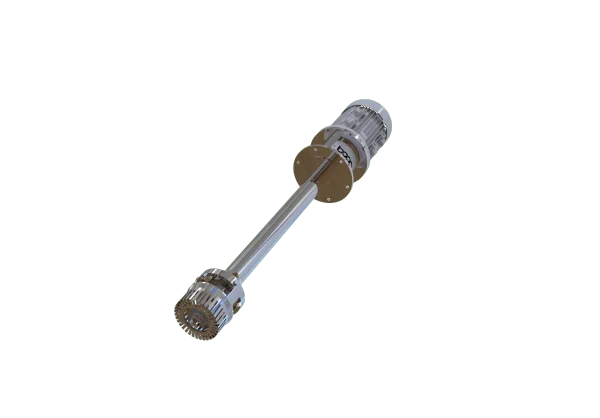
The Role of a High-Shear Jet Mixer in Solid-Liquid Applications
For processes that require high-speed dispersion, solid-liquid dissolution, or intensive mixing, a radial flow high-shear jet mixer may be worth considering.
The FRK Radial Flow High Shear Jet Mixer is designed for these applications. Its radial flow configuration emphasizes dispersion performance, making it an option for processes where effective solid-liquid contact and the breakup of agglomerates are important.
Compared with an axial-radial flow jet mixer such as the FRJ, the FRK prioritizes a stronger dispersion effect while providing a smaller mixing flow. Equipment selection should therefore reflect the primary process requirement: stronger dispersion or greater overall mixing flow.
A high-shear jet mixer is not a universal solution for every solid-liquid process. Its suitability depends on the material properties, required processing result, vessel configuration, and operating conditions. Applications that require dedicated emulsification or homogenization may need different equipment.
Build a More Efficient Mixing Process
Solid-liquid mixing efficiency depends on more than mixer speed or installed power. Uneven distribution, slow incorporation, sedimentation, and excessive processing time can result from mismatches between material properties, flow patterns, feeding methods, and equipment capability.
Manufacturers can improve performance by controlling solid feeding, selecting a mixing action that matches the process objective, and evaluating viscosity, particle properties, and vessel geometry together. For applications requiring intensive dispersion, a suitable high-shear jet mixer may help improve solid-liquid contact and achieve the desired result more efficiently.
The key is to identify the actual process limitation before changing equipment or operating conditions. A well-matched mixing system can support more consistent product quality, shorter processing cycles, and more reliable production.


