


Liquid foundation must balance several properties at once: uniform color, smooth texture, consistent coverage, and a stable appearance throughout its intended shelf life. Achieving this balance depends partly on how pigments and other solid ingredients are incorporated into the liquid formulation. Poor dispersion can leave visible specks, uneven color, or agglomerates that affect the sensory quality of the finished product.
For cosmetic manufacturers, pigment dispersion is not simply a matter of stirring ingredients together. The process must bring pigment particles into effective contact with the liquid phase, break down dispersible agglomerates, and distribute the particles consistently throughout the batch. A jet stream mixer can support this stage by combining directed flow with high-shear mixing, helping manufacturers improve the consistency of liquid foundation formulations.
Why Pigment Dispersion Matters in Liquid Foundation
Liquid foundation formulations may contain pigments such as iron oxides and titanium dioxide, alongside oils, water, film-forming ingredients, dispersants, thickeners, and other functional components. These ingredients differ in density, wettability, and compatibility with the surrounding phase. Their behavior during mixing influences the appearance and performance of the final product.
Pigments that are not adequately wetted may form clusters when they enter the liquid. If these agglomerates persist, the foundation may develop uneven color or visible particles. Incomplete distribution can also cause differences between samples taken from different parts of a batch.
The challenge becomes more complex as the formulation develops viscosity. A mixture that circulates easily at the beginning of processing may become more resistant to flow as additional ingredients are incorporated. Mixing conditions must therefore suit both the initial dispersion stage and the evolving properties of the formulation.
A suitable mixing process helps distribute pigment particles more evenly, but dispersion quality also depends on the pigment grade, particle characteristics, surface treatment, dispersant selection, and the formulation itself. Equipment should be chosen to complement these factors rather than expected to compensate for an unsuitable raw-material or formulation choice.
How Jet Stream Mixing Supports Pigment Dispersion
A jet stream mixer generates directed liquid flow through a high-speed rotating assembly. The resulting flow and localized shear help bring solid particles into contact with the liquid and distribute them through the mixing vessel.
During liquid foundation preparation, this action can support the incorporation of pigment powders and the breakdown of agglomerates that are susceptible to mechanical dispersion. It can also help maintain movement within the batch as additional ingredients are introduced.
The outcome depends on the relationship between shear intensity and circulation. Strong local dispersion is useful for incorporating pigment, while broader circulation helps carry the dispersed material throughout the vessel. If the mixing action is concentrated in one area without sufficient batch movement, uniformity may take longer to achieve. Conversely, circulation alone may not provide the dispersion intensity required by a pigment-rich formulation.
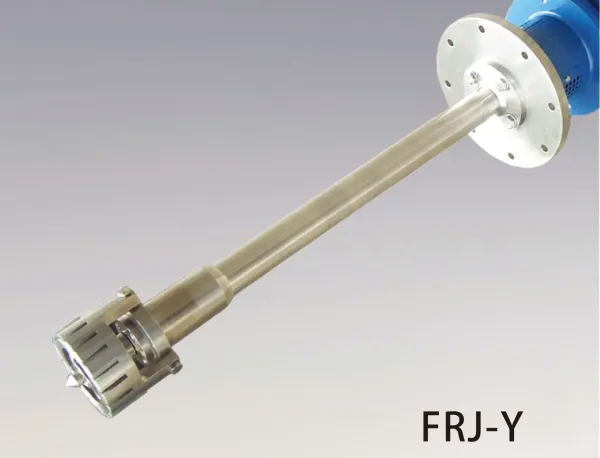
BOAO offers two relevant jet mixer configurations: the FRK radial-flow high-shear jet mixer and the FRJ axial-radial flow jet mixer. The FRK emphasizes dispersion intensity and has a comparatively smaller flow, while the FRJ provides greater flow and is more focused on overall mixing and circulation. The appropriate option depends on the formulation, vessel geometry, viscosity, and primary processing objective.
Jet stream mixers are designed for mixing, solid-liquid dissolution, and dispersion. They should not be treated as direct substitutes for dedicated milling equipment when a formulation requires substantial particle-size reduction, or for specialized emulsification and homogenization equipment when those operations are essential.
Key Stages in Liquid Foundation Pigment Processing
Preparing the Liquid Phase
Before pigment addition, the liquid phase must be prepared according to the formulation. Depending on the product, this may involve combining water-based or oil-based ingredients, introducing a dispersant, or establishing the required temperature and viscosity.
The sequence matters because pigment wetting depends partly on the liquid environment. Adding powders before the appropriate dispersing ingredients are present may make agglomeration more difficult to control. Manufacturers should establish the charging sequence according to the specific pigment and formulation rather than applying one mixing procedure to every foundation product.
Incorporating Pigment Powders
Pigment should be introduced at a rate that allows it to contact the liquid instead of accumulating as a dry layer or forming large wet clusters. A suitable feeding position helps bring the powder into the active mixing zone.
A jet stream mixer can support this operation by creating flow that draws ingredients into the liquid and distributes them through the batch. However, powder feeding remains an independent process variable. Excessive addition rates, poor wetting, or unsuitable dispersant levels can still produce agglomerates even when the mixer provides substantial shear.
For formulations containing several pigments, the order of addition and the proportion of each pigment should be controlled carefully. Consistent charging and mixing procedures help reduce batch-to-batch variation in shade.
Dispersing and Uniformly Distributing Pigments
Once incorporated, pigments need to be distributed throughout the formulation. This requires sufficient local mixing action to disperse agglomerates and adequate circulation to carry the material through the vessel.
For a formulation where dispersion is the main challenge, an FRK radial-flow high-shear jet mixer may be considered. If the batch requires greater circulation to distribute ingredients throughout a larger vessel, an FRJ axial-radial flow jet mixer may be more suitable. Final selection should be based on actual product properties and trials rather than on flow configuration alone.
Mixing time should also be established through process evaluation. Extending the mixing cycle indefinitely does not necessarily improve the product and may introduce unnecessary energy, heat, or processing time. The objective is to achieve the required dispersion and uniformity within a controlled operating window.
Checking the Finished Batch
Visual appearance is useful for identifying obvious color streaks or visible particles, but it is not sufficient to establish pigment dispersion quality on its own. Manufacturers may also evaluate color consistency, samples taken from different vessel locations, fineness of dispersion where applicable, viscosity, and stability under defined test conditions.
The required checks depend on the product specification. For example, a foundation with a high pigment load may require closer control of color strength and dispersion than a sheer formulation. A consistent sampling and testing procedure helps determine whether the mixing stage has achieved the desired result before the batch moves to filling or further processing.
Choosing the Right Jet Stream Mixer for Foundation Formulations
The most suitable mixer depends on the formulation's physical properties and the specific problem that needs to be solved. Important considerations include pigment concentration, particle characteristics, liquid viscosity, dispersant system, batch volume, vessel dimensions, and the required dispersion result.
The FRK radial-flow high-shear jet mixer may be considered when stronger dispersion is the priority. The FRJ axial-radial flow jet mixer may be more appropriate when greater flow and batch circulation are needed. Where the formulation requires intensive particle-size reduction or a specialized emulsion structure, additional processing equipment may still be necessary.
The selected configuration should be evaluated using representative ingredients and realistic operating conditions. This makes it possible to assess pigment incorporation, batch uniformity, processing time, temperature changes, and downstream handling before finalizing the production setup.
Achieving More Consistent Liquid Foundation Quality
Consistent liquid foundation depends on the coordination of formulation design, pigment feeding, dispersion, circulation, and quality control. A jet stream mixer can contribute to this process by supporting solid-liquid incorporation and pigment distribution, provided its flow characteristics and shear action match the formulation.
For cosmetic manufacturers, the practical objective is not simply to maximize shear. It is to achieve the required color uniformity and dispersion while maintaining the desired viscosity, texture, and processing efficiency. By selecting the appropriate FRK or FRJ configuration and integrating it into a well-defined production process, manufacturers can build a more repeatable approach to liquid foundation preparation.


