


Abrasive slurries are widely used in chemical production, including mineral processing, inorganic chemical preparation, and solid-liquid reaction systems. These applications require more than effective mixing inside a single tank. Powder feeding, solids suspension, batch uniformity, and slurry transfer must work together to maintain stable production.
When dense particles settle at the tank bottom, operators may face uneven solids concentrations, incomplete material recovery, and inconsistent downstream processing. BOAO jet stream mixers provide a mixing solution for chemical slurry systems, helping promote liquid circulation and solid-liquid dispersion. The FRJ Axial-Radial Flow Jet Mixer and FRK Radial Flow High Shear Jet Mixer offer different flow characteristics to suit different process requirements.
Integrating Jet Stream Mixers into Abrasive Slurry Processing
A typical chemical slurry preparation system may include a mixing vessel, powder-feeding equipment, a jet stream mixer, liquid supply lines, and a discharge system connected to a transfer pump or downstream process equipment.
Each component affects the overall result. If powders enter the vessel faster than they can be incorporated, agglomerates may form around the feeding point. If circulation is insufficient, solids can accumulate at the bottom. If the slurry is not uniform before discharge, the concentration delivered to a reactor, filter, or storage tank may vary between batches.
A coordinated system addresses these issues through three connected operations:
- Powder incorporation: Controlled feeding allows the liquid and mixing flow to incorporate incoming solids without creating excessive local accumulation.
- Slurry circulation: The mixer promotes movement throughout the vessel, helping distribute solids and reduce sediment buildup.
- Discharge and transfer: The outlet, pipeline, and transfer pump must handle the slurry’s viscosity, particle size, and solids concentration.
The jet stream mixer supports the mixing stage, while the vessel layout and connected equipment determine how effectively the complete system performs.
Bottom-Up Mixing for Sediment Control
Dense or coarse particles can settle when the surrounding liquid cannot maintain sufficient suspension. In large tanks, weak-flow regions near the bottom or vessel walls may allow solids to accumulate even when the upper liquid appears well mixed.
Bottom-up mixing focuses on mobilizing solids in these lower regions and returning them to the circulating liquid. A jet stream mixer generates high-velocity flow that promotes solid-liquid mixing and particle redistribution.
For chemical system design, the important factors are tank geometry, liquid depth, particle characteristics, and mixer installation position. A configuration that creates strong movement near the mixer may still leave deposits in remote areas if the overall circulation pattern is unsuitable.
The required outcome should be defined before equipment selection. A process that needs uniform solids concentration during discharge may require a different operating strategy from one that mainly needs to minimize sediment accumulation during batch preparation.
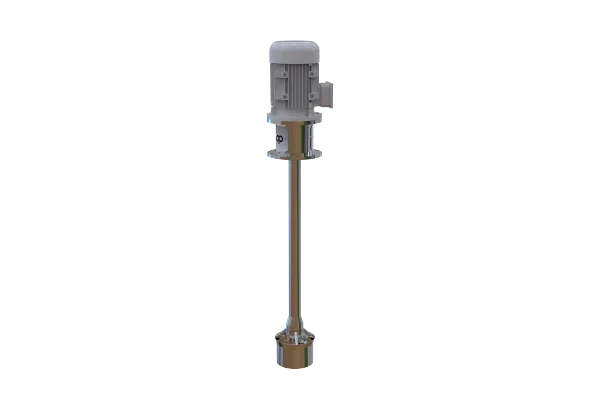
FRJ and FRK: Selecting the Right Flow Characteristics
BOAO offers two jet stream mixer configurations for different mixing priorities.
FRJ Axial-Radial Flow Jet Mixer
The FRJ provides a larger mixing flow and is suited to applications that prioritize overall circulation and batch-wide mixing. It can be considered for chemical slurry preparation where solids need to be distributed throughout a vessel before transfer to downstream equipment.
When configuring an FRJ system, engineers should assess the tank dimensions, expected solids loading, and areas where sediment typically forms. The objective is to achieve useful circulation across the working volume, not simply strong movement around the mixing head.
FRK Radial Flow High Shear Jet Mixer
The FRK emphasizes radial flow and stronger dispersion characteristics, with a smaller mixing flow than the FRJ. It is worth evaluating when the process places greater emphasis on powder incorporation and local dispersion.
For example, a chemical formulation process that introduces mineral powders into a liquid phase may benefit from prioritizing dispersion during the incorporation stage. However, if the main challenge is maintaining solids suspension across a large tank, overall circulation must remain part of the selection decision.
In practical terms, FRJ is more aligned with larger mixing flow, while FRK emphasizes stronger dispersion. The appropriate model depends on the dominant process requirement and the configuration of the complete slurry system.
Designing for Abrasion and Chemical Compatibility
Abrasive particles can wear wetted components through repeated impact and friction. Wear severity depends on particle hardness, size, shape, concentration, velocity, and the material exposed to the slurry.
Equipment selection should therefore be based on actual material properties rather than the general description of a slurry as abrasive. Provide the equipment supplier with the particle-size distribution, maximum particle size, solids concentration, slurry viscosity, density, and chemical composition.
BOAO’s jet stream mixers are available in stainless steel 304 or 316L. Material selection should reflect the chemical environment and corrosion requirements, while expected particle erosion should be assessed separately. Electropolishing is available when the process requires a particular surface finish, but it does not eliminate abrasive wear.
The operating pressure also affects system configuration. Suitable atmospheric-pressure applications can use a packing arrangement without a mechanical seal. Pressurized applications require a mechanical seal selected for the working pressure and process conditions.
Configuring a Complete Chemical Slurry Mixing System
A practical equipment specification should cover the entire process rather than the mixer alone.
Material and batch requirements: Confirm viscosity, solids concentration, particle size, density, chemical compatibility, and required slurry uniformity. FRJ and FRK series cover nominal batch volumes from approximately 10 L to 10,000 L, depending on the model and application.
Vessel and installation: Tank dimensions, bottom shape, internal structures, and liquid level affect circulation. Vertical, eccentric, and inclined installation arrangements can be considered according to vessel design, with extended configurations available for suitable applications.
Equipment connections: Coordinate the powder-feeding point, liquid inlet, mixer position, discharge outlet, and transfer pump. The pump and pipeline must accommodate the expected solids loading and particle size without creating an avoidable bottleneck.
Operating targets: Define the required mixing time, acceptable solids concentration variation, sediment control objective, and discharge conditions. These criteria provide a practical basis for evaluating the proposed system.
For demanding applications, trials using representative slurry can help verify whether the selected configuration achieves the required solids distribution and operating performance.
A Process-Based Approach to Slurry System Selection
For abrasive chemical slurries, reliable production depends on coordinating powder incorporation, solids circulation, and downstream transfer. The FRJ Axial-Radial Flow Jet Mixer is a candidate when larger mixing flow is the priority, while the FRK Radial Flow High Shear Jet Mixer is suited to applications emphasizing stronger dispersion.
By matching the mixer, vessel, feeding arrangement, and transfer equipment to the actual slurry properties, chemical manufacturers can develop a more coherent mixing system for their production requirements.


