


In biopharmaceutical manufacturing, clinical diagnostics, and industrial fermentation, the preparation of culture media is a foundational process where compromise is never an option. The rapid, total dissolution of complex nutrient salts, peptones, yeast extracts, and agar powders into a perfectly homogenous, sterile-ready solution presents severe engineering challenges.
Traditional impellers and standard anchor agitators frequently fall short in this application. They leave behind persistent unhydrated agglomerates, demand excessive processing times, and risk damaging sensitive biological components through localized heat accumulation.
To eliminate these critical mixing bottlenecks and ensure uncompromised batch consistency, process engineers are increasingly moving away from macro-transport stirring toward advanced high-shear fluid dynamics. Implementing specialized high-shear technology, such as the FRJ Jet Mixer and FRK Jet Mixer series, provides the precise combination of hydraulic shear and high volumetric turnover required to shatter stubborn powder matrices while safeguarding the chemical integrity of the media.
The Complex Fluid Dynamics of Nutrient Salt Dissolution
Nutrient media formulations are notoriously difficult to hydrate efficiently on an industrial scale. When bulk dry powders—especially highly hydroscopic or macromolecular ingredients like dehydrated bile salts, casein hydrolysates, or protective polymers—make contact with a liquid solvent, they don't simply dissolve. Instead, they exhibit a strong tendency to form highly resilient agglomerates, commonly referred to in the process industries as "fish-eyes."
A fish-eye occurs when the outermost layer of a dense powder clump hydrates instantly upon contact with water, creating a sticky, gelatinous, and semi-impermeable encapsulated skin. This hydrated outer shell shields a completely dry, trapped core of powder from the surrounding liquid.
Traditional mixing technology relies almost exclusively on macro-movement. Conventional impellers push these encapsulated clumps around the periphery of the vessel rather than breaking them apart. The negative downstream ramifications for a sterile production line are multifaceted and severe:
- Severe Downstream Filtration Clogging: Undissolved micro-particles and hidden gel bodies that escape macro-mixing will rapidly blind expensive 0.22µm or 0.45µm sterile membrane filters. This causes premature filter cartridge replacement, forces unplanned production shutdowns, and dramatically increases overall operational costs.
- Extended Batch Processing Times: Waiting hours for spontaneous, passive hydration to break down fish-eyes stalls the entire manufacturing timeline. This delays downstream sterilization, creates bottlenecks in the tank farm, and reduces the plant's overall asset utilization.
- Nutrient Degradation & Thermal Shock: Attempting to force dissolution through prolonged mixing with standard equipment often introduces a different hazard: localized heat buildup around the impeller hub. Many vital media components—such as heat-sensitive vitamins, amino acids, and complex proteins—are highly thermolabile. Extended exposure to even minor temperature spikes can denature these essential nutrients, altering the final chemical profile and drastically reducing cell growth yields or diagnostic accuracy in the final product.
Choosing the Right Flow Profile: FRJ Axial-Radial vs. FRK Pure Radial
Overcoming these structural powder barriers requires a precise, engineered balance between localized kinetic energy (shear force) and macro-tank turnover (volumetric flow). A single mixing profile cannot fit every formulation or vessel geometry. This is why selecting the appropriate flow orientation is critical, across the entire scaling spectrum from pilot systems like the FRJ90 and FRK90 up to high-capacity industrial platforms like the FRJ280 and FRK280.
The FRJ Series: Maximizing Volumetric Turnover with Axial-Radial Flow
For large-scale media preparation vessels where heavy bulk density powders are introduced rapidly, preventing the immediate settling of solids at the bottom of the tank is the primary operational priority.
The FRJ Jet Mixer addresses this via a specialized, hybrid axial-radial flow pattern. The mixer's precision-engineered stator shroud acts as a powerful suction pump, drawing liquid and floating dry powders directly down into the high-shear rotor zone from the top. Once inside, the particles are subjected to intense mechanical forces before being expelled outward through the radial ports.
This creates a highly dynamic, bottom-to-top circulation loop within the vessel. If your specific recipe involves a high volume of rapidly settling crystalline salts or large batches where overall tank homogeneity and rapid initial powder distribution are paramount, the FRJ configuration delivers unmatched volumetric efficiency and macro-mixing performance.
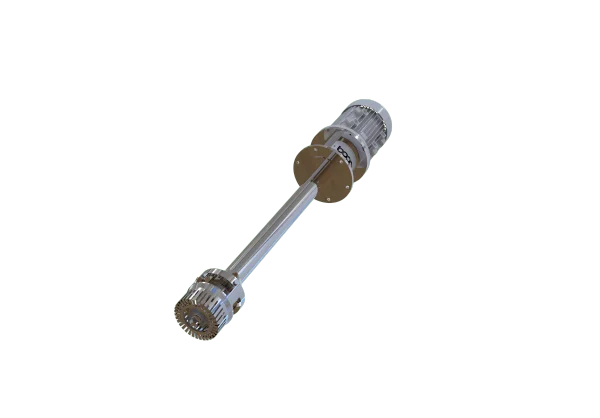
The FRK Series: Concentrating Hydraulic Shear via Pure Radial Flow
When dealing with exceptionally stubborn, hydrophobic, or highly viscous binding agents that resist wet-out, macro-circulation alone is insufficient. The mechanical energy must be focused directly onto the agglomerates.
The FRK Jet Mixer utilizes a dedicated radial flow profile designed to maximize localized energy dissipation. As the fluid enters the mixing head, the internal geometry concentrates the motor's power into highly directed, high-velocity radial jets. This creates a rigorous zone of intense hydraulic shear and localized velocity gradients.
When fish-eyes pass through this high-energy stator zone, the shear forces instantly slice through the protective gelatinous skin, exposing the dry inner cores to the liquid medium for immediate hydration. While the overall volumetric turnover rate of the FRK is slightly more localized compared to the high-flow FRJ series, it offers unparalleled performance in eliminating micro-clumps and accelerating the dissolution of the most difficult ingredients.
Engineering for Sterile End-Product Integrity and Compliance
In sterile manufacturing environments, process speed is only half of the validation equation. Cleanability, material traceability, and isolation from external contamination dictate whether a piece of equipment can be safely integrated into a regulated bioprocess workflow.
- Sanitary Materials of Construction: To withstand continuous exposure to concentrated nutrient salts, acidic or alkaline pH adjustments, and aggressive cleaning chemicals, all wetted components are fabricated from premium, certified 304 or 316L stainless steel. This guarantees high corrosion resistance and prevents metal ion leaching into sensitive media.
- Ultra-Smooth Surface Finishes: To meet strict sanitary standards, these jet mixers are available with high-grade mechanical polishing or advanced electropolishing options. Electropolishing removes microscopic peaks and valleys from the steel surface, minimizing roughness. This prevents micro-organisms from adhering to the metal, eliminates product carryover between batches, and ensures total compatibility with Clean-in-Place (CIP) and Sterilize-in-Place (SIP) systems.
- Hermetic Sealing for Pressurized Systems: For closed, sterile-ready ecosystems where the media must be kept under an overpressure of inert gas or processed under vacuum, standard gland packing is insufficient. Mid-to-high capacity models, such as the FRJ160 or FRK160, are configured with high-performance mechanical seals. These seals provide a reliable, hermetic barrier that completely isolates the internal batch from ambient atmospheric contamination.
- Adaptive Vessel Architecture: Industrial mixing requires flexibility. Depending on the specific geometry of your reaction vessel or batching tank, these jet mixers support various installation configurations, including vertical, eccentric (off-center mounting to break natural vortexing without dirty baffles), or angled/tilted installations. Furthermore, the shaft length can be fully customized and extended to match deep tanks, ensuring that even the bottom-most layers of the fluid receive sufficient mixing energy.
Operational Gains: Transforming the Downstream Workflow
Upgrading from rudimentary stirring systems to a scientifically targeted jet mixing approach yields immediate, measurable advantages for the production facility. By matching your process requirements to either the high-turnover FRJ series or the high-shear FRK series, you establish a highly controlled, repeatable preparation step.
The complete elimination of fish-eyes and the achievement of molecular-level homogeneity directly optimize downstream operations. Sterile filter lifespans are extended significantly, batch-to-batch chemical variance is virtually eliminated, and the biological availability of the nutrient salts is fully preserved—ultimately leading to maximized cell growth yields and highly predictable, sterile end products.


