


In food processing, foam control is not only about keeping tanks from overflowing. It can influence product loss, cleaning requirements, process stability, and the way ingredients are handled throughout a production line. For manufacturers pursuing cleaner labels, reducing unnecessary processing aids can also become part of equipment and process design.
A food-grade mechanical defoamer offers a physical approach to foam management. Instead of relying primarily on chemical antifoam agents, it uses mechanical force to break foam, separate entrained liquid from gas, and return recovered liquid to the process. This makes mechanical foam control particularly relevant to hygienic food processing systems where ingredient integrity and clean processing are important.
Why Foam Control Matters in Clean-Label Food Processing
Foam can develop during mixing, aeration, recirculation, and other high-shear operations. Fruit-based beverages, fermentation liquids, liquid food formulations, and other products may contain proteins, sugars, organic compounds, or surface-active ingredients that make foam more persistent.
Once foam accumulates, several problems can appear.
Some product remains trapped in the foam and may leave the vessel with exhaust gas or overflow. Operators may then increase chemical antifoam addition simply to keep the process under control. While this can be effective for certain formulations, it introduces another processing aid that may not fit the manufacturer's clean-label strategy.
A better approach is to consider whether the foam can be physically managed before chemical intervention becomes necessary.
Mechanical Defoaming Without Adding Another Foam-Control Agent
A mechanical defoamer works directly on the foam rather than changing the formulation to suppress it.
When foam enters the rotor's working area, the rotating structure applies strong mechanical shear to the bubbles. The bubbles break, releasing the liquid they contain. Centrifugal force then moves the separated liquid toward the equipment wall, where it forms a controlled liquid flow.
Part of this recovered liquid can return directly to the food-processing vessel. In configurations equipped with a suitable collection and return path, additional liquid can be collected and sent back into the process.
The key point is that foam is treated as a recoverable process stream rather than simply waste that needs to be suppressed.
This approach can be useful when manufacturers want to reduce dependence on chemical antifoam while maintaining the required mixing or aeration conditions.
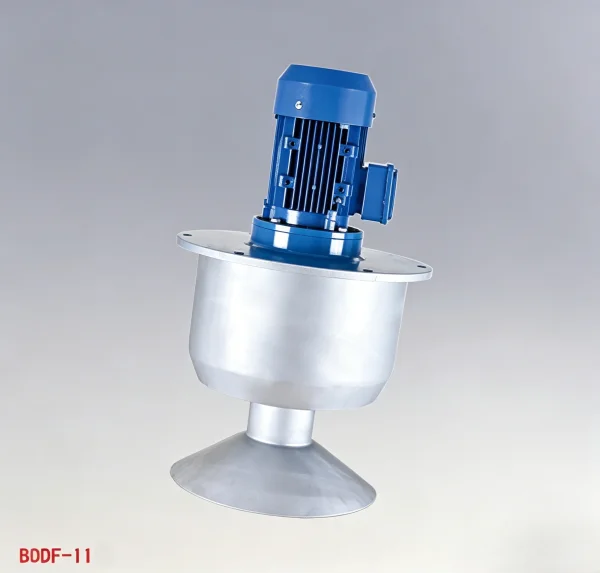
Integrating Foam Control into a Hygienic Processing System
For a food-processing solution, the defoamer should not be considered an isolated machine.
Its value depends on how it fits into the complete production system. Tank geometry, mixing equipment, aeration intensity, recirculation, piping, cleaning procedures, and liquid-return arrangements all influence foam behavior.
A food-grade mechanical defoamer can therefore be integrated into the process at points where foam generation is most likely to interfere with production.
For example, during liquid mixing, foam may occupy useful vessel volume and carry product toward the exhaust side. During fermentation-related food production, continuous aeration can generate substantial foam as microbial activity increases. In either case, mechanical foam breaking can help maintain usable tank capacity while returning separated liquid to the process.
This system-level approach is more practical than treating foam as a problem that exists only at the top of the tank.
Supporting Cleaner Processing with Hygienic Construction
A clean-label strategy is not limited to the ingredient list. The processing equipment itself must support hygienic production.
Food-contact components should be selected according to the product, cleaning regime, temperature, and sanitation requirements. Stainless-steel construction such as 304 or 316L can be used for applicable food-processing environments, while sealing materials such as EPDM, silicone rubber, or FKM can be selected according to operating conditions.
Electropolished surfaces may also be considered where a smoother hygienic surface is required.
The mechanical design should minimize locations where food residue can accumulate. This becomes especially important when the defoamer is incorporated into a production line that undergoes frequent cleaning.
Reducing Product Loss During Foam Handling
One of the strongest reasons to use mechanical defoaming in food production is not simply appearance or tank capacity—it is liquid recovery.
Foam can carry valuable ingredients away from the main process. If the foam is discharged without recovering its liquid content, the loss can become significant over continuous production runs.
Mechanical foam breaking provides a route for recovering part of this entrained liquid. Instead of continuously adding antifoam to suppress the foam and allowing product-containing foam to escape, the system physically breaks the foam and directs the released liquid back toward the process.
For high-value formulations or large-volume production, this recovery-oriented approach can complement broader efforts to reduce material waste.
Choosing the Right Configuration for the Production Line
The vessel configuration is an important factor when selecting a mechanical defoamer.
For fully enclosed food-processing vessels, a sealed mechanical defoaming configuration can be integrated with the closed process system and its exhaust or condensation arrangement.
For open tanks, vessels, or pools, an open-tank mechanical foam breaker is more appropriate. This configuration is designed around the operating conditions of an open process rather than forcing an enclosed-vessel solution into an unsuitable installation.
The selection should therefore start with the actual vessel arrangement, foam generation point, liquid-return route, and cleaning requirements.
A Practical Role in Clean-Label Food Production
Clean-label production does not mean eliminating every processing aid or assuming that one piece of equipment can solve every formulation challenge. It means designing the process so that unnecessary additions and avoidable losses can be minimized where technically practical.
Food-grade mechanical defoamers provide one such option. By breaking foam mechanically, recovering entrained liquid, and supporting reduced reliance on chemical antifoam, they can become part of a broader hygienic food-processing solution.
For manufacturers developing complete food-processing lines, foam control is therefore worth considering at the equipment-design stage—not only after excessive foam has already become a production problem.


