


In industrial fermentation, foam is more than a surface-level inconvenience. Persistent foam can occupy valuable headspace, carry fermentation broth into exhaust lines, increase product loss, and complicate process control. When foam generation becomes difficult to manage, the capacity of the mechanical defoamer becomes an important factor in equipment selection.
However, foam elimination capacity is not as straightforward as it may appear. A mechanical defoamer rated at a particular number of cubic meters per hour does not necessarily deliver the same result in every fermentation process. The actual outcome depends on the properties of the foam, the rate at which it enters the equipment, the mechanical forces available to break it, and the effectiveness of liquid recovery.
For process engineers, the key question is not simply how much foam a unit can handle under nominal conditions. It is whether the equipment can control the foam load generated by the process during its most demanding operating stages.
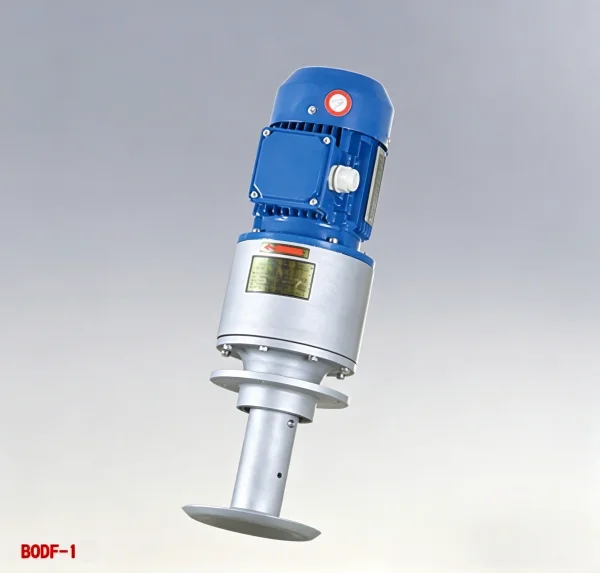
The BOAO BODF series mechanical defoamer addresses this challenge through high-speed rotor action, centrifugal separation, and liquid-return pathways. Understanding how these mechanisms relate to capacity helps engineers make better-informed decisions for fermentation and other industrial foam-control applications.
What Does Foam Elimination Capacity Mean?
Foam elimination capacity generally describes the amount of foam a device can handle or break down over a specified period. In practice, the exact meaning depends on the equipment design and the test method used to establish the rating.
Three measurements should be distinguished when evaluating a mechanical defoamer:
- Rated defoaming capacity: The nominal capacity stated in the equipment specifications, expressed in m³/h for the BODF series.
- Foam elimination performance: How effectively the equipment disrupts incoming foam under defined operating conditions.
- Liquid recovery performance: How much liquid separated from the foam is returned to the process rather than lost through the exhaust system or other outlets.
These measurements are related, but they are not interchangeable.
For example, a unit may break down incoming foam effectively while some liquid droplets remain entrained in the exhaust gas. Another system may recover a substantial amount of liquid but struggle when foam generation rises sharply. A complete assessment therefore needs to consider both foam control and liquid recovery.
Published research on mechanical foam breakers also shows that performance depends on factors such as bubble characteristics, liquid retention within the foam, gas loading, and equipment geometry. There is no universal relationship that predicts the efficiency of every mechanical defoamer from a single capacity figure.
How a Mechanical Defoamer Eliminates Foam
The BODF series uses a rotating mechanical assembly to disrupt foam and separate the liquid contained within it.
When foam enters the rotor's working area, the high-speed rotor applies shear forces that break the bubble structure. As the bubbles collapse, the released liquid is driven toward the equipment wall by centrifugal force. The liquid forms a stream, with part returning directly to the fermentation tank and another portion passing through the porous wall structure to a vortex collector before flowing back through a return pipeline.
This arrangement combines two operations: mechanical foam destruction and liquid recovery.
The distinction is important because effective foam control does not necessarily require eliminating every bubble throughout the entire vessel. Instead, the equipment must process the foam reaching its working area quickly enough to help prevent uncontrolled accumulation, while providing a suitable path for the separated liquid to return to the process.
Mechanical foam breakers use different combinations of shear, impact, centrifugal force, and flow effects. Their performance depends on the particular design and the properties of the foam being treated.
Five Factors That Influence Foam Elimination Capacity
The Rate of Foam Generation
The first factor is the volume of foam produced by the process over time.
In aerobic fermentation, incoming air, agitation, microbial activity, and surface-active components in the broth can contribute to foam formation. The foam load may change throughout a batch as biomass concentration, medium composition, and operating conditions evolve.
A unit that performs adequately during a stable production stage may become insufficient during peak aeration or a period of unusually high foam formation.
For this reason, capacity selection should be based on the expected peak foam load rather than tank volume alone. Historical operating records, foam-level observations, and representative process trials can help establish the demand that the equipment needs to handle.
Foam Stability and Liquid Retention
Two foams with similar volumes can behave very differently inside a mechanical defoamer.
Some foams drain readily, allowing the liquid to return to the vessel as the bubbles collapse. Others contain persistent bubbles and retain more liquid within their structure. The latter may require more demanding operating conditions to achieve satisfactory foam breakdown.
Foam stability is influenced by the composition of the liquid, including proteins, surfactants, and other surface-active substances. Bubble size and the amount of liquid held within the foam also affect the difficulty of mechanical foam control.
Research into foam-breaking behavior has identified foam structure and liquid retention as important variables when evaluating the performance of different mechanical designs.
Consequently, engineers should consider the properties of the actual fermentation broth when selecting equipment. A nominal capacity that works well with one medium should not automatically be assumed suitable for another.
Rotor Speed and Mechanical Energy
A mechanical defoamer must apply sufficient force to disrupt the foam structure. Rotor speed is one of the relevant design parameters, but it should not be interpreted in isolation.
The BODF technical specifications list operating speeds of 2,800–2,850 rpm for the smaller models and 2,900 rpm for the larger listed models. Motor power also increases across the product range.
These figures describe the specified equipment configurations. They do not establish that doubling motor power, for example, would double foam elimination capacity. Rotor geometry, foam entry conditions, internal flow patterns, and residence time also affect performance.
A suitable evaluation considers the complete equipment design and its compatibility with the expected foam load. Selecting a model based on rotational speed alone may overlook other factors that determine how effectively foam is processed.
Gas Loading and Foam Entry Conditions
The amount of gas moving through a fermentation system can affect both foam generation and the operating demand placed on a defoamer.
Higher aeration rates may produce foam more rapidly, depending on the medium and process conditions. If the foam reaches the equipment faster than it can be broken down and discharged, foam may continue to accumulate even while the rotor is operating.
The location of the defoamer, the arrangement of the inlet, and the configuration of the gas and liquid pathways should therefore be evaluated as part of system design.
Where large aeration volumes are required, the BODF mechanical defoamer can be considered alongside an exhaust-gas condensation system to help reduce liquid losses. The actual benefit depends on the overall installation and operating conditions.
Liquid Return and Overall System Performance
Foam elimination is only one part of the process. The separated liquid must also return to the vessel without creating additional operational problems.
The BODF series provides liquid-return pathways through the equipment wall and vortex collector. The installation should allow these pathways to function as intended, with appropriate piping arrangements and compatibility with the process.
If liquid return is restricted or the exhaust system allows excessive liquid carryover, the overall process may experience losses even when foam is being disrupted effectively.
This is why foam elimination capacity and liquid recovery should be assessed together. The objective is not merely to break bubbles, but to maintain effective foam control while limiting the loss of valuable fermentation liquid.
Understanding the BODF Capacity Range
The BODF series mechanical defoamer offers nominal capacity options ranging from 5 to 500 m³/h, covering a variety of industrial foam-control requirements. Across the product range, motor power varies from 0.37 kW to 30 kW, while the listed rotational speeds range from 2,800 to 2,900 rpm.
These specifications provide a starting point for equipment selection, but they should not be interpreted as a direct prediction of performance under every operating condition. Actual foam elimination depends on foam stability, gas loading, the rate of foam generation, and the arrangement of the liquid-return system.
The BODF-I and BODF-II share the same technical capacity range but are designed for different vessel configurations. Type I is intended for fully enclosed vessels, whereas Type II is suitable for open vessels or tanks. The choice should therefore consider both the required capacity and the physical arrangement of the installation.
Because the supplied specifications do not establish a universal test method for the rated capacity, engineers should confirm the relationship between the equipment rating and the actual foam load before finalizing the selection.
How to Select the Right Capacity for a Fermentation Process
Choosing a mechanical defoamer should begin with the process rather than the equipment catalog.
First, characterize the foam load. Determine when foam generation is highest, whether the foam is persistent, and whether liquid carryover has occurred during previous production runs.
Second, establish the operating conditions. Review aeration rate, agitation, broth composition, expected changes during the batch, and the consequences of uncontrolled foam accumulation.
Third, compare the process demand with the available capacity ratings. The comparison is meaningful only when the process measurement and the equipment rating refer to compatible quantities. Avoid treating tank volume or airflow alone as a direct substitute for foam elimination capacity.
Fourth, verify the installation configuration. Select Type I or Type II according to whether the vessel is fully enclosed or open. Confirm the required motor type, material compatibility, and sealing arrangement for the intended environment.
Finally, validate performance where uncertainty is significant. For processes with highly stable foam, substantial liquid losses, or large fluctuations in foam generation, a representative trial or engineering assessment can help establish whether the selected model is suitable. Scale-up should account for the fact that foam properties and equipment behavior may change between laboratory and production conditions.
Mechanical Defoaming Capacity and Chemical Antifoam Use
Mechanical defoamers can reduce dependence on chemical antifoam agents, which may be desirable when additive carryover, downstream separation, or product purification is a concern.
However, mechanical foam control is not automatically the best solution for every process. Certain biological systems are sensitive to mechanical stress, and some fermentation processes may still require supplementary chemical antifoam dosing. The choice depends on the organism, broth characteristics, product requirements, and the economics of the process.
A review of foam control in biotechnological processes highlights both the potential advantages of mechanical methods and the need to evaluate them against specific bioprocess conditions.
For the BODF series, the practical objective is to identify a capacity and installation configuration that control the expected foam load while supporting liquid recovery and stable operation. Where required, the system can be evaluated together with exhaust-gas condensation rather than treating the defoamer as an isolated component.
Turning Capacity Data into a Reliable Selection Decision
Foam elimination capacity is an essential equipment specification, but it should never be treated as a complete prediction of real-world performance. The foam generation rate, bubble stability, gas loading, rotor configuration, and liquid-return arrangement all influence the result.
The BODF series offers nominal capacity options from 5 to 500 m³/h, allowing engineers to assess different models against their process requirements. The most reliable selection combines these specifications with representative operating data and, where necessary, practical performance verification.
By evaluating the full foam-control system rather than relying on a single number, process engineers can make a more defensible equipment choice, reduce avoidable liquid losses, and improve the reliability of industrial fermentation operations.


