


In modern industrial food manufacturing, processing lines are shifting away from standalone components toward fully automated, turnkey process solutions. Achieving precise texture, micron-level particle sizes, and long-term emulsion stability across multi-phase formulations requires more than just an isolated mixing head. It demands an integrated process engineering approach that optimizes fluid dynamics, thermal control, and automation frameworks. As production lines scale up to handle complex hydrocolloid hydration, high-fat dairy emulsification, and dense condiment synthesis, complete inline high shear mixing skids have become the industry standard. This comprehensive guide examines the engineering architecture, hygienic standards, and system integration strategies of complete high shear emulsifying pump solutions for large-scale food production.
Skid Architecture and System Integration
A turnkey high shear emulsifying pump solution is built as a self-contained, frame-mounted skid designed for plug-and-play integration into existing plant piping. Rather than sourcing separate mixers, auxiliary feed pumps, instrumentation, and control valves, plant engineers utilize a pre-engineered system where every sub-component is matched to the physical and thermal profile of the target food product.
The foundation of the skid is a rigid, open-frame chassis constructed from structural grade 304 or 316L stainless steel, designed with sloped surfaces to eliminate water pooling during plant washdowns. Mounted within this footprint is the high shear emulsifying pump setup, which can be configured as a Single-stage In-line High Shear Mixer or a Three-stage In-line High Shear Mixer depending on the specific process requirements. The equipment is paired with precise instrumentation loops to monitor process stability.
Upstream from the mixing chamber, multi-feed inlet manifolds are equipped with pneumatic flow control valves and mass flow meters. These instruments monitor incoming liquid streams and dry powder additions to maintain precise ingredient ratios.
Downstream, the discharge line features inline analytical sensors, including digital pressure transmitters, resistance temperature detectors, and electromagnetic flow meters. These sensors provide real-time process feedback to prevent over-processing or thermal scorching of delicate proteins and starches.
For high-viscosity or high-solid processing applications, a standalone emulsifying pump may lack the required suction capability. In these scenarios, the complete skid solution integrates a low-speed, positive displacement booster pump, such as a rotary lobe pump or a twin-screw pump, positioned directly upstream. This dual-pump architecture ensures a continuous, pressurized feed to the high shear head, preventing cavitation, eliminating process starvation, and stabilizing the output flow rate.
Additionally, integrated multi-port bypass manifold piping allows operators to instantly switch between single-pass continuous texturizing, closed-loop batch recirculation, and automated chemical cleaning without modifying external plant pipe networks.
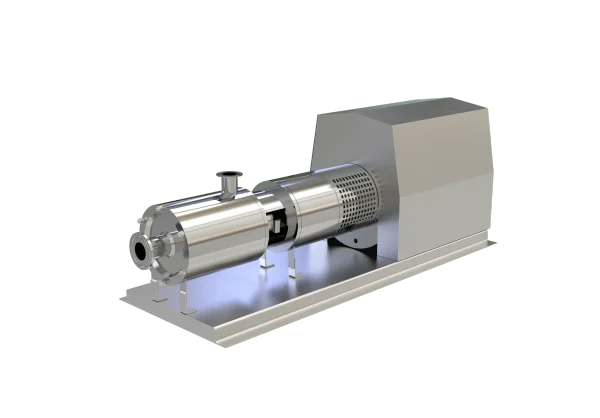
Fluid Dynamics and Emulsification Mechanics
The performance of an inline high shear emulsifying pump solution relies on converting mechanical energy into intense hydraulic shear within a confined mixing chamber. The core mechanism consists of a dynamically balanced rotor spinning at high velocities inside a matched stationary stator. As food ingredients enter the center of the mixing head, the rotation of the rotor blades generates strong centrifugal forces, drawing the liquid stream outward at linear speeds exceeding twenty meters per second.
The primary breakdown of coarse materials happens when the fluid enters the narrow clearance between the rotor and stator, which measures under one millimeter. Within this zone, the food matrix experiences intense hydraulic shear, rapid pressure changes, and localized cavitation. Large oil droplets or solid particulates are instantly disrupted and broken down into sub-micron dimensions.
When processing food emulsions like salad dressings, mayonnaise, or flavor oils, the high frequency of the shear cycles breaks the coarse dispersed phases down into small, uniform droplets. This significant drop in particle size helps counter the effects of natural gravitational separation, oil creaming, and phase inversion, delivering long-term physical stability without requiring high levels of chemical stabilizer additives. Furthermore, because the internal volume of the active pump chamber is tightly restricted, one hundred percent of the ingredient stream is forced through the active shear slots, ensuring total uniformity and eliminating unmixed bypass channels.
Material Engineering and Hygienic Design Standards
Equipment solutions used in industrial food manufacturing must adhere to strict sanitary engineering design principles to prevent product contamination and stop the growth of biological biofilms. All wetted metallic components within the complete emulsifying skid must be selected from low-carbon austenitic stainless steel alloys, with grade 316L stainless steel representing the standard for acid-resistant and saline-rich food applications.
The internal surfaces of the pump casing, manifold piping, and the intricate channels of the rotor-stator assembly undergo precision finishing to eliminate microscopic surface imperfections. The wetted areas are typically electropolished to achieve a surface roughness rating of less than 0.8 micrometers, or ideally less than 0.4 micrometers for dairy and infant formula lines. This ultra-smooth surface profile prevents raw ingredients from adhering to the metal walls, making it difficult for bacterial colonies to establish a foothold.
Equally critical is the selection of non-metallic static seals and dynamic shaft configurations. Elastomers must comply with international regulatory frameworks, such as the United States Food and Drug Administration Title 21 CFR standards and European Regulation EC 1935/2004. Common food-safe seal materials include:
• Ethylene Propylene Diene Monomer (EPDM): Excellent for hot water, diluted organic acids, and high-temperature steam sterilization cycles.
• Fluororubber (FKM): Specified for processing high-fat content items, animal oils, vegetable oils, and lipid-rich flavor bases.
• Silicone Rubber: Frequently chosen for high-purity applications due to its excellent physiological inertness and thermal stability.
Dynamic shaft sealing within the system solution utilizes dual-face mechanical seals equipped with an integrated thermo-siphon barrier system. This auxiliary network maintains a constant circulation of sterile water or food-grade lubricant flush loops across the seal faces. This cooling action prevents friction-induced heat from scorching delicate sugar or protein molecules at the sealing boundary, while ensuring absolute isolation between the process fluid and the outside environment.
Automated CIP/SIP Cleanability and Scalable Process Control
Modern food processing facilities operate on continuous schedules that require highly integrated, automated cleaning protocols. High shear emulsifying pump skids are engineered to function as an active component within Clean-in-Place (CIP) and Steam-in-Place (SIP) networks. Complete CIP drainability is a critical engineering requirement, meaning the entire system solution is designed without blind pockets, sharp interior corners, or flat horizontal ledges where product residue or caustic wash chemicals could accumulate.
During a standard CIP cycle, the internal geometry of the rotor and stator allows the turbulent chemical wash fluids to thoroughly flush all wetted areas. When installed with a proper downward horizontal pitch, gravity acts on the fluid volume, allowing complete self-draining through the low-point drain valves. This capability protects product purity and slashes the downtime needed for manual equipment teardown and sanitization.
To match the existing infrastructure of various processing plants, the instrumentation and control framework of the skid is designed with scalable flexibility. In high-level automated installations, the skid features an on-board electrical control panel housing a Programmable Logic Controller (PLC) and a high-resolution Human-Machine Interface (HMI). This digital core automates the entire processing sequence, managing drive motor frequencies through Variable Frequency Drives (VFDs) to alter shear rates based on real-time viscosity feedback.
Alternatively, for plants with established centralized control rooms, the skid can be configured with a centralized junction box terminal. This arrangement routes all instrument signals, sensor data, and valve actuators directly to the primary factory Distributed Control System (DCS), allowing plant operators to manage the emulsification solution remotely. Regardless of the control architecture, the system enforces safety interlocks, such as seal barrier fluid pressure monitoring, pump dry-run protection, and excessive line pressure mitigation, ensuring consistent batch traceability and stable operational security across all production shifts.


