


In sterile injectable manufacturing, liquid-liquid mixing is an important step in preparing formulations with consistent composition and predictable product performance. Depending on the formulation, the process may involve combining an active pharmaceutical ingredient solution with a buffer, mixing aqueous excipients, adjusting the concentration of a liquid preparation, or incorporating compatible liquid components into a final formulation.
The challenge is not simply to make two liquids move together. Differences in viscosity, density, miscibility, and addition rate can affect how quickly the components distribute throughout the vessel. Inadequate circulation may leave local concentration differences, while excessive agitation may introduce unwanted foaming or affect sensitive formulation components.
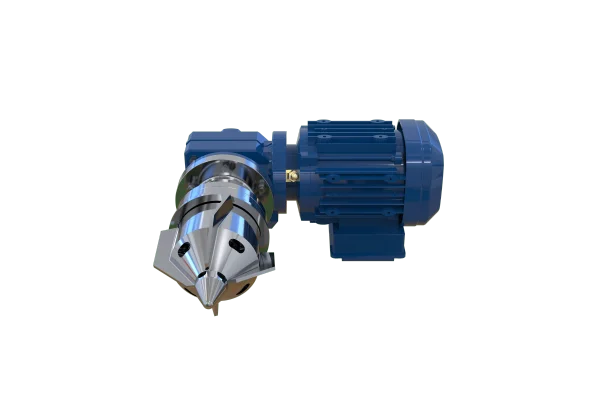
A suitable mixing system should therefore provide effective bulk circulation, controlled agitation, and compatibility with the hygiene requirements of pharmaceutical production. A maglev bottom-entry magnetic mixer can support these objectives through its bottom-mounted mixing arrangement, magnetic drive, and reduced axial end-face friction within the agitator assembly.
How Maglev Bottom Mixers Support Liquid-Liquid Homogenization
Maglev bottom mixers combine magnetic torque transmission with a levitation mechanism designed to reduce axial contact friction during operation. These features can be relevant to pharmaceutical preparation processes where equipment cleanliness, component wear, and reliable mixing are important considerations.
Supporting Uniform Liquid Distribution
When two compatible liquids are introduced into a preparation vessel, the mixer must circulate the contents sufficiently to distribute the added component throughout the batch. Effective circulation helps reduce localized concentration differences and supports a more consistent formulation.
A bottom-entry mixer introduces agitation from the lower part of the vessel. Depending on the impeller design, rotational speed, and vessel geometry, this arrangement can help establish circulation through the working volume. The actual mixing result depends on factors such as liquid viscosity, density differences, batch volume, and the location and rate of ingredient addition.
For sterile injectable preparations, engineers should assess mixing performance using formulation-relevant criteria, such as concentration uniformity and the time required to reach the specified mixing endpoint. The presence of a maglev mechanism alone does not guarantee faster homogenization; the complete impeller and vessel configuration must be suited to the formulation.
Reducing Axial Friction Within the Agitator
In a maglev bottom-entry magnetic mixer, the internal magnetic assembly is suspended during operation by the levitation mechanism. The axial end face does not contact and rub against the corresponding surface during normal operation, while radial positioning is maintained by the designed support arrangement.
Reducing this axial end-face friction can help limit wear at relevant components, including the sleeve end face, and reduce the risk of particles generated by component deterioration. This is particularly relevant when manufacturing high-value injectable products, where equipment condition and contamination control are closely managed.
However, reduced internal friction should not be confused with reduced shear in the formulation. Shear exposure is influenced by impeller geometry, rotational speed, local flow patterns, and fluid properties. If a formulation contains shear-sensitive proteins, suspended particles, or other sensitive ingredients, these factors still require process evaluation.
Maintaining Hygienic Conditions During Injectable Preparation
The hygienic design of mixing equipment is central to sterile injectable production. A magnetic drive can transmit torque through a stationary isolation barrier, avoiding the conventional rotating shaft penetration and its associated dynamic shaft-seal interface when the system is appropriately designed.
This arrangement can reduce one potential leakage pathway and support the design of a closed preparation vessel. The internal magnetic assembly is separated from the external drive components by the isolation barrier, helping maintain the intended process boundary.
Nevertheless, a magnetic drive does not independently guarantee sterility. The isolation sleeve, static seals, welds, vessel connections, and other product-contact interfaces must all be suitable for the intended application. Materials must be compatible with the formulation, cleaning agents, and sterilization conditions.
Where cleaning-in-place (CIP) or sterilization-in-place (SIP) is required, the vessel and mixer arrangement should be evaluated for cleanability, drainability, and compatibility with the validated cleaning and sterilization procedures. The finished system must also meet the applicable pharmaceutical manufacturing and contamination-control requirements.
Application in Different Injectable Formulation Processes
The suitability of a maglev bottom mixer depends on the specific formulation and the type of liquid-liquid mixing required.
Aqueous Solutions and Buffer Preparation
Many injectable products require buffers, pH-adjusting solutions, and aqueous excipients to be combined at controlled concentrations. In these processes, consistent circulation helps distribute each addition and reduce local concentration differences.
A bottom-entry magnetic mixer can support bulk liquid movement during ingredient addition and subsequent mixing. The operating speed and mixing duration should be established through process development, with sampling or other suitable measurements used to verify that the required uniformity has been achieved.
Combining Miscible Liquid Ingredients
Some formulations contain multiple liquid components that are mutually miscible but differ in viscosity or density. These differences can influence circulation and mixing time, particularly when a small quantity of one component is added to a larger batch.
The mixer should generate sufficient circulation to distribute the added liquid without creating unnecessary turbulence or excessive air entrainment. Addition position, feed rate, impeller configuration, and rotational speed should be considered together rather than relying on mixer speed alone.
Formulations Requiring Dispersion of an Immiscible Phase
Certain pharmaceutical formulations may involve an immiscible liquid phase, such as an oil phase dispersed in an aqueous phase. These applications require additional care because uniform liquid-liquid distribution may involve droplet formation and stabilization rather than simple blending.
A conventional bottom-entry mixer may provide bulk circulation, but it does not automatically produce a stable emulsion or a specific droplet-size distribution. Where fine emulsification is required, the process may need a dedicated high-shear mixer, homogenizer, or another validated technology. The appropriate equipment depends on the formulation, target droplet characteristics, and product quality requirements.
This distinction is important when selecting a maglev bottom mixer: it can support suitable liquid-liquid mixing duties, but the term homogenization should be defined according to the actual product and process endpoint.
Integrating Mixing Performance with Product Quality
For sterile injectable manufacturing, mixing performance should be assessed against measurable product-quality requirements rather than visual appearance alone. Depending on the formulation, relevant criteria may include concentration uniformity, pH consistency, appearance, and the distribution of any dispersed phase.
Process development should establish the appropriate mixing speed, duration, addition sequence, and sampling strategy. For sensitive formulations, the evaluation may also need to consider foaming, temperature changes, air entrainment, and the potential impact of agitation on the active ingredient.
Selecting a Suitable Maglev Bottom Mixer for Sterile Injections
Before choosing a maglev bottom-entry magnetic mixer, pharmaceutical process engineers should define the liquids being combined, their miscibility and viscosity, the working volume, and the required mixing endpoint. The assessment should also cover the sensitivity of the formulation to shear, air entrainment, and temperature changes.
Mechanical and hygienic requirements are equally important. Confirm the compatibility of product-contact materials, isolation components, and static seals with the formulation and cleaning or sterilization conditions. Verify that the mixer can achieve the required circulation and uniformity within the available process time.
For suitable liquid-liquid preparation duties, a maglev bottom mixer can combine controlled agitation with reduced axial end-face friction and a magnetic drive arrangement that supports closed-vessel design. Its value in sterile injectable manufacturing comes from matching these design features to a clearly defined formulation, mixing objective, and validated production process.


